MORAL EQUALITY: HIRING STRATEGY
Modern Stoicism reduces radical human dignity to a hiring strategy.
29 Oct 2026
29th October: Character Is Fate | The Conversion of Radical Humanism into a Corporate Hiring Strategy
The Text in Question
The Daily Stoic Rendering
“Each person acquires their own character, but their official roles are designated by chance. You should invite some to your table because they are deserving, others because they may come to deserve it.”
- Seneca, Moral Letters, 47.15b
Standard Academic Translation
“Each man acquires his character for himself, but his status is assigned by chance. You should admit some to your table because they are worthy, and others that they may become worthy.”
- Seneca, Moral Letters, 47.15b (Gummere adapted)
Academic Context & Breakdown
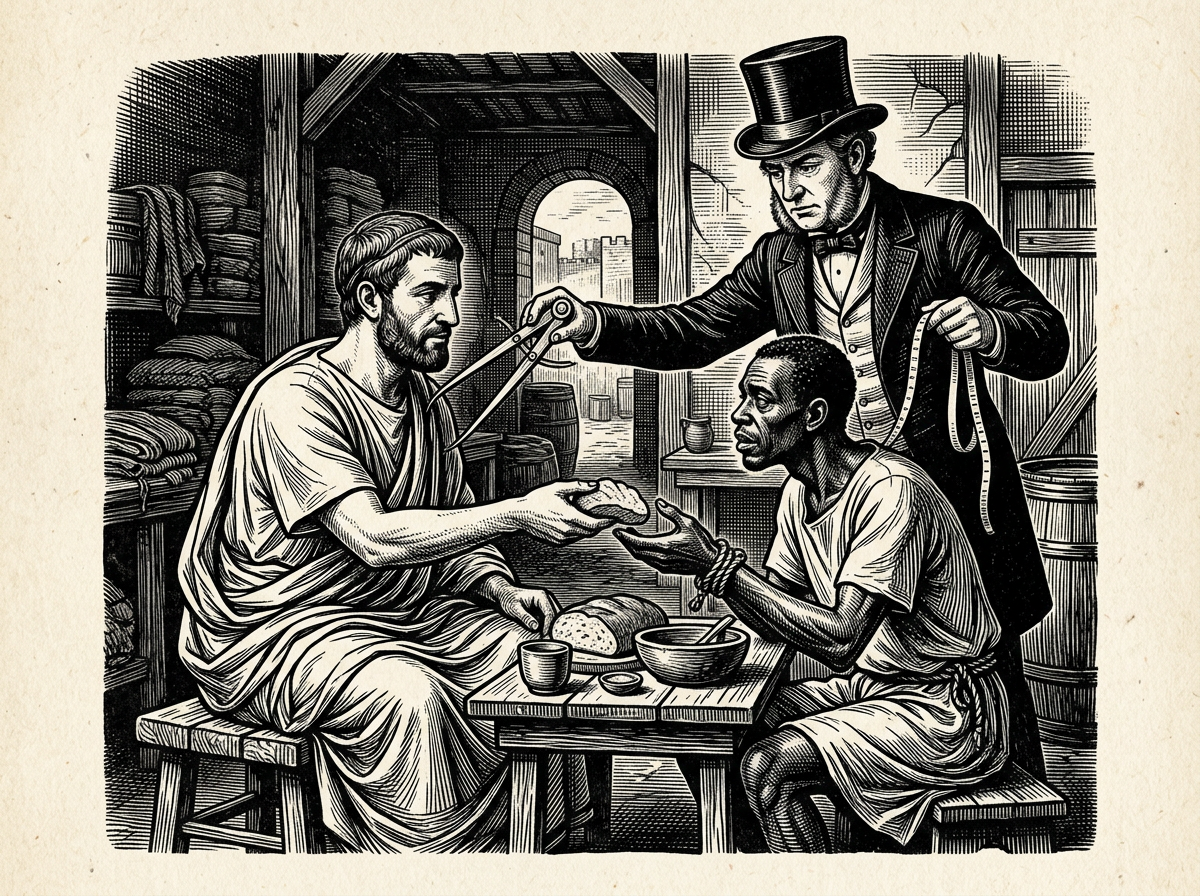
Seneca wrote this revolutionary letter to his friend Lucilius while living under a Roman imperial economy entirely sustained by the brutal, total subjugation of millions of enslaved human beings. He was addressing an aristocratic class that routinely beat, starved, and humiliated their household slaves as subhuman chattel.
This passage is a radical, explosive indictment of Roman social hierarchy. Seneca was telling a Roman slaveholder to break unthinkable social taboos by dining at the same table with his own slaves, insisting that birth, luck, and legal enslavement are mere external accidents (fortuna), whereas moral character is the only real mark of human worth.
The Opening Counter-Punch
The commentary hijacks Seneca’s dangerous, anti-hierarchical defense of human dignity and degrades it into a talent-acquisition manual for corporate hiring managers. It takes a radical demand to recognize the shared humanity of slaves and twists it into a tactical checklist for evaluating job applicants and building a professional network. By swapping revolutionary moral equality for bourgeois resume auditing, the text sanitizes Seneca’s fierce social critique to pamper modern careerists.
The Breakdown
- The commentary pivots from Seneca's defense of enslaved human beings to corporate HR practices, observing that "in the hiring process, most employers look at where someone went to school." Seneca was commanding slave owners to dine with the most oppressed class in the Roman world, but the commentary changes this radical breakdown of caste barriers into a mundane discussion about screening candidate credentials.
- The text turns moral virtue into an instrument for career mobility, claiming that "when you seek to advance your own position in life, character is the best lever." Seneca insisted that recognizing moral worth in others is an uncalculated duty owed to human nature, whereas the commentary alters this unselfish moral obligation into a self-serving strategy for personal networking and social advancement.
- The commentary flattens Seneca's call to elevate those of low status into a risk-management exercise for your personal circle, advising you on "the people you invite into your life." Seneca challenged his reader to actively elevate and honor the marginalized, but the commentary shifts the focus to carefully curating your personal network for long-term personal gain.
What Is the Lesson?
The authentic lesson of Moral Letters 47.15 is that social status, wealth, and power are arbitrary accidents of fortune that reveal nothing about a person's true human worth. You practice this by actively rejecting superficial social hierarchies and treating every human being, regardless of their rank, job, or status, with equal moral respect. Refuse to measure people by their titles, and judge both yourself and others solely by the integrity of the rational soul.
How The Philosopher Would Respond
Seneca would flatly reject the idea that his defense of human equality should be degraded into a career lever or a hiring strategy, viewing any attempt to measure moral worth by social advancement as the ultimate failure of philosophical understanding.
"Remember that he whom you call your slave sprang from the same stock, is smiled upon by the same skies, and on equal terms with yourself breathes, lives, and dies. It is just as possible for you to see him a freeman as for him to see you a slave."
- Seneca, Moral Letters, 47.10
Related dispatches
MORAL DRIFT: THERAPEUTIC STOICISM · A Critique of Modern Stoicism
Reducing Stoic cosmic unity to soft therapeutic interdependence dilutes civic duty.
28 Oct 2026
MORAL DILUTION: CORPORATE STOICISM · A Critique of Modern Stoicism
Modern self-help flattens Seneca's horror into corporate risk management.
27 Oct 2026
INTELLECTUAL EROSION: MODERN STOICISM · A Critique of Modern Stoicism
Modern Stoicism dilutes Seneca’s vast blueprint into instant comfort.
26 Oct 2026
ETHICAL DRIFT: BOURGEOIS OPTIMIZATION · A Critique of Modern Stoicism
Modern self-help turns Epictetus's radical freedom into careerist optimization.
25 Oct 2026