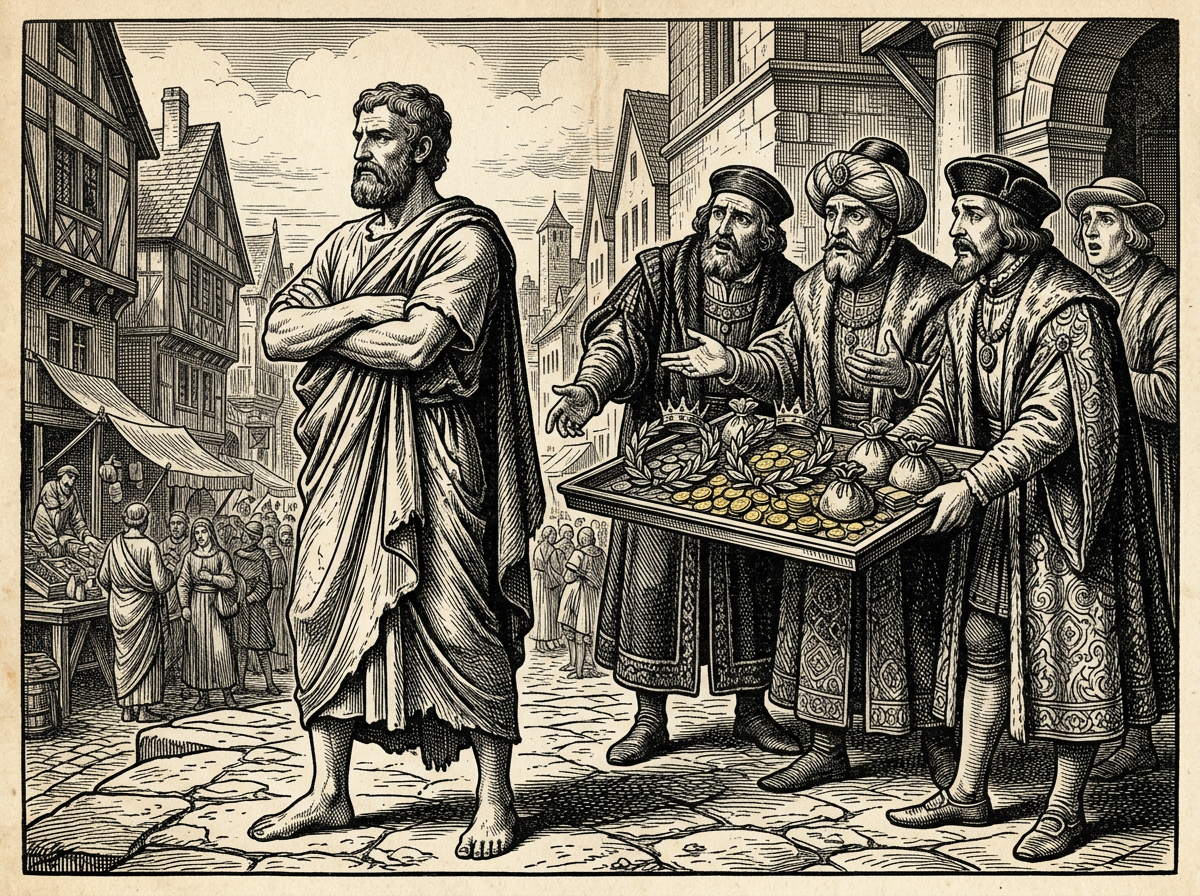
ETHICAL DRIFT: BOURGEOIS OPTIMIZATION
Modern self-help turns Epictetus's radical freedom into careerist optimization.
25 Oct 2026
25th October: Two Tasks | The Commodification of Radical Moral Agency into Modern Careerist Self-Actualization
The Text in Question
The Daily Stoic Rendering
“What, then, makes a person free from hindrance and self determining? For wealth doesn’t, neither does high-office, state or kingdom rather, something else must be found . . . in the case of living, it is the knowledge of how to live.”
- Epictetus, Discourses, 4.1.62-64
Standard Academic Translation
“What is it, then, that makes a man unhindered and his own master? For wealth does not do it, nor a consulship, nor a province, nor a kingdom; but something else must be found... In the art of living, then, it is the knowledge of how to live.”
- Epictetus, Discourses, 4.1.62-64 (Oldfather adapted)
Academic Context & Breakdown
Epictetus delivered this lecture in his drafty school in Nicopolis, addressing young, ambitious Romans obsessed with status and political office. He was a former slave who had lived under the absolute power of masters, speaking in a long treatise titled On Freedom (De Libertate).
This passage is a radical, uncompromising definition of human liberty: freedom is not an external condition, a privilege of status, or a career option, but an internal state achieved solely through mastering the rational faculty (prohairesis). Epictetus was insisting that a slave who has mastered the art of living is freer than the Roman Emperor who remains enslaved to his own passions and fears.
The Opening Counter-Punch
The commentary hijacks Epictetus's radical definition of inner spiritual freedom and degrades it into a cozy career-coaching manifesto. It takes a former slave's uncompromising demand for complete detachment from external outcomes and twists it into a guide for personal self-actualization and job satisfaction. By swapping total moral autonomy for bourgeois lifestyle optimization, the text sanitizes a fierce philosophical truth to feed the modern reader's ego.
The Breakdown
- The commentary fabricates a modern dualism out of nowhere, declaring that you have two essential tasks: "to be a good person and to pursue the occupation that you love." Epictetus explicitly taught that external occupations, wealth, and status carry zero intrinsic moral weight, making this attempt to elevate personal career fulfillment to a core life mandate an unauthentic corruption of Stoic doctrine.
- The text flattens Epictetus’s rigorous discipline of mental mastery into a superficial, feel-good productivity hack, advising the reader to "say no to distractions, to destructive emotions, to outside pressure." Epictetus was demanding the total destruction of irrational desires to achieve moral freedom, whereas the commentary reduces this radical inner warfare to simple time-management techniques for modern professionals.
- The commentary appeals directly to modern self-centered individualism, urging the reader to ask "what is it that only I can do?" Epictetus never framed the "art of living" as a quest for personal uniqueness or self-expression, but as the universal obligation to align one's rational mind with cosmic Nature, regardless of one's specific social role.
What Is the Lesson?
The authentic lesson of Discourses 4.1 is that true freedom comes entirely from knowing how to govern your own mind, irrespective of your external station in life. You practice this by identifying every external desire, whether for wealth, promotion, or comfort, and stripping away its power to dictate your choices. Measure your freedom not by what you achieve or where you work, but by whether your rational agency remains unhindered by fear and appetite.
How The Philosopher Would Respond
Epictetus would flatly reject the idea that philosophy exists to help someone pursue an "occupation they love," viewing any dependence on external circumstances as the defining mark of a spiritual slave.
"If you choose to regard external things as your own, you will be hindered, you will be constrained, you will be enslaved to those who have power over those things... Learn what freedom is, and do not be a slave to your own desires."
- Epictetus, Discourses, 4.1.56, 4.1.175
Related dispatches
MORAL DILUTION: CORPORATE STOICISM · A Critique of Modern Stoicism
Modern self-help flattens Seneca's horror into corporate risk management.
27 Oct 2026
INTELLECTUAL EROSION: MODERN STOICISM · A Critique of Modern Stoicism
Modern Stoicism dilutes Seneca’s vast blueprint into instant comfort.
26 Oct 2026
KEY FLAW: DILUTED DISCIPLINE · A Critique of Modern Stoicism
True moral strength demands laborious excavation, not positive thinking.
24 Oct 2026
MORAL DILUTION : CONSUMER VIRTUE · A Critique of Modern Stoicism
Modern self-help turns moral duty into consumer choice
23 Oct 2026