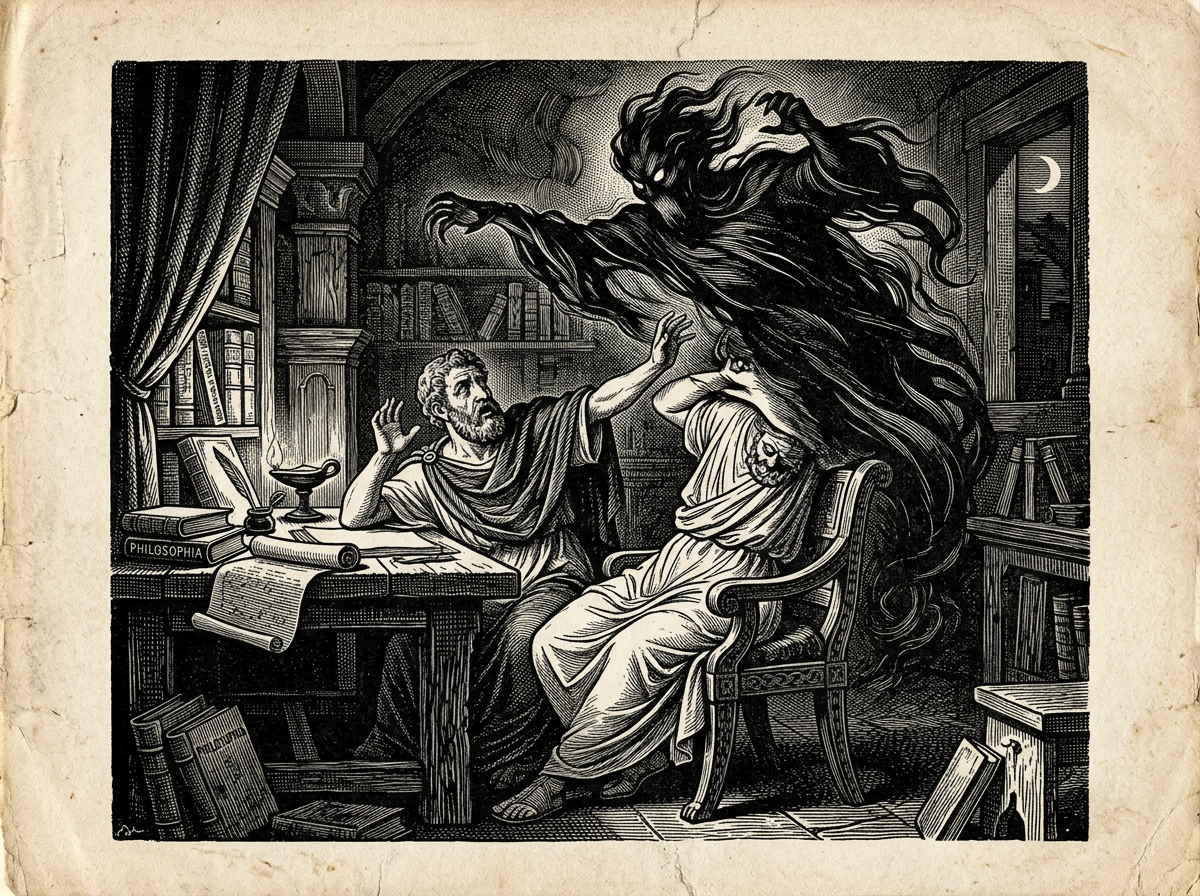
MORAL DILUTION: CORPORATE STOICISM
Modern self-help flattens Seneca's horror into corporate risk management.
27 Oct 2026
27th October: We Reap What We Sow | The Reduction of Tragic Blood Guilt into a Business Ethics Cautionary Tale
The Text in Question
The Daily Stoic Rendering
“Crimes often return to their teacher.”
- Seneca, Thyestes, 311
Standard Academic Translation
“Crimes often recoil upon the teacher of them.”
- Seneca, Thyestes, 311 (Fitch adapted)
Academic Context & Breakdown
Seneca wrote his dark, blood-drenched tragedy Thyestes while trapped in the toxic inner circle of Nero’s court, well aware that his pupil was transforming into a murderous tyrant. In this line, the character Atreus is plotting an act of unthinkable violence, killing his brother’s children and serving them to their father at a banquet, while reflecting on the cyclical, self-consuming nature of ancestral sin.
This is not a casual proverb about business ethics or office karma. It is Seneca’s horrific, prophetic realization that complicity in tyranny unleashes a monstrous moral contagion that inevitably consumes its own creators.
The Opening Counter-Punch
The commentary hijacks a grim, tragic warning about the inescapable curse of moral corruption and degrades it into a low-stakes cautionary tale for modern corporate compliance. It takes Seneca’s agonizing recognition of blood guilt and twists it into a practical checklist for choosing reliable business partners. By swapping tragic existential ruin for shallow corporate self-preservation, the text sanitizes Seneca’s darkest line to sell a comfortable lesson in risk management.
The Breakdown
- The commentary takes Seneca's terrifying reflection on moral curse and flattens it into a workplace precaution, asking if you "show a client how to do something unethical or illegal, might they return the favor to an unsuspecting you later on?" Seneca was writing about the inevitable recoil of systemic violence, but the commentary changes his cosmic warning into a petty fear of getting screwed over in a contract.
- The text trivializes Seneca’s tragic life and ultimate forced suicide into a simple superstition, claiming that "karma is a notion we have imported from the East, along similar lines." The academic text depicts a inexorable cycle of crime devouring the criminal, whereas the commentary alters this grim tragic law into a cheap, pop-psychology bumper sticker about bad vibes coming back to get you.
- The commentary reduces the horrific murder of a philosopher by his royal pupil to a basic management mistake, suggesting it is "something to think about when you consider whom to work with." Seneca was examining the total collapse of rational agency under tyrannical power, but the commentary shifts the focus to routine networking strategies and HR warnings about bad employees.
What Is the Lesson?
The authentic lesson of Thyestes 311 is that engaging in or enabling vicious acts unleashes a destructive cycle that ultimately destroys your own moral agency and peace. You practice this by refusing to compromise your ethical standards for short-term gain, influence, or political protection. Never plant the seeds of corruption, because the destructive habits you teach to others will inevitably return to destroy you.
How The Philosopher Would Respond
Seneca would flatly reject the idea that his tragedy is merely a tactical warning against picking bad business partners, viewing any attempt to frame moral ruin as a mere loss of profit as a complete failure to grasp the horror of vice.
"He who plans a crime performs it. No time is wasted in doing evil when the mind has once resolved upon it; the penalty of evil falls upon the author of it even as he designs it."
- Seneca, Letters on Morals, 81.22 / Thyestes, 1100-1102
Related dispatches
INTELLECTUAL EROSION: MODERN STOICISM · A Critique of Modern Stoicism
Modern Stoicism dilutes Seneca’s vast blueprint into instant comfort.
26 Oct 2026
ETHICAL DRIFT: BOURGEOIS OPTIMIZATION · A Critique of Modern Stoicism
Modern self-help turns Epictetus's radical freedom into careerist optimization.
25 Oct 2026
KEY FLAW: DILUTED DISCIPLINE · A Critique of Modern Stoicism
True moral strength demands laborious excavation, not positive thinking.
24 Oct 2026
MORAL DILUTION : CONSUMER VIRTUE · A Critique of Modern Stoicism
Modern self-help turns moral duty into consumer choice
23 Oct 2026