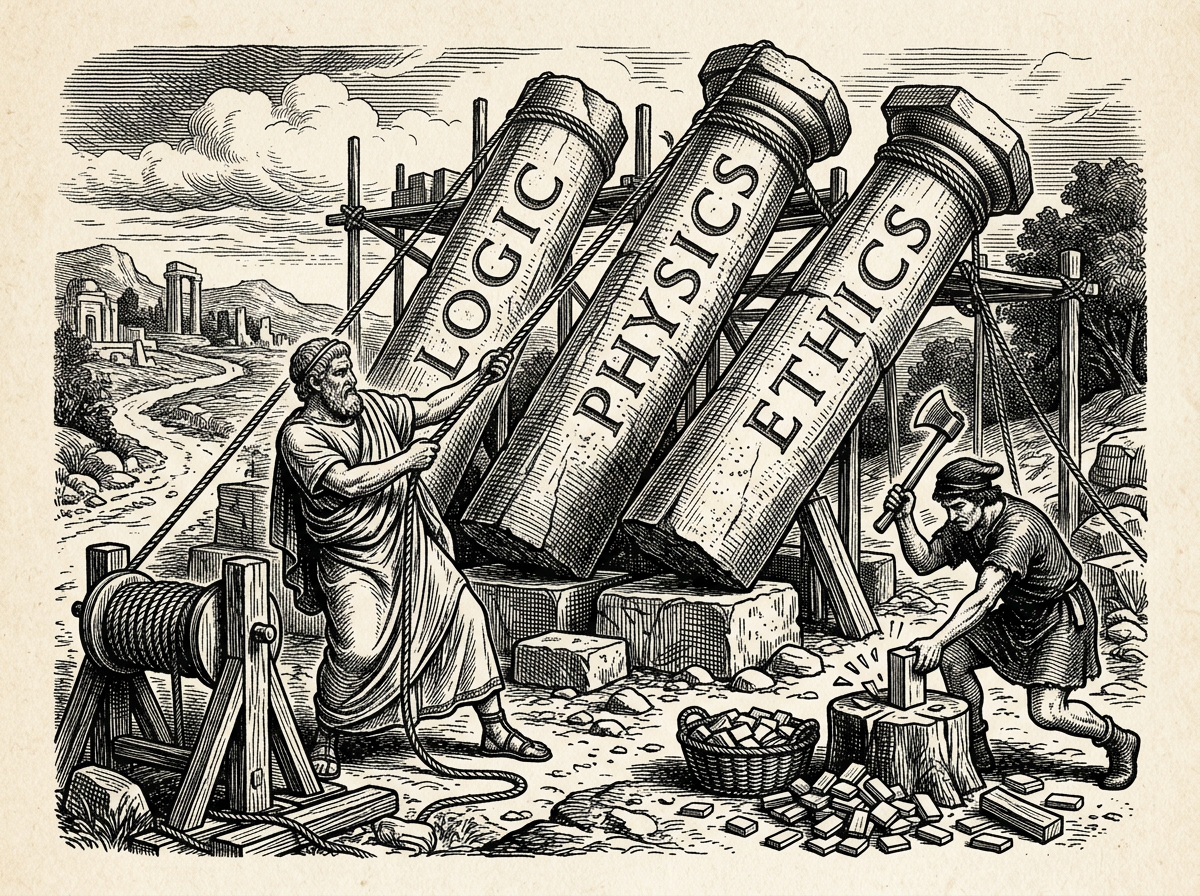
INTELLECTUAL EROSION: MODERN STOICISM
Modern Stoicism dilutes Seneca’s vast blueprint into instant comfort.
26 Oct 2026
26th October: Three Parts, One Aim | The Flattening of Classical Philosophy into Instant Life-Hacks
The Text in Question
The Daily Stoic Rendering
“The best and the greatest number of authors have asserted that philosophy consists of three parts: the moral, the natural, and the rational. The first puts the soul in order. The second thoroughly examines the natural order of things. The third inquires into the proper meaning of words, and their arrangements and proofs which keep falsehoods from creeping in to displace truth.”
- Seneca, Moral Letters, 89.9
Standard Academic Translation
“The greatest and most numerous authorities have held that philosophy has three parts: moral, natural, and rational. The first gives order to the soul; the second investigates the nature of things; the third examines the precise meaning of words, their combinations, and arguments, so that falsehood may not creep in and take the place of truth.”
- Seneca, Moral Letters, 89.9 (Gummere adapted)
Academic Context & Breakdown
Seneca wrote this letter in his quiet, late retirement while watching Nero’s totalitarian state execute his peers and systematically rewrite reality. He was writing to Lucilius to map out the vast, demanding blueprint of the Stoic system—a lifelong curriculum requiring deep ethical discipline, rigorous scientific inquiry into cosmology, and razor-sharp logic.
Seneca was not offering a quick recipe for daily happiness. He was warning his student that leaving out any single pillar of philosophy leaves a human mind vulnerable to tyrannical propaganda and self-deception.
The Opening Counter-Punch
The commentary hijacks Seneca’s comprehensive system of intellectual warfare and flattens it into a instant, feel-good life-hack. It takes decades of rigorous, grueling study across logic, physics, and ethics and collapses them into a shallow slogan about feeling good right now. By swapping an arduous lifelong pursuit of cosmic truth for immediate emotional comfort, the text sanitizes Seneca's vast vision to pamper a lazy reader.
The Breakdown
- The commentary erases the distinct, grueling demands of logic and natural science, reducing all three classical branches to a single generic goal "to help you live a good life ruled by reason." Seneca explicitly argued that logic exists as a shield against false arguments and that physics reveals our true place in the universe, making this total erasure of philosophical rigor an unauthentic dilution of Stoic education.
- The commentary strips away the necessity of long-term discipline and deep study by promising that this benefit is available "not in the future, but right now." Seneca emphasized that training the rational mind requires continuous, painstaking labor over a lifetime, whereas the commentary alters this serious commitment into an instant-gratification productivity promise.
- The commentary completely ignores Seneca's stern warning about how "falsehoods from creeping in to displace truth" manipulate uneducated minds, replacing his call for logical vigilance with a vague recommendation to live well. By ignoring the protective function of logic, the commentary changes a weapon of intellectual self-defense into a soft, passive self-improvement suggestion.
What Is the Lesson?
The authentic lesson of Seneca’s 89th letter is that a sound character requires a complete, balanced intellectual defense built on moral self-control, an understanding of nature, and logical rigor. You practice this by training your mind to spot fallacies, investigating how the world actually works, and aligning your daily habits with reason. Do not settle for quick moral slogans; commit to the hard, lifelong work of mastering all three parts of philosophy.
How The Philosopher Would Respond
Seneca would flatly reject the idea that philosophy can be condensed into an instant, bite-sized recipe for daily comfort, viewing any attempt to shortcut the three branches as a dangerous invitation to delusion.
"Philosophy is divided into three parts: moral, natural, and rational... Do not attempt to reduce what is vast to a mere handful. Philosophy is an entire body; you cannot grasp its power if you cut it into pieces."
- Seneca, Moral Letters, 89.1, 89.4
Related dispatches
MORAL DILUTION: CORPORATE STOICISM · A Critique of Modern Stoicism
Modern self-help flattens Seneca's horror into corporate risk management.
27 Oct 2026
ETHICAL DRIFT: BOURGEOIS OPTIMIZATION · A Critique of Modern Stoicism
Modern self-help turns Epictetus's radical freedom into careerist optimization.
25 Oct 2026
KEY FLAW: DILUTED DISCIPLINE · A Critique of Modern Stoicism
True moral strength demands laborious excavation, not positive thinking.
24 Oct 2026
MORAL DILUTION : CONSUMER VIRTUE · A Critique of Modern Stoicism
Modern self-help turns moral duty into consumer choice
23 Oct 2026