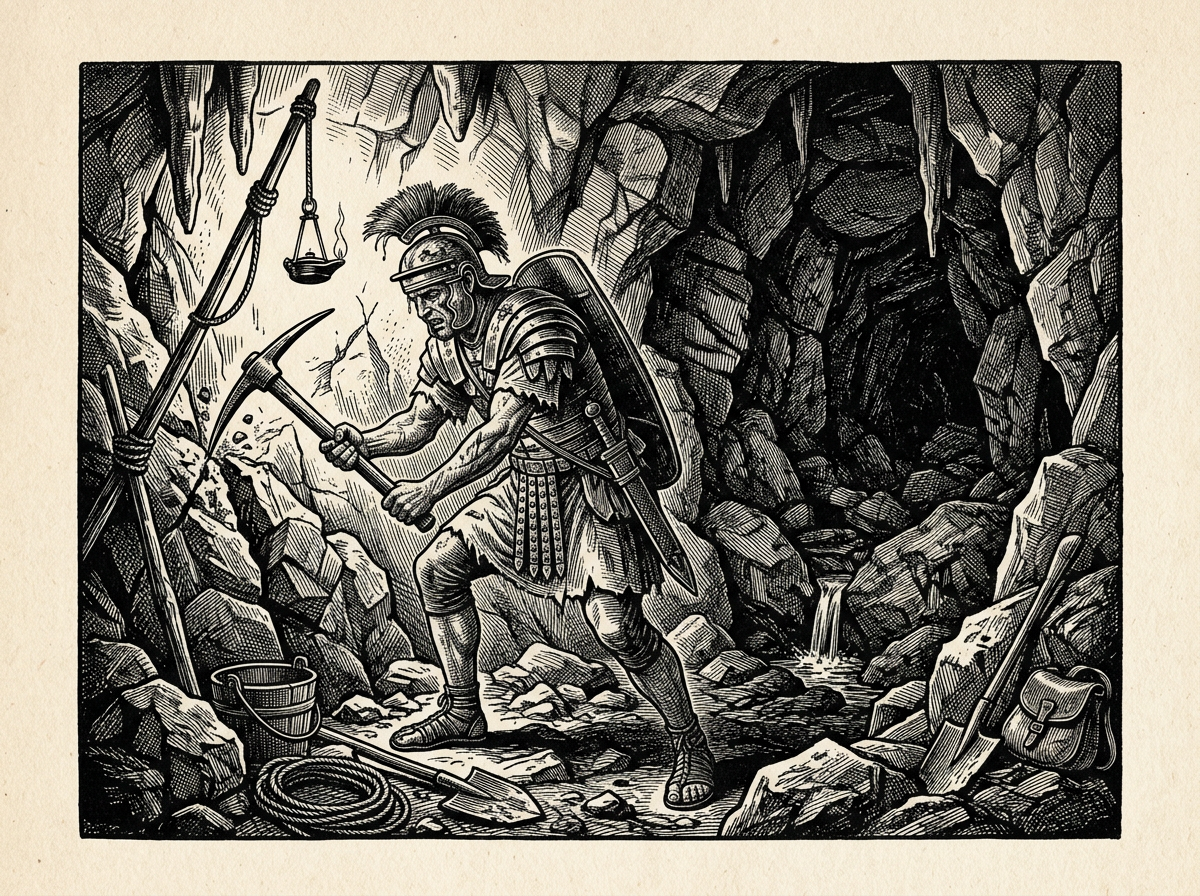
KEY FLAW: DILUTED DISCIPLINE
True moral strength demands laborious excavation, not positive thinking.
24 Oct 2026
24th October: The Fountain Of Goodness | The Trivialization of Moral Struggle into Passive Self-Discovery
The Text in Question
The Daily Stoic Rendering
“Dig deep within yourself, for there is a fountain of goodness ever ready to flow if you will keep digging.”
- Marcus Aurelius, Meditations, 7.59
Standard Academic Translation
“Look within. Within is the fountain of good, and it is always ready to bubble up, if you only keep digging.”
- Marcus Aurelius, Meditations, 7.59 (Farquharson adapted)
Academic Context & Breakdown
Marcus Aurelius wrote this brief, urgent note to himself while stationed in a drafty military tent on the Danubian frontier. Surrounding him were treacherous political plots, a devastating empire-wide plague, and the relentless brutality of the Marcomannic Wars. He was an aging, physically ailing Emperor holding the Roman world together by sheer force of rational will.
This passage is a grim call to relentless internal labor, not a gentle visualization exercise. Marcus uses the metaphor of excavating a well to remind himself that moral virtue requires backbreaking, continuous effort to clear away the mud of selfish desires, fear, and fatigue. Goodness is not a hidden treasure waiting to be stumbled upon, but a spring that must be laboriously carved out of harsh rock.
The Opening Counter-Punch
The commentary hijacks Marcus’s demand for unyielding spiritual labor and degrades it into a cozy, low-stakes morning affirmation. It takes an Emperor's battle-tested command for rigorous moral discipline and twists it into a feel-good guide for seeking personal happiness. By swapping hard internal excavation for soft, self-soothing optimism, the text sanitizes Marcus’s uncompromising call to duty to pamper the modern reader's ego.
The Breakdown
- The commentary flattens Marcus's severe demand for labor into a shallow contrast with external circumstances, observing that "today, we could hope that goodness comes our way, good news, good weather, good luck." Marcus was addressing the internal struggle to maintain virtue in a world of horror, but the commentary shifts the original meaning away from moral agency toward a trivial desire for pleasant weather and good fortune.
- The text trivializes the immense difficulty of Stoic self-mastery, reassuring the reader that "goodness isn’t something that’s going to be delivered by mail." Marcus used the image of digging a deep, rocky well to convey the constant effort required to keep the rational mind clear, whereas the commentary flattens this fierce spiritual warfare into a light, modern metaphor about home delivery.
- The commentary reduces the rigorous cultivation of virtue to a soft exercise in positive thinking, claiming that "you find it within your own thoughts, and you make it with your own actions." The academic translation demands continuous, active labor ("if you only keep digging") to maintain a pure soul, but the commentary alters this unyielding discipline into a vague, self-help suggestion to produce good vibes.
What Is the Lesson?
The authentic lesson of Meditations 7.59 is that moral virtue is an internal reservoir that requires continuous, unflagging effort to keep clear of corrupting influences. You practice this by identifying the precise mental habits, excuses, and laziness that choke your rational mind, and ruthlessly working to clear them away every single day. Do not wait for favorable conditions to act virtuously; dig relentlessly into your own character regardless of external circumstances.
How The Philosopher Would Respond
Marcus Aurelius would flatly reject the idea that cultivating goodness is a light, easy task to improve one's daily mood, viewing any relaxation of spiritual discipline as a failure to serve the rational soul.
"To the rational animal the same act is according to nature and according to reason. Labor not unwillingly, nor without regard to the common interest, nor without due consideration, nor with distraction."
- Marcus Aurelius, Meditations, 7.11, 3.5
Related dispatches
MORAL DILUTION: CORPORATE STOICISM · A Critique of Modern Stoicism
Modern self-help flattens Seneca's horror into corporate risk management.
27 Oct 2026
INTELLECTUAL EROSION: MODERN STOICISM · A Critique of Modern Stoicism
Modern Stoicism dilutes Seneca’s vast blueprint into instant comfort.
26 Oct 2026
ETHICAL DRIFT: BOURGEOIS OPTIMIZATION · A Critique of Modern Stoicism
Modern self-help turns Epictetus's radical freedom into careerist optimization.
25 Oct 2026
MORAL DILUTION : CONSUMER VIRTUE · A Critique of Modern Stoicism
Modern self-help turns moral duty into consumer choice
23 Oct 2026