MORAL DILUTION : CONSUMER VIRTUE
Modern self-help turns moral duty into consumer choice
23 Oct 2026
23rd October: Show The Qualities You Were Made For | The Reduction of Sacred Nature into Consumer Choices
The Text in Question
The Daily Stoic Rendering
“People aren’t in awe of your sharp mind? So be it. But you have many other qualities you can’t claim to have been deprived of at birth. Display then those qualities in your own power: honesty, dignity, endurance, chastity, contentment, frugality, kindness, freedom, persistence, avoiding gossip, and magnanimity.”
- Marcus Aurelius, Meditations, 5.5
Standard Academic Translation
“No one can marvel at your cleverness. Granted! But there are many other qualities of which you cannot say, ‘I was not endowed with them by nature.’ Display those, then, which are entirely in your power: sincerity, dignity, endurance of labor, aversion to pleasure, contentment with your lot, frugality, kindness, freedom, simplicity, gravity, magnanimity.”
- Marcus Aurelius, Meditations, 5.5 (Farquharson adapted)
Academic Context & Breakdown
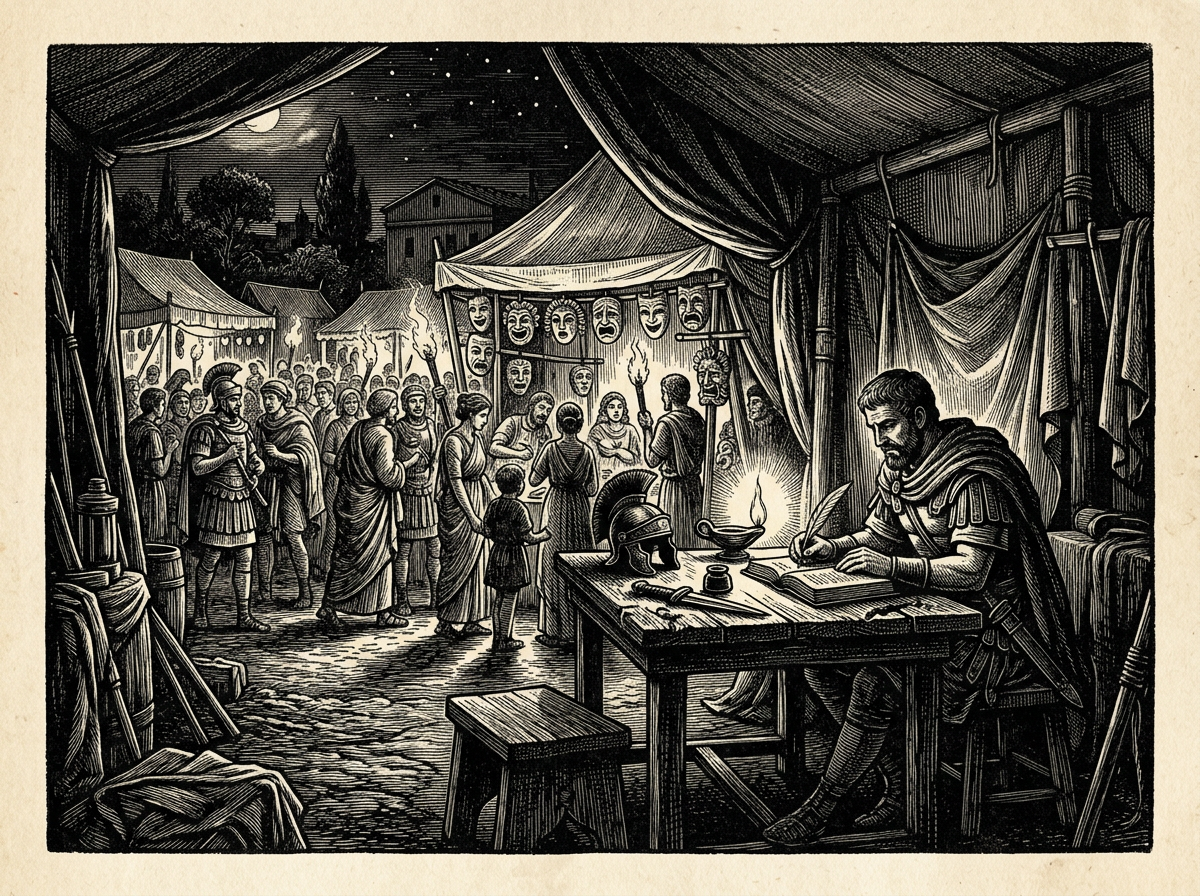
Marcus Aurelius wrote this entry in his military camp while commanding Roman legions along the northern frontier, surrounded by scheming court intellectuals and quick-witted politicians. He was an emperor privately battling his own feelings of inadequacy, knowing he lacked the dazzling intellectual brilliance and quick wit of famous Greek rhetoricians.
He was not writing a pep-talk to boost his self-esteem or overcome body image issues. He was performing a cold, rational audit on his soul, reminding himself that while natural intellect is an unearned biological gift, moral virtue is an absolute duty required by human nature.
The Opening Counter-Punch
The commentary hijacks an Emperor's grave self-audit and degrades it into a shallow self-esteem motivational speech. It takes a severe command to fulfill one's rational function and twists it into a feel-good guide for overcoming personal insecurities. By swapping cosmic moral duty for bourgeois self-improvement, the text sanitizes Marcus’s uncompromising demands to feed the reader's need for validation.
The Breakdown
- The commentary takes Marcus’s severe audit of natural talent vs. moral duty and degrades it into a list of modern insecurities, reassuring readers who worry that "they weren’t born taller, another that they’re not smarter, with a different complexion." Marcus was contrasting unearned mental quickness with total moral duty, but the commentary shifts the original focus away from cosmic alignment toward self-absorbed anxieties over physical genetics and social aesthetics.
- The text trivializes Marcus’s demand for radical moral discipline by reframing character as a casual menu of options, insisting "you have the choice to be truthful... you can choose to be happy." Marcus treated virtue not as a collection of personal preference choices, but as an absolute, non-negotiable obligation demanded by rational nature, making this soft "option" framing a total dilution of strict Stoic duty.
- The commentary flatly corrupts Marcus's core principle by appealing directly to human vanity, asking whether traits born of effort aren't "more impressive anyway?" Marcus explicitly commanded his soul to practice virtue without seeking to impress anyone or win applause, whereas the commentary alters his private discipline into a calculated strategy for social admiration.
What Is the Lesson?
The authentic lesson of Meditations 5.5 is that lacking unearned natural talents is never an excuse for failing to cultivate moral character. You practice this by identifying the precise virtues entirely within your control, such as sincerity, endurance, and frugality, and exercising them relentlessly without making excuses for your natural limitations. Perform these duties quietly and completely, regardless of whether anyone marvels at your performance.
How The Philosopher Would Respond
Marcus Aurelius would flatly reject the suggestion that virtue exists to make a person "impressive" to others, viewing any desire for human admiration as a pathetic betrayal of rational nature.
"A horse when it has run, a dog when it has tracked the game, a bee when it has made the honey, rises not to give a shout, but passes on to another thing. So should a man be when he has done a good act, not calling out for others to come and see."
- Marcus Aurelius, Meditations, 6.6
Related dispatches
MORAL DILUTION: CORPORATE STOICISM · A Critique of Modern Stoicism
Modern self-help flattens Seneca's horror into corporate risk management.
27 Oct 2026
INTELLECTUAL EROSION: MODERN STOICISM · A Critique of Modern Stoicism
Modern Stoicism dilutes Seneca’s vast blueprint into instant comfort.
26 Oct 2026
ETHICAL DRIFT: BOURGEOIS OPTIMIZATION · A Critique of Modern Stoicism
Modern self-help turns Epictetus's radical freedom into careerist optimization.
25 Oct 2026
KEY FLAW: DILUTED DISCIPLINE · A Critique of Modern Stoicism
True moral strength demands laborious excavation, not positive thinking.
24 Oct 2026