SHALLOW READING: RECKLESS SPEECH
Why modern Stoicism reduces moral discipline to mere social politeness
05 Oct 2026
5th October: Words Can't Be Unsaid | The Trivialization of Moral Slip to Casual Regret
The Text in Question
The Daily Stoic Rendering
“Better to trip with the feet than with the tongue.” - ZENO, QUOTED IN DIOGENES LAERTIUS, LIVES OF THE EMINENT PHILOSOPHERS, 7.1.26
Standard Academic Translation
“It is better to slip with the feet than with the tongue.” - ZENO, QUOTED IN DIOGENES LAERTIUS, LIVES OF THE EMINENT PHILOSOPHERS, 7.1.26 (R.D. Hicks)
Academic Context & Breakdown
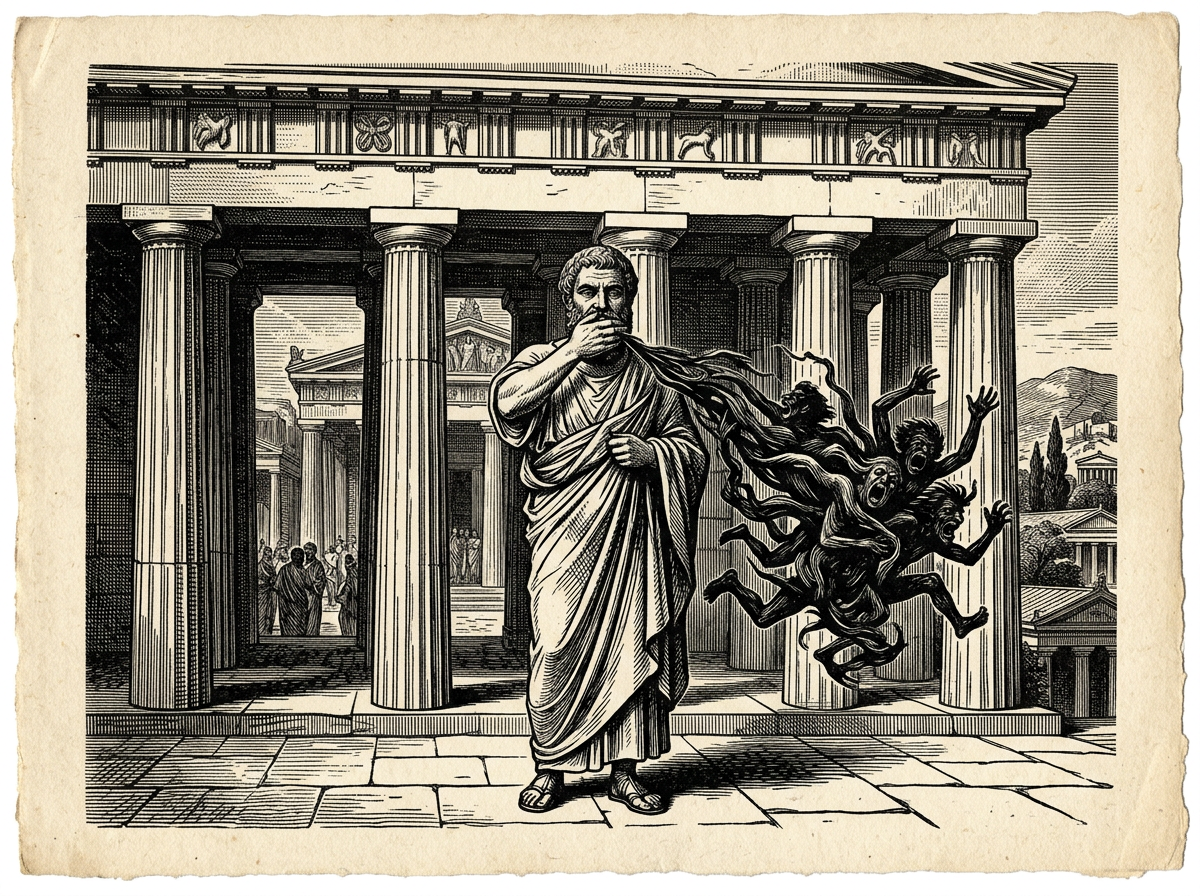
Zeno of Citium, the founder of Stoicism, taught under the public colonnade of the Stoa Poikile in ancient Athens, stripped of his former wealth after surviving a catastrophic shipwreck. He addressed men who valued public rhetoric and political influence above all else, warning them of the grave moral danger of reckless speech.
For Zeno, a physical fall breaks a bone, but a verbal lapse reveals a corrupt and undisciplined soul (hegemonikon). Slips of the tongue are not mere social awkwardness; they betray a mind that has surrendered reason to irrational impulse, causing irreparable moral damage to both speaker and listener.
The Opening Counter-Punch
The commentary guts an uncompromising principle of moral discipline and degrades it into a trite warning against awkward social slips. It swaps Zeno's severe demand for total rational mastery over one's speech with a shallow, self-help warning about avoiding awkward conversations. Where the founder of Stoicism demanded rigorous internal control, the commentary offers a bland reminder not to hurt feelings.
The Breakdown
- The commentary asserts that "you can always get up after you fall," trivialize physical injury to set up an easy contrast rather than engaging with Zeno’s actual moral hierarchy. By ignoring the severity of physical suffering in the ancient world, the commentary distorts the translation's weight, turning a stark existential warning into a lighthearted analogy about bumping your knee.
- By focusing on how "what has been said can never be unsaid," the commentary shifts the danger from internal moral corruption to external reputation management. Zeno cared about the soul's discipline, whereas the commentary alters the quote's core meaning to focus on the social consequences and inconvenience of public mistakes.
- The commentary warns specifically against saying "especially cruel and hurtful things," substituting modern emotional sensitivity for Zeno's focus on truth, reason, and self-mastery. The translation warns against any irrational slip of the tongue, including lie, boast, or foolish compromise, not merely modern politeness or avoiding hurt feelings.
Application of the True Lesson
The standard academic translation demands that you treat every spoken word as a direct reflection of your internal moral state, requiring complete control over your impulses before opening your mouth.
To practice this today, commit to absolute silence in situations where you are tempted to gossip, boast, complain, or offer an uninvited opinion, proving to yourself that your tongue remains under the strict authority of your reason.
How the Philosopher Would Respond
Zeno would thoroughly despise seeing his radical demand for self-mastery reduced to a gentle tip on avoiding social embarrassment.
“We have two ears and one mouth, so we should listen more than we speak.” - ZENO, QUOTED IN DIOGENES LAERTIUS, LIVES OF THE EMINENT PHILOSOPHERS, 7.1.23
Related dispatches
STOIC MISTRANSLATION: SOCIAL GUILT · A Critique of Modern Stoicism
Pop Stoicism trades cosmic endurance for easy moralizing
04 Oct 2026
CENTRAL ERROR: SENTIMENTAL REDUCTION · A Critique of Modern Stoicism
Stop turning Marcus Aurelius’s cosmic physics into corporate team synergy.
03 Oct 2026
MORAL REFRAMING: ASSET MANAGEMENT · A Critique of Modern Stoicism
Virtue is a moral fortress, not a personal asset strategy
02 Oct 2026
CHIEF DEFECT: SENTIMENTAL STOICISM · A Critique of Modern Stoicism
Stoic duty is an unyielding mandate, not a cozy affirmation.
01 Oct 2026