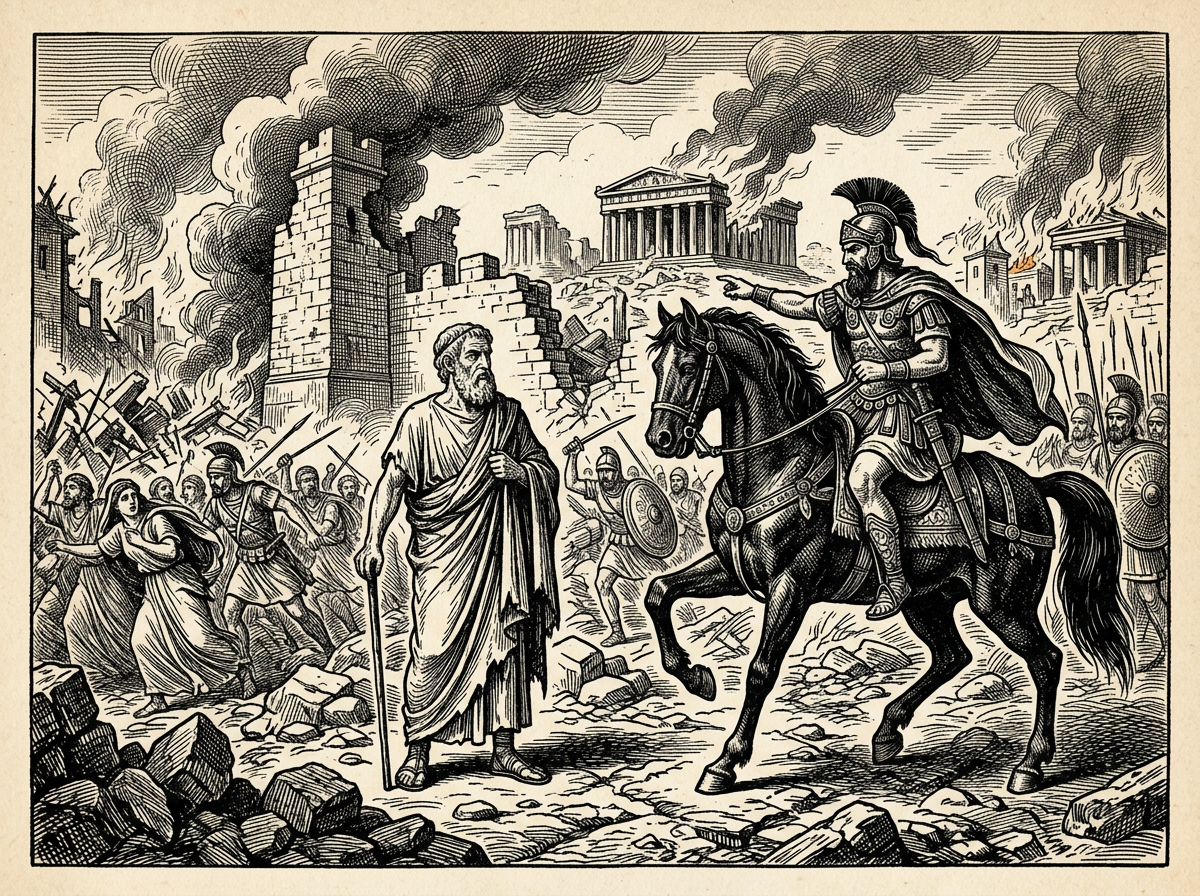
CORE FALLACY: DELUSIONAL DENIAL
Modern Stoicism trades hard moral courage for cheap mental escape
30 Sept 2026
30th September: You Can’t Touch Me | The Commodification of Heroic Martyrdom into Psychological Escapism
The Text in Question
The Daily Stoic Rendering:
“If you lay violent hands on me, you’ll have my body, but my mind will remain with Stilpo.” - Zeno, quoted in Diogenes Laertius, Lives of the Eminent Philosophers, 7.1.24
Standard Academic Translation:
"When Demetrius took Megara, Zeno declared that he had lost nothing, for Stilpo had stripped him of nothing that was truly his own; and when the tyrant threatened him: 'You shall die,' Zeno replied: 'Nay, rather, you shall die, for you are mortal.' But when he was dragged away, he said: 'You may carry off my body, but my soul remains with Stilpo.'" - Zeno, quoted in Diogenes Laertius, Lives of the Eminent Philosophers, 7.1.24 (trans. R.D. Hicks)
Academic Context & Breakdown
Zeno of Citium, the founder of Stoicism, uttered these words during a terrifying moment of military sack and siege. Demetrius Poliorcetes ("The Besieger") had just breached the city of Megara, unleashing pillage, enslavement, and violence upon its inhabitants. Zeno had studied in Megara under Stilpo, a Megarian philosopher who taught that moral virtue and internal wisdom are the only goods that cannot be looted by an invading army.
In Hicks’s translation, Zeno confronts a tyrant who wields absolute power over life and death. When threatened with execution, Zeno does not plead for mercy or engage in psychological coping mechanisms; he cold-bloodedly reminds the tyrant of his own mortality. Zeno's declaration that his soul "remains with Stilpo" is not an assertion of magical thinking, but a absolute refusal to let physical violence or death alter his rational commitment to virtue.
The commentary guts this lethal confrontation with tyranny and rewires it into a soft lesson on mental escapism. It transforms Zeno’s terrifying indifference to execution into a self-help routine for avoiding uncomfortable emotions. By swapping out radical moral autonomy for pop-psychology mind tricks, the commentary turns Stoic martyrdom into a cheap exercise in positive thinking.
The Opening Counter-Punch
The commentary guts Zeno’s cold confrontation with total annihilation and degrades it into a lesson on psychological denial. It takes a founder's fearless stance against a bloodthirsty tyrant and transforms it into a self-satisfied trick for pretending adversity isn't real.
The Breakdown
- The commentary replaces Zeno's absolute moral conviction with psychological denial, praising Rubin Carter's claim: "I don’t acknowledge the existence of the prison. It doesn’t exist for me." Zeno never pretended that the invading army, the physical chains, or the threat of execution did not exist. By endorsing delusional denial over raw acceptance of reality, the commentary twists Stoic endurance into a self-defeating game of mental pretend.
- The commentary trivializes catastrophic physical violence into routine daily friction, promising that "in the midst of any and every kind of adversity, it is there." In Hicks's translation, Zeno is facing the literal destruction of a city and his own immediate execution by a tyrant. The commentary sanitizes this existential proving ground, expanding it to cover minor personal annoyances and daily stress.
- The commentary turns a hard-won spiritual refuge into a self-congratulatory shield of personal invulnerability, reassuring the reader that "your mind can remain philosophical... It’s untouchable and in a way, then, so are you." Zeno did not claim that his mind was automatically "untouchable" as a birthright or easy self-help perk. He anchored his soul in years of grueling philosophical discipline under Stilpo, whereas the commentary treats spiritual invulnerability as a quick, effortless life-hack.
The Lesson of the Text
The academic translation teaches that external force can break your body, strip your wealth, and end your physical life, but it can never force you to betray your moral reason. We apply this by recognizing that physical suffering and external loss have no power to degrade our character unless we voluntarily surrender our rational judgment.
How the Philosopher Would Respond
Zeno would flatly reject this attempt to turn radical moral sovereignty into a psychological denial trick. He did not face down tyrants and executioners to teach you how to pretend your problems don't exist, but to prove that virtue remains unbent even when your body is destroyed.
"A bad feeling is a commotion of the soul contrary to reason, and contrary to Nature. ... The wise man is free from passion, because he is not prone to fall into such weakness." - Zeno, quoted in Diogenes Laertius, Lives of the Eminent Philosophers, 7.1.110
117
Related dispatches
CHIEF DEFECT: SENTIMENTAL STOICISM · A Critique of Modern Stoicism
Stoic duty is an unyielding mandate, not a cozy affirmation.
01 Oct 2026
EXISTENTIAL REDUCTION: BOURGEOIS NOSTALGIA · A Critique of Modern Stoicism
Don't reduce Seneca's political exile to cozy lifestyle downsizing
29 Sept 2026
MAIN ERROR: EGOIC REDUCTION · A Critique of Modern Stoicism
Modern self-help turns Epictetus’s humbling theology into a cheap life hack.
28 Sept 2026
CRITICAL FLAW: TRIVIALIZED TRAUMA · A Critique of Modern Stoicism
Modern Stoicism turns existential trauma into wealth management anxiety.
28 Sept 2026