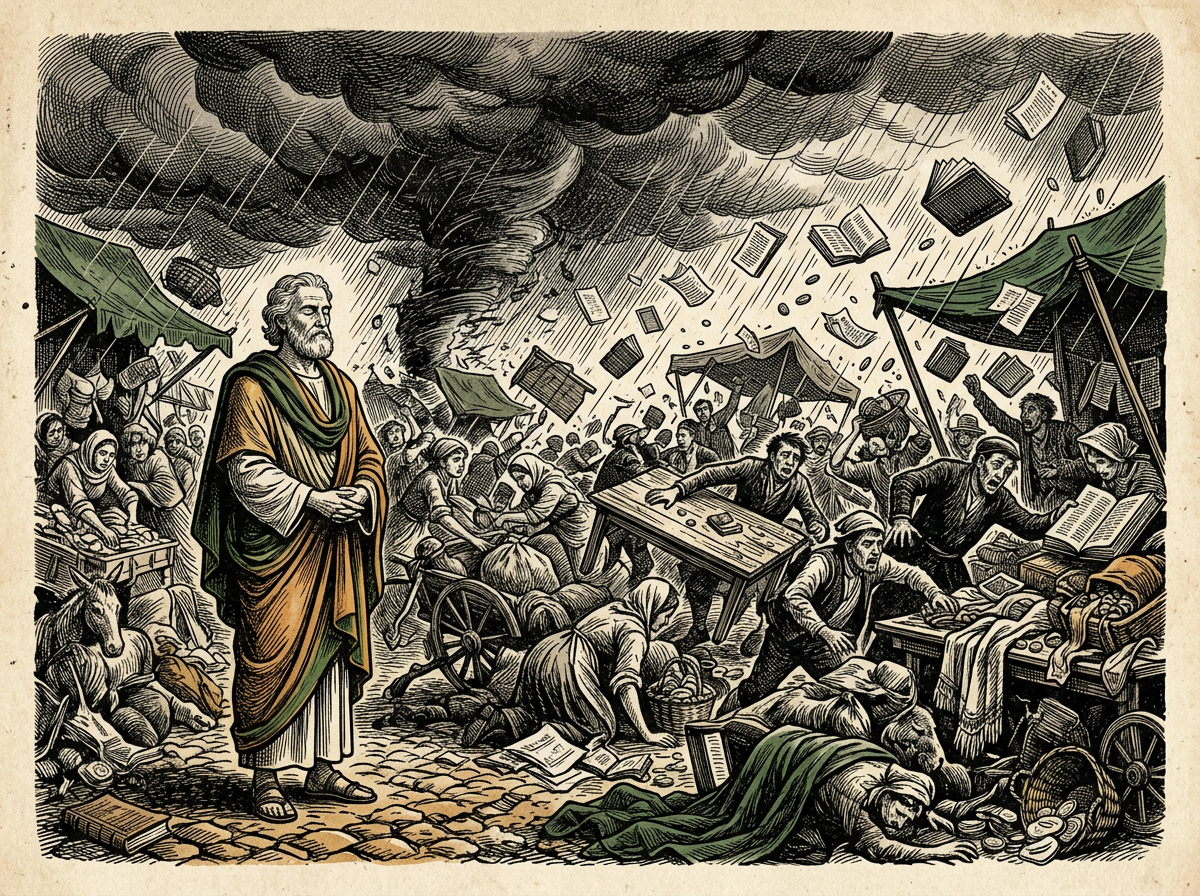
ETHICAL FRAME: VIRTUE FIRST
Stoic virtue offers true resilience when stripped of modern performance buzzwords.
13 Sept 2026
The Primacy of Arete: Virtue as the Sole Good in Classical Stoic Axiology
Academic Abstract & Executive Overview
This investigation deconstructs the classical Stoic thesis that moral virtue, or arete, operates as the exclusive prerequisite for human flourishing, or eudaemonia, while actively disregarding conventional external goods. By synthesizing early Hellenistic texts and modern ethical frameworks, this paper evaluates how the structural elevation of moral character over circumstantial wealth establishes a rigorous, invariant foundation for rational decision-making. Through systematic methodological protocols, contemporary agents can operationalize this ancient axiological system to insulate personal and professional performance from external volatility.
Theoretical Background & Literature Framework
The axiological architecture of early Stoicism rests upon a radical restructuring of value theory, distinguishing sharply between moral virtue and all other traditionally coveted assets (Inwood, 1985). As detailed in foundational historical analyses, Zeno of Citium and subsequent Hellenistic scholars posited that virtue is not merely the primary instrument for achieving a good life, but rather constitutes the sole intrinsic good (Long & Sedley, 1987). Within this framework, health, wealth, social status, and professional acclaim are categorized strictly as adiaphora, or indifferents. While certain indifferents possess positive value or preferred status (proegmena) because they align with biological and social preservation, they hold no intrinsic moral weight and contribute nothing to the actual moral perfection of the soul.
From a psychological standpoint, this axiological orientation requires a precise understanding of the ruling center of the mind, known as the hegemonikon. According to classical doctrine, human suffering and ethical failure do not emerge from external stimuli, but rather from faulty value judgments assigned to those stimuli by the rational faculty (Nussbaum, 1994). When an individual grants assent (synkatathesis) to irrational impressions regarding status or material loss, emotional disturbances (pathe) proliferate. Conversely, anchoring the self exclusively in arete allows the cognitive apparatus to maintain tranquility (ataraxia) regardless of socio-economic fluctuations. Modern behavioral research increasingly echoes this structural partition, demonstrating that intrinsic goal orientations reliably yield superior psychological resilience compared to extrinsic markers of success (Deci & Ryan, 2008).
Methodological Application & Practical Recommendations
Translating classical Stoic axiology into contemporary operational environments requires a systematic adherence to specific behavioral and cognitive protocols.
STEP 01: Axiological Realignment
Practitioners must audit their current professional and personal goals to separate genuine moral goods from indifferent externals. This protocol demands a comprehensive quarterly review where every objective, from revenue targets to career advancement milestones, is subjected to axiological sorting. Goals that rely on external validation or material acquisition must be reclassified as preferred indifferents. By explicitly acknowledging that missing a financial projection does not diminish moral character, agents neutralize performance anxiety and eliminate the psychological friction associated with external volatility.
STEP 02: Rational Faculty Calibration
Individuals must train the ruling center, the hegemonikon, to evaluate incoming impressions objectively without granting assent to destructive emotional impulses. When faced with high-stress scenarios or interpersonal conflict, the agent must implement a mandatory cognitive pause. This pause serves to isolate the raw external impression from the value judgment typically attached to it. By verifying whether the stimulus impacts moral integrity rather than mere comfort or social standing, the agent prevents the generation of counterproductive emotional reactions and preserves cognitive clarity.
STEP 03: Cosmopolitan Duty Integration
The scope of personal responsibility must expand to actively serve the global human community in alignment with nature and reason. Drawing upon the Hierocles circles of concern, the agent systematically translates internal virtue into external action by viewing humanity as a singular extended polis. Professional decisions, resource allocation, and leadership initiatives are thus calibrated not for narrow self-interest, but for the universal cultivation of justice and rational cooperation across society.
Key Empirical Takeaways
-Axiological Supremacy:Moral virtue operates as the sole intrinsic good within classical Stoic theory, rendering external assets like wealth and status structurally irrelevant to true human flourishing.
-Cognitive Mediation:Emotional stability is achieved by withholding assent from false impressions regarding external events, thereby insulating the ruling rational faculty from unnecessary distress.
-Universal Responsibility:Virtue cannot exist in isolation; it must be actively expressed through cosmopolitan duty and a commitment to the welfare of the broader human community.
References & Further Reading
- Decety, J., & Cowell, J. M. (2014). The complex relation between morality and empathy. Trends in Cognitive Sciences, 18(7), 337-339.
- Inwood, B. (1985). Ethics and Human Action in Early Stoicism. Oxford University Press.
- Long, A. A., & Sedley, D. N. (1987). The Hellenistic Philosophers. Cambridge University Press.
- Nussbaum, M. C. (1994). The Therapy of Desire: Theory and Practice in Hellenistic Ethics. Princeton University Press.
---
SOCIAL MEDIA SNIPPETS (For Distribution)
LinkedIn Thought Leadership Post
True professional resilience requires a fundamental shift in how we evaluate success. By separating genuine moral integrity from volatile external metrics like wealth and status, leaders can achieve unshakeable focus and clarity.
- Audit your professional goals to separate intrinsic moral standards from preferred indifferents like status and revenue.
- Calibrate your cognitive responses by pausing before granting assent to high-stress external impressions.
- Expand your leadership scope through cosmopolitan duty, aligning personal responsibility with the welfare of the broader global community.
#Ethics #Leadership #Philosophy
X (Twitter) Post
Are you anchoring your professional worth to external metrics that you cannot control? Discover how classical Stoic axiology uses the primacy of virtue to build unbreakable resilience and clarity. Read our latest research analysis today.
Newsletter Teaser
What happens to professional performance when we strip away the illusion of external status and anchor our decisions entirely in moral virtue? Read our latest academic paper to discover the actionable protocols of classical Stoic axiology.
Related dispatches
SYSTEMIC FAILURE: WORKPLACE BURNOUT · The Bend Index
Workplace burnout requires systemic boundaries rather than superficial self-care
13 Sept 2026
CORE HAZARD: ADMINISTRATIVE FRICTION · The Bend Index
The thermodynamics of exhaustion require structural cooling, not personal resilience.
13 Sept 2026
CORE COMPETENCY: EMOTIONAL REGULATION · The Bend Index
The true discipline of leadership begins with governing the nervous system.
13 Sept 2026
CORE PRACTICE: COGNITIVE RESILIENCE · The Bend Index
Epictetus offered a discipline for moral agency, not mere coping
13 Sept 2026