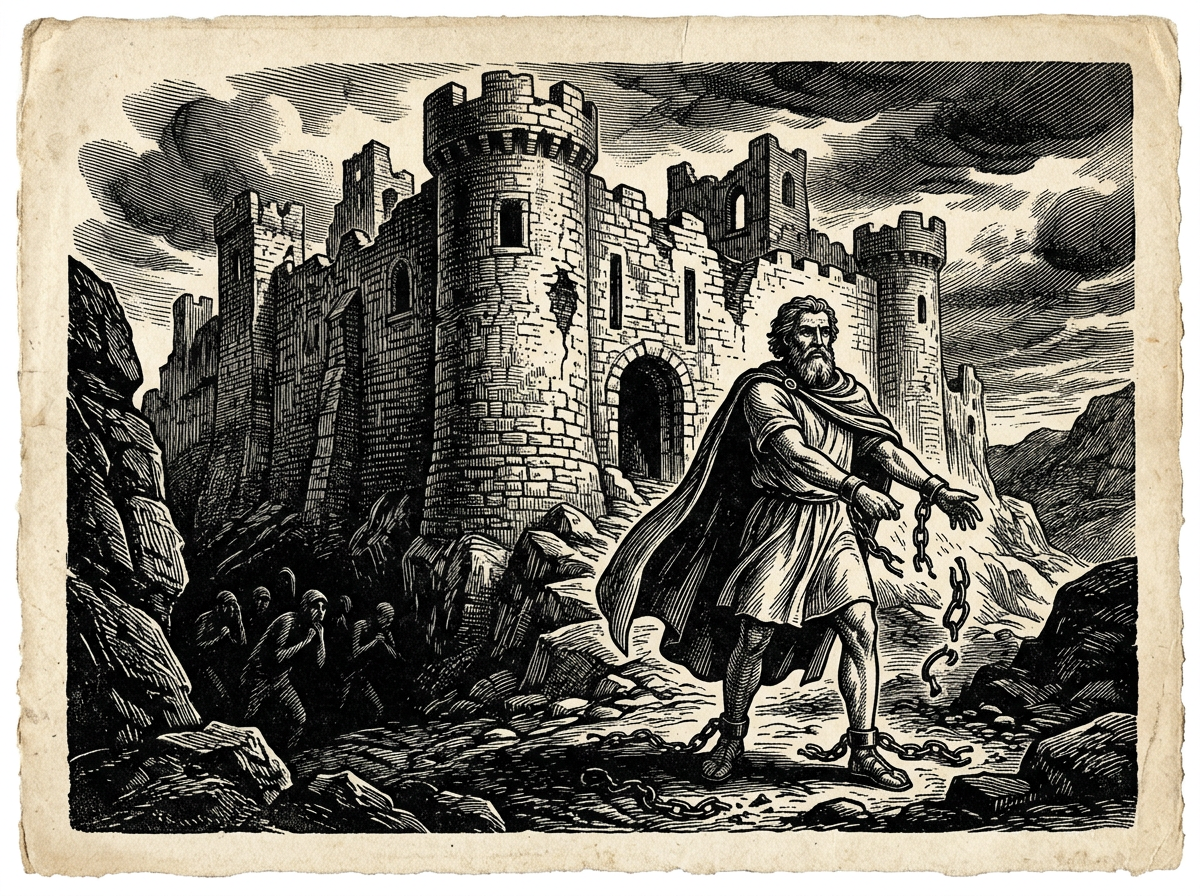
CORE ERROR: DOMESTICATED STOICISM
Stoicism is an offensive against tyranny, not suburban stress management
12 Sept 2026
13th September: Protecting Our Inner Fortress From Fear | The Dilution of Spiritual Warfare into Psychological Comfort
The Text in Question
The Daily Stoic Rendering:
“No, it is events that give rise to fear when another has power over them or can prevent them, that person becomes able to inspire fear. How is the fortress destroyed? Not by iron or fire, but by judgments . . . here is where we must begin, and it is from this front that we must seize the fortress and throw out the tyrants.” - Epictetus, Discourses, 4.1.85
86; 87a
Standard Academic Translation:
“What is it, then, that makes a man fear? Is it not the things that are outside his power, when someone who has control over them or can prevent them becomes a cause of terror? How, then, is a city taken? Not by fire or sword, but by false judgments. It is here that we must begin, and it is from this citadel that we must expel the tyrants.” - Epictetus, Discourses, 4.1.85
86; 87a (trans. Robin Hard)
1.5 Academic Context & Breakdown
Epictetus spoke these words in his school at Nicopolis around 108 AD, addressing young Romans preparing to enter imperial public life. A former slave who had been crippled by his master and later banished from Rome by Emperor Domitian, Epictetus knew the literal teeth of tyranny. He taught in a simple stone room, surrounded by students who lived under the constant threat of imperial execution, exile, or property confiscation.
In the academic translation, Epictetus is not delivering a metaphor for stress management. He is analyzing the anatomy of human servitude, declaring that no emperor, master, or tyrant holds actual power over a human soul. Slavery occurs only when an individual surrenders their own power of judgment (prohairesis) to external desires and fears.
- The Opening Counter-Punch
The Daily Stoic guts Epictetus’s radical declaration of spiritual independence and reduces it to a vague self-help pep talk about managing anxiety. It swaps an aggressive, offensive reclamation of moral agency for a passive defense of emotional comfort. This isn't Stoic liberation; it is suburban fear management packaged as ancient strength.
- The Breakdown
- Downgrading Spiritual Tyranny to Mere Loss of Nerve — The commentary claims that we open our gates "when we lose our nerve and give in to fear." Epictetus explicitly defines tyrants not as external emotional slumps, but as our own corrupt judgments that grant external people power over us. Softening a total epistemological failure into merely losing one's nerve inauthentically turns a fundamental moral treason into a simple lapse in confidence.
- Rebranding Radical Freedom as Passive Citadel Preservation — The commentary urges readers to hold the fort because "you’ve been granted a strong fortress." Epictetus demands that we aggressively "throw out the tyrants" and reclaim a citadel we have already surrendered to false value judgments. Distorting an active counter-offensive into a passive preservation tactic strips the text of its revolutionary core.
- Distorting Moral Sovereignty into Fragile Emotional Defense — The commentary frames fear as an external invader, cautioning that "impenetrable fortresses can still be breached, if betrayed from the inside." Epictetus insists that external things have zero power to breach anything, and that fear exists only when we voluntarily idolize external outcomes. Shifting the focus from dismantling false values to protecting oneself from bad feelings completely subverts the academic original.
- The Lesson & Application
The academic text teaches that external circumstances and powerful people have zero inherent power to terrify or enslave us. Tyranny exists only when we assign irrational value to things outside our control, effectively handing the whip to someone else.
We practice this by identifying every instance where we feel fear or intimidation, isolating the underlying false judgment, and systematically stripping external outcomes of their perceived authority over our peace of mind.
- How the Philosopher Would Respond
Epictetus would scoff at treating the soul as a fragile property to be sheltered from daily anxiety. He did not teach his students to hide behind mental walls, but to actively dismantle the internal idols that make them cower before external power.
“My leg you will fetter, but my moral purpose not even Zeus himself can conquer. 'I will throw you into prison.' My poor body, you mean. 'I will behead you.' When did I ever tell you that my neck was the only one that could not be cut?” - Epictetus, Discourses, Book I, 1.22
24
Related dispatches
MORAL DILUTION: CORPORATE STOICISM · A Critique of Modern Stoicism
Modern self-help flattens Seneca's horror into corporate risk management.
27 Oct 2026
INTELLECTUAL EROSION: MODERN STOICISM · A Critique of Modern Stoicism
Modern Stoicism dilutes Seneca’s vast blueprint into instant comfort.
26 Oct 2026
ETHICAL DRIFT: BOURGEOIS OPTIMIZATION · A Critique of Modern Stoicism
Modern self-help turns Epictetus's radical freedom into careerist optimization.
25 Oct 2026
KEY FLAW: DILUTED DISCIPLINE · A Critique of Modern Stoicism
True moral strength demands laborious excavation, not positive thinking.
24 Oct 2026