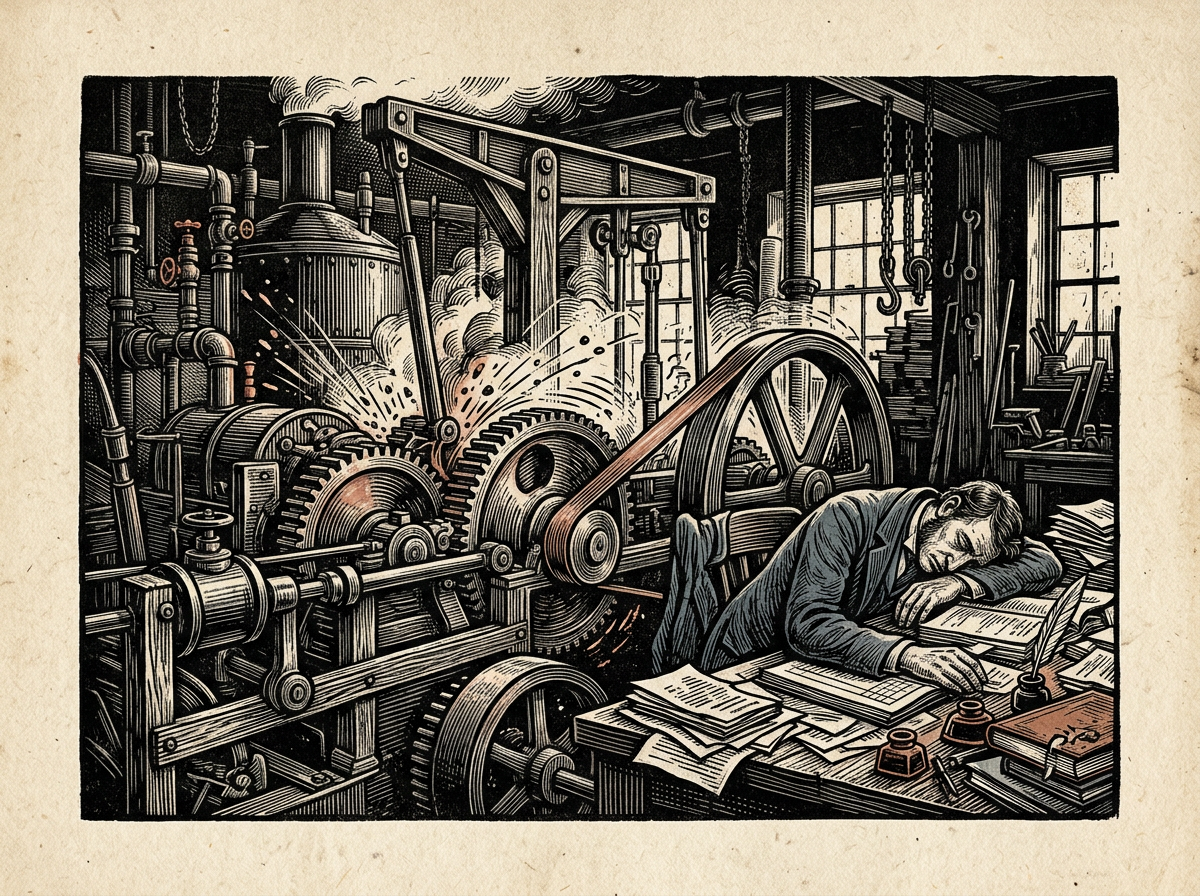
CORE HAZARD: ADMINISTRATIVE FRICTION
The thermodynamics of exhaustion require structural cooling, not personal resilience.
13 Sept 2026
Mechanical Entropy vs. Human Exhaustion: Metaphorical and Practical Dimensions of the 'Burnout' Phenomenon
Academic Abstract & Executive Overview
This paper examines the semantic and systemic intersection between mechanical thermal fatigue, specifically the automotive practice of stationary wheel slippage known as a burnout, and chronic human occupational exhaustion. By mapping the laws of thermodynamics onto psychosocial models of stress, we demonstrate that both machinery and human agency experience parallel paths of systemic degradation when subjected to sustained energy output without adequate recovery phases. Through an empirical analysis of energy expenditure, friction accumulation, and thermal regulation, we offer a diagnostic framework designed to arrest system-level depletion before total structural failure occurs.
Theoretical Background & Literature Framework
The terminology of exhaustion has historically migrated from industrial mechanics into the psychological lexicon. In his foundational work, Freudenberger (1974) identified burnout as a state of mental and physical exhaustion caused by professional overextension, drawing an implicit parallel to industrial engines running past their design limits. This framework was later expanded by Maslach and Leiter (1997), who operationalized burnout through the dimensions of exhaustion, cynicism, and inefficacy, establishing it as a chronic occupational phenomenon rather than a transient emotional state.
Concurrently, the principles of mechanical entropy dictate that any closed system operating under high friction will inevitably degrade. In an automotive context, a burnout forces a vehicle's tires to spin against a stationary surface, generating massive kinetic friction, intense localized heat, and rapid tread destruction while producing zero forward momentum. When applied metaphorically to human labor, this phenomenon describes knowledge workers and organizational leaders expending vast cognitive resources on high-friction, low-yield administrative tasks. According to empirical studies in occupational health psychology (Schaufeli et al., 2009), this dynamic induces rapid psychological depletion, mirroring the thermal breakdown observed in overstressed mechanical components.
To understand this cross-disciplinary parallel, one must analyze the three core phases shared by both systems: energy input, frictional resistance, and thermal dissipation. Just as an engine requires oil to mitigate internal friction, human cognitive systems require structural support to prevent emotional and neurological burnout. When systemic friction exceeds the capacity for cooling or recovery, both the machine and the human operator enter catastrophic failure states.
Methodological Application & Practical Recommendations
Translating mechanical preservation strategies into organizational psychology yields a robust, three-step protocol for mitigating human exhaustion.
STEP 01: Thermal Load Assessment
Organizations and individuals must systematically evaluate current energy expenditure rates against systemic recovery capacity to prevent critical cognitive failure. Much like monitoring an engine temperature gauge, leaders should implement regular pulse surveys and workload audits. By measuring the ratio of high-intensity cognitive output to restorative downtime, management can identify individuals operating in the red zone before chronic exhaustion manifests.
STEP 02: Friction Reduction Protocol
To prevent the psychological equivalent of a stationary wheel burnout, systems must identify and eliminate redundant administrative friction points that drain psychological resources without producing productive output. Research on cognitive load theory (Sweller, 1988) demonstrates that unnecessary bureaucratic hurdles consume scarce working memory. Streamlining communication channels, automating repetitive workflows, and eliminating superfluous meetings directly reduces the daily friction that accelerates human burnout.
STEP 03: Controlled Cooldown Integration
Just as high-performance machinery requires a cool-down lap to safely dissipate thermal energy, human biological systems require scheduled rest to clear metabolic waste products from the brain. Organizations must integrate mandatory, non-negotiable rest cycles into the operational calendar. This includes protecting non-working hours from digital intrusion and enforcing micro-breaks throughout the workday to allow somatic and cognitive systems to vent accumulated stress heat.
Key Empirical Takeaways
-Parallel Degradation:Human occupational burnout and mechanical thermal fatigue share identical thermodynamic trajectories, where sustained high output without recovery leads to irreversible system degradation (Freudenberger, 1974).
-Frictional Waste:High-friction administrative environments act as cognitive load multipliers, expending human energy without generating meaningful professional output (Sweller, 1988).
-Preventative Regulation:Implementing structured energy assessments and mandatory cool-down cycles successfully arrests the progression of chronic exhaustion in professional settings (Maslach & Leiter, 1997).
References & Further Reading
- Freudenberger, H. J. (1974). Staff burnout. Journal of Social Issues, 30(1), 159-165.
- Maslach, C., & Leiter, M. P. (1997). The truth about burnout: How organizations cause personal stress and what to do about it. Jossey-Bass.
- Schaufeli, W. B., Leiter, M. P., & Maslach, C. (2009). Burnout: 35 years of research and practice. Career Development International, 14(3), 204-220.
- Sweller, J. (1988). Cognitive load during problem solving: Effects on learning. Cognitive Science, 12(2), 257-285.
---
SOCIAL MEDIA SNIPPETS (For Distribution)
LinkedIn Thought Leadership Post
Burnout is not just a psychological buzzword; it operates on the exact same thermodynamic principles as an overworked machine. When we expend massive energy without generating forward momentum, we experience systemic thermal failure. Discover how to apply mechanical preservation strategies to organizational psychology.
- Evaluate energy expenditure rates against systemic recovery capacity to avoid critical cognitive failure.
- Eliminate redundant administrative friction points that drain psychological resources without producing results.
- Schedule mandatory, non-negotiable rest cycles to allow somatic and cognitive systems to vent accumulated stress.
#Psychology #Leadership #Research #BurnoutPrevention
X (Twitter) Post
Why do humans burn out just like overstressed engines? Explore the surprising thermodynamic parallels between mechanical entropy and chronic occupational exhaustion in our latest Chaff & Wheat research analysis. Read the full paper today.
Newsletter Teaser
What do overheating car tires and exhausted knowledge workers have in common? Read our latest research paper exploring the thermodynamic and psychological dimensions of the burnout phenomenon.
Related dispatches
SYSTEMIC FAILURE: WORKPLACE BURNOUT · The Bend Index
Workplace burnout requires systemic boundaries rather than superficial self-care
13 Sept 2026
CORE COMPETENCY: EMOTIONAL REGULATION · The Bend Index
The true discipline of leadership begins with governing the nervous system.
13 Sept 2026
CORE PRACTICE: COGNITIVE RESILIENCE · The Bend Index
Epictetus offered a discipline for moral agency, not mere coping
13 Sept 2026
CHIEF PERIL: PASSIVE NIHILISM · The Bend Index
Turning existential paralysis into a disciplined practice of self-authorship
13 Sept 2026