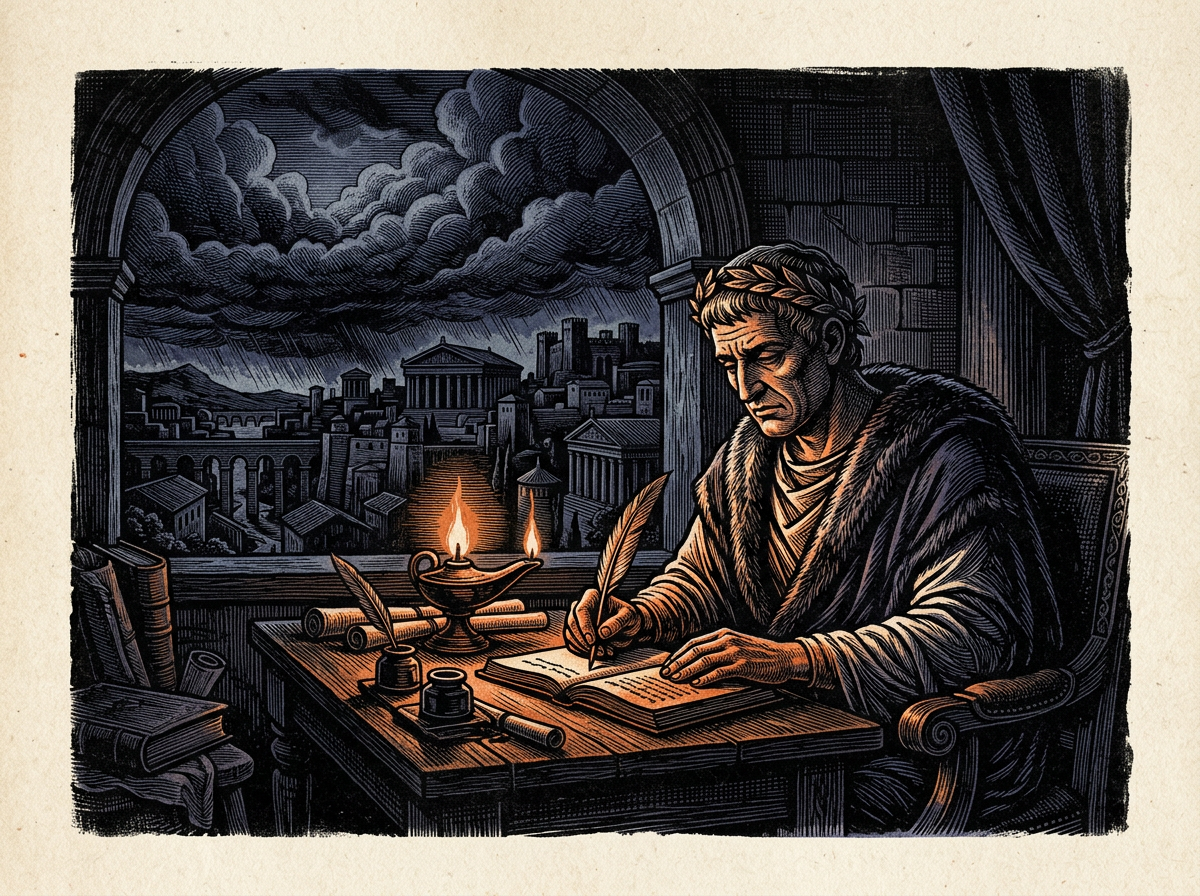
INNER DISCIPLINE: EXTERNAL GOVERNANCE
Inner command remains the necessary foundation of public leadership
12 Sept 2026
The Sovereign Self: Psychological Introspection and Governance in the Writings of Marcus Aurelius
Academic Abstract & Executive Overview
This analysis examines the dual existence of Roman Emperor Marcus Aurelius through the lens of classical historiography and modern virtue ethics. By evaluating his private journals alongside external geopolitical pressures, the research illuminates how sovereign authority coexists with profound psychological asceticism. Ultimately, the synthesis of historical documentation and philosophical inquiry reveals that inner governance serves as a necessary prerequisite for effective external leadership.
Theoretical Background & Literature Framework
The historical trajectory of the Antonine dynasty during the second century CE presents a compelling paradox of absolute power intersecting with severe systemic vulnerability (Birley, 2012). Marcus Aurelius governed the Roman Empire during a period characterized by catastrophic military conflicts, specifically the protracted Marcomannic Wars along the Danubian frontier, and the devastating demographic shock of the Antonine Plague (Duncan-Jones, 2018). Within this crucible of crisis, the emperor composed his private philosophical reflections, known traditionally as the Meditations. Scholarship in the field of ancient philosophy, notably the contributions of Hadot (1998) and Sellars (2003), frames these writings not merely as theoretical treatises, but as rigorous spiritual exercises designed to cultivate psychological resilience.
From a psychoanalytic and virtue ethics perspective, these texts document an ongoing negotiation between public political obligation and private moral duty (Gill, 2006). According to Nussbaum (1994), Hellenistic philosophy treats the soul as a site of medical intervention where cognitive restructuring remedies emotional turbulence. Marcus Aurelius utilized introspective writing to distance himself from the corrupting allure of absolute power. By applying the foundational tenets of Stoicism, he transformed the imperial throne into an observatory for human psychology. Modern psychological research on cognitive behavioral therapy confirms that such structured self-monitoring effectively reduces anxiety and enhances emotional regulation, mirroring the ancient Stoic practice of the prohairesis, or the faculty of choice (Robertson, 2019). The theoretical framework thus posits that external imperial stability depended entirely upon the monarch maintaining an internal locus of control amidst external chaos.
Methodological Application & Practical Recommendations
To operationalize the philosophical principles evidenced in the life and writings of Marcus Aurelius, contemporary leaders and researchers can implement a structured methodology derived from Hellenistic spiritual exercises.
Step 01: Biographical Contextualization
Scholars and practitioners must study the socio-political challenges of the Antonine Plague and the Marcomannic Wars to understand the genesis of the Emperor's writings (Birley, 2012). Recognizing the vast scale of external stressors allows modern agents to contextualize their own professional burdens within a broader historical continuum, thereby mitigating feelings of isolation or helplessness during organizational crises.
Step 02: Journaling Praxis
Implement structured, reflective journaling modeled after Hellenistic spiritual exercises (Hadot, 1998). Individuals should dedicate specific diurnal intervals, preferably upon awakening and before rest, to examine their cognitive impressions, detach from emotional reactivity, and reaffirm their overarching moral commitments. This written exercise operationalizes the Stoic discipline of assent.
Step 03: Virtue Alignment Assessment
Benchmark personal actions against the four cardinal virtues of Stoicism, which include wisdom, courage, justice, and temperance (Sellars, 2003). Practitioners should establish a weekly evaluative matrix where professional decisions are audited against these criteria, ensuring that executive power remains anchored in ethical stewardship rather than unbridled self-interest.
Key Empirical Takeaways
-Sovereign Duality:Historical analysis confirms that profound political responsibility can coexist with rigorous internal moral discipline, challenging assumptions that absolute power inherently corrupts character.
-Cognitive Restructuring:The historical practice of imperial journaling anticipates modern cognitive behavioral interventions, demonstrating that structured self-reflection effectively stabilizes emotional responses under pressure.
-Virtue as Governance:Effective leadership in times of acute crisis requires the prioritization of the four cardinal virtues, establishing moral integrity as the primary instrument of socio-political stabilization.
References & Further Reading
- Birley, A. R. (2012). Marcus Aurelius: A biography. Routledge.
- Duncan-Jones, R. (2018). Structure and scale in the Roman economy. Cambridge University Press.
- Gill, C. (2006). The structured self in Hellenistic and Roman philosophy. Oxford University Press.
- Hadot, P. (1998). The inner citadel: The meditations of Marcus Aurelius. Harvard University Press.
- Nussbaum, M. C. (1994). The therapy of desire: Theory and practice in Hellenistic ethics. Princeton University Press.
- Robertson, D. (2019). Verissimus: The stoic philosophy of Marcus Aurelius. St. Martin's Press.
- Sellars, J. (2003). The art of living: The Stoics on the nature and function of philosophy. Acumen Publishing.
---
SOCIAL MEDIA SNIPPETS (For Distribution)
LinkedIn Thought Leadership Post
Great leadership begins with internal governance. Our latest research paper for Chaff & Wheat explores how Roman Emperor Marcus Aurelius managed absolute power through rigorous psychological introspection. Discover how ancient philosophy provides a timeless blueprint for modern executives facing unprecedented volatility.
- Uncover the historical context of the Antonine Plague and how it shaped Stoic resilience.
- Learn how to implement structured journaling modeled after Hellenistic spiritual exercises.
- Benchmark your professional decisions against the four cardinal virtues of wisdom, courage, justice, and temperance.
Read the full analysis today. #Psychology #Leadership #Research
X (Twitter) Post
How did Marcus Aurelius govern an empire in crisis while maintaining inner peace? Our new research uncovers the intersection of sovereign authority and psychological introspection. Read the full analysis on Chaff & Wheat. #Stoicism #LeadershipDevelopment
Newsletter Teaser
Can absolute power coexist with profound personal humility and psychological asceticism? Discover how Marcus Aurelius used structured journaling and virtue ethics to navigate historical crises in our latest academic feature.
Related dispatches
MORAL DILUTION: CORPORATE STOICISM · A Critique of Modern Stoicism
Modern self-help flattens Seneca's horror into corporate risk management.
27 Oct 2026
INTELLECTUAL EROSION: MODERN STOICISM · A Critique of Modern Stoicism
Modern Stoicism dilutes Seneca’s vast blueprint into instant comfort.
26 Oct 2026
ETHICAL DRIFT: BOURGEOIS OPTIMIZATION · A Critique of Modern Stoicism
Modern self-help turns Epictetus's radical freedom into careerist optimization.
25 Oct 2026
KEY FLAW: DILUTED DISCIPLINE · A Critique of Modern Stoicism
True moral strength demands laborious excavation, not positive thinking.
24 Oct 2026