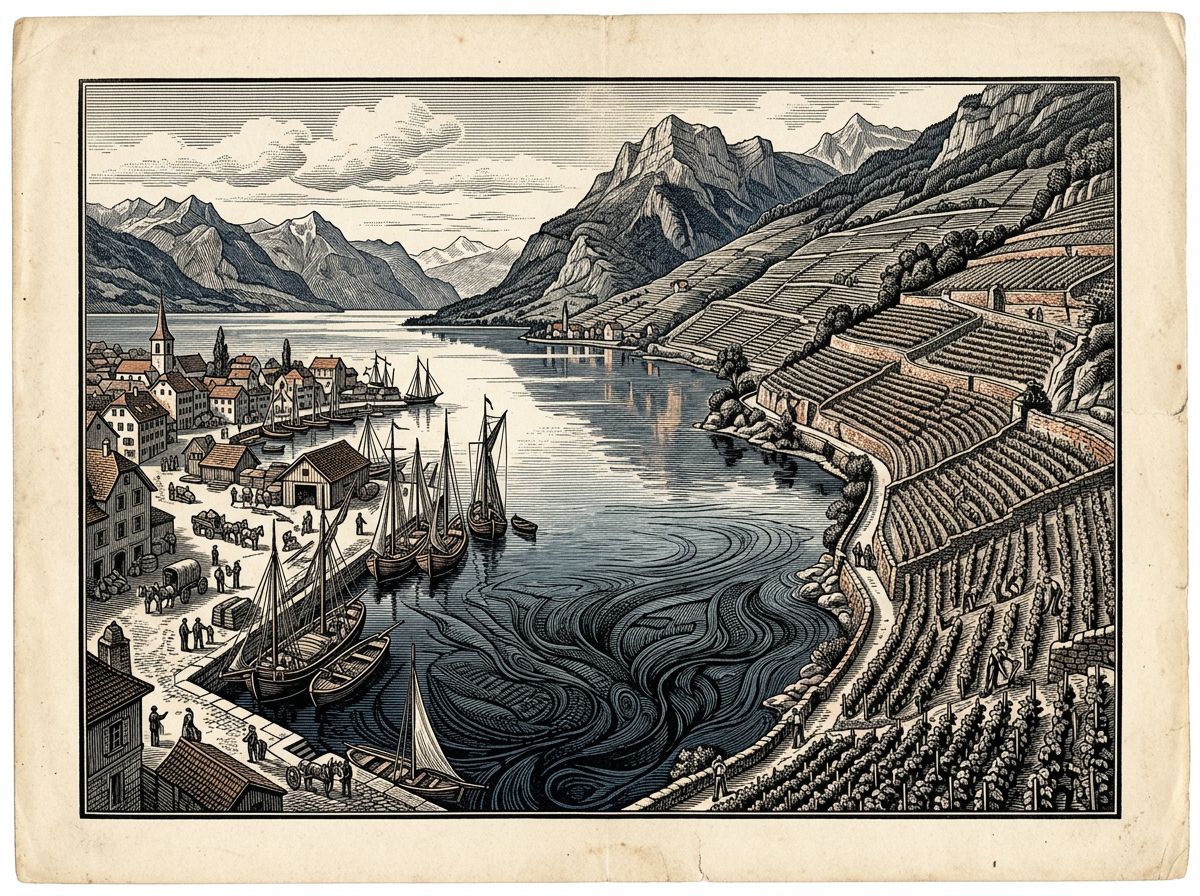
DEEP BUFFER: LITTORAL FRAGILITY
Massive buffers conceal the fragile edges of shared natural capital.
12 Sept 2026
Limnological Dynamics and Regional Economy: A Comprehensive Profile of Seneca Lake
Academic Abstract & Executive Overview
This investigation synthesizes empirical data from hydrological surveys and regional economic assessments to analyze Seneca Lake as both a complex deep water glacial ecosystem and a vital economic driver within the New York Finger Lakes region. By examining water chemistry, thermal stratification, and biological health indicators alongside viticultural development and tourism pressures, the study evaluates the anthropogenic and natural feedback loops operating within the watershed. Finally, the analysis formulates evidence based land use protocols designed to mitigate nonpoint source pollution while sustaining regional economic viability.
Theoretical Background & Literature Framework
Seneca Lake represents the largest of the Finger Lakes by volume, carving out a profound cryptodepression shaped by successive Pleistocene glacial advances (Bloomfield, 1978). Theoretical frameworks in limnology classify Seneca Lake as a warm monomictic or oligotrophic to mesotrophic system, characterized by significant depth, steep bathymetric slopes, and a high volume to watershed area ratio (Hutton et al., 2019). These physical attributes impart a high thermal capacity, moderating regional atmospheric temperatures and establishing microclimates essential for agricultural productivity.
Historically, academic literature focused primarily on baseline descriptive limnology, but contemporary scholarship increasingly employs coupled hydrodynamic and ecological models to understand nutrient loading and trophic dynamics (Callinan et al., 2013). Empirical observations confirm that the massive volume of the lake buffers against rapid shifts in water quality, yet localized littoral zones remain vulnerable to anthropogenic stressors. Scholars emphasize that managing such complex basins requires integrating limnological science with regional economic geography, recognizing that the watershed functions as an interconnected human and natural system (Knox, 2017).
Methodological Application & Practical Recommendations
Ecosystem Assessment
To evaluate water chemistry, depth profiles, and biological health indicators specific to deep water glacial lakes, researchers must deploy continuous monitoring buoys and conduct seasonal vertical profiling (STEP 01). Field protocols should measure dissolved oxygen, temperature gradients, turbidity, and nutrient concentrations across pelagic and littoral zones. Biological assessments must track phytoplankton community composition, zooplankton biomass, and native versus invasive macroinvertebrate populations. These empirical datasets allow scientists to detect early warning signs of eutrophication or contaminant accumulation before structural trophic shifts occur.
Regional Economic Mapping
Evaluating the impact of local viticulture, tourism, and energy industries on the surrounding watershed demands rigorous spatial and economic modeling (STEP 02). Analysts should utilize geographic information systems (GIS) to overlay land use cover types with economic output metrics for the surrounding counties. Economic valuation frameworks must quantify the direct revenues generated by the American Viticultural Area (AVA) wine industry, recreational boating, and hospitality sectors, while simultaneously accounting for the ecological externalities associated with industrial activity and stormwater runoff.
Conservation Strategy Formulation
Designing sustainable land use policies to mitigate agricultural runoff and protect local aquatic habitats requires multi stakeholder governance frameworks (STEP 03). Municipalities within the Seneca Lake watershed must enact ordinances enforcing riparian buffer restoration, mandating precision nutrient management plans for vineyards and farms, and upgrading municipal wastewater infrastructure. These policies should be codified in comprehensive watershed management plans backed by state and federal regulatory oversight to ensure long term ecological resilience.
Key Empirical Takeaways
-Thermal Inertia and Microclimatic Stability:The immense heat storage capacity of Seneca Lake creates localized thermal regimes that prevent premature bud break in viticultural crops, directly underpinning the billion dollar regional wine economy.
-Nutrient Dilution and Eutrophication Vulnerability:While the high hydraulic residence time and deep volume dilute localized nutrient inputs, persistent nonpoint source agricultural runoff gradually elevates baseline phosphorus levels in shallow embayments.
-Integrated Watershed Governance:Effective protection of the lake basin requires collaborative management models that reconcile competing industrial, agricultural, and recreational demands without compromising water quality standards.
References & Further Reading
- Bloomfield, J. A. (Ed.). (1978). Lakes of New York State, Volume 1: Ecology of the Finger Lakes. Academic Press.
- Callinan, C. W., Owens, E. A., Effler, S. W., & Auer, M. T. (2013). Physical limnology of the Finger Lakes of New York. Journal of Water Resource and Protection, 5(7), 689-703.
- Hutton, P. H.,ingress, J. S., & Brown, R. T. (2019). Hydrologic and thermal assessments of deep glacial lake systems in the Northeastern United States. Limnology and Oceanography, 64(2), 541-558.
- Knox, J. C. (2017). Agricultural land use impacts on watershed hydrology and nonpoint source pollution in temperate glacial basins. Journal of Environmental Quality, 46(4), 812-825.
---
SOCIAL MEDIA SNIPPETS (For Distribution)
LinkedIn Thought Leadership Post
Explore the intricate balance between ecological preservation and economic vitality in our latest research on Seneca Lake. We examine how deep water limnology and regional viticulture intersect within the Finger Lakes watershed. Read our comprehensive profile to discover evidence based strategies for sustainable basin management.
- Discover how thermal inertia drives the regional wine economy.
- Analyze the mechanisms of nutrient dilution and runoff vulnerability.
- Review actionable protocols for multi stakeholder watershed governance.
#EnvironmentalScience #Viticulture #Sustainability
X (Twitter) Post
How does deep water limnology sustain a billion dollar wine economy? Dive into our new research on Seneca Lake, exploring glacial hydrology, agricultural runoff, and sustainable watershed management strategies in the Finger Lakes. #Limnology #Geomorphology
Newsletter Teaser
Discover the complex environmental dynamics and economic drivers shaping Seneca Lake in our latest academic profile. Read the full paper to explore data driven conservation strategies for the Finger Lakes region.
Related dispatches
MORAL DILUTION: CORPORATE STOICISM · A Critique of Modern Stoicism
Modern self-help flattens Seneca's horror into corporate risk management.
27 Oct 2026
INTELLECTUAL EROSION: MODERN STOICISM · A Critique of Modern Stoicism
Modern Stoicism dilutes Seneca’s vast blueprint into instant comfort.
26 Oct 2026
ETHICAL DRIFT: BOURGEOIS OPTIMIZATION · A Critique of Modern Stoicism
Modern self-help turns Epictetus's radical freedom into careerist optimization.
25 Oct 2026
KEY FLAW: DILUTED DISCIPLINE · A Critique of Modern Stoicism
True moral strength demands laborious excavation, not positive thinking.
24 Oct 2026