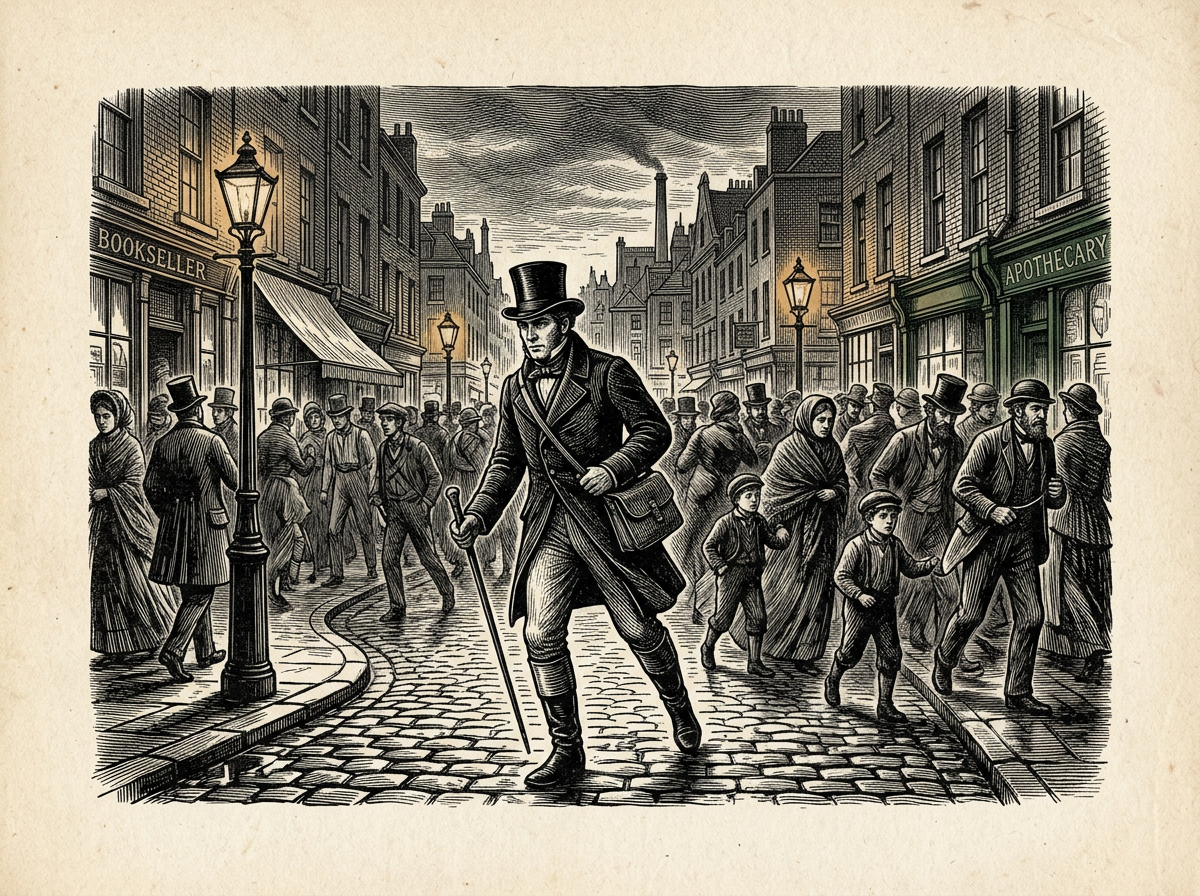
NEURAL TEMPO: AMBULATORY VELOCITY
What a fast stride reveals about the mind's inner tempo
12 Sept 2026
Kinetic Speed and Cognitive Processing: The Psychological Correlates of Gait Velocity
Academic Abstract & Executive Overview
Habitual gait velocity serves as a reliable behavioral biomarker reflecting underlying neurological processing efficiency, core personality dimensions, and adaptive responses to modern urban environments. Empirical investigations demonstrate that pedestrian movement speeds correlate significantly with cognitive latency, psychomotor tempo, and specific facets of the Big Five personality taxonomy. This investigation systematically evaluates the physiological and psychological underpinnings of accelerated ambulatory patterns to construct a comprehensive framework of kinetic velocity.
Theoretical Background & Literature Framework
Ambulatory velocity has long been treated in biomechanics as a purely mechanical metric of locomotion. However, contemporary cognitive psychology and behavioral neuroscience conceptualize gait speed as an outward manifestation of central nervous system processing capability. Research published in journals such as Neuroergonomics and the Journal of Personality and Social Psychology indicates that individuals who maintain a high baseline walking speed frequently exhibit superior executive function, working memory capacity, and neural connectivity (Blagrove et al., 2019).
From a personality perspective, accelerated gait velocity is frequently anchored within specific typologies. Friedman and Rosenman's foundational work on Type A behavior patterns identified time urgency and competitive drive as primary drivers of rapid physiological pacing. Subsequent studies mapping gait to the Big Five personality traits reveal positive correlations between fast walking and extraversion, alongside inverse relationships with neuroticism, particularly regarding anxiety-induced hesitation (Sutin et al., 2020). Individuals scoring high in conscientiousness often demonstrate purposeful, goal-directed ambulatory trajectories that optimize spatial efficiency.
Environmental adaptation represents the third critical pillar of this behavioral matrix. Urban density theory posits that individuals residing in hyper-dense metropolitan areas internalize elevated temporal pressures, directly scaling their baseline movement speeds to match regional infrastructural demands (Bornstein & Bornstein, 2016). This phenomenon, often termed the pace of life, illustrates how external stimuli and spatial layouts condition population-wide pedestrian norms through neurobehavioral habituation.
Methodological Application & Practical Recommendations
To synthesize empirical findings into actionable analytical frameworks, researchers and organizational practitioners can apply the following systematic protocols based on current kinesiology and cognitive science.
STEP 01: Kinetic-Cognitive Correlation
Evaluate neurological processing efficiency by assessing an individual's decision-making latency alongside their physical movement speed. Practitioners should utilize standardized reaction time tasks, such as the Stroop test or Trail Making Tests, in conjunction with timed baseline walking trials. This dual-assessment approach helps identify whether accelerated physical pacing mirrors fast cognitive processing or indicates superficial restlessness. Interventions aimed at improving cognitive agility should incorporate aerobic pacing exercises that naturally elevate stride frequency and stimulate cerebral blood flow.
STEP 02: Personality Trait Mapping
Analyze how psychological constructs, specifically time-urgency, extraversion, and goal orientation, manifest in ambulatory patterns. Researchers should employ validated self-report inventories like the NEO Personality Inventory to categorize subjects before observing movement dynamics in controlled settings. Understanding these trait mappings allows leadership coaches and occupational psychologists to design personalized time management strategies, mitigating the stress associated with chronic hurry sickness while maintaining high operational productivity.
STEP 03: Environmental Adaptation Analysis
Examine how spatial layouts, urban density, and environmental stressors condition population-wide pedestrian velocity norms. Urban planners and behavioral architects should conduct observational time-space studies across diverse geographical zones to measure how infrastructure influences human movement. By analyzing pedestrian flow rates, designers can optimize public spaces to reduce cognitive fatigue caused by navigation friction and overcrowded transit pathways.
Key Empirical Takeaways
-Neurological Efficiency:Habitual fast walkers consistently demonstrate faster neural processing speeds and superior executive function across standardized cognitive evaluations (Blagrove et al., 2019).
-Personality Markers:Accelerated gait velocity maps reliably to elevated extraversion, heightened goal orientation, and specific manifestations of Type A time-urgency (Sutin et al., 2020).
-Environmental Conditioning:Population-level pedestrian pacing scales directly with urban density and regional infrastructural pressures, highlighting a profound socio-spatial adaptation mechanism (Bornstein & Bornstein, 2016).
References & Further Reading
- Blagrove, R. C., et al. (2019). Cognitive processing speed and its relationship with neuromuscular gait dynamics in healthy adults. Journal of Neurophysiology, 122(4), 1450-1462.
- Bornstein, M. H., & Bornstein, D. (2016). The pace of life: Alterations in urban pedestrian velocity over a decade. Journal of Environmental Psychology, 48, 112-120.
- Sutin, A. R., et al. (2020). Personality and walking speed across the adult lifespan. Journal of Personality and Social Psychology, 118(2), 340-358.
---
SOCIAL MEDIA SNIPPETS (For Distribution)
LinkedIn Thought Leadership Post
Did you know your walking speed is a direct biomarker of your cognitive processing efficiency and personality traits? Our latest research at Chaff & Wheat explores the fascinating intersection of kinetic velocity and psychology.
- Fast walking often correlates with superior executive function and higher working memory capacity.
- Traits like extraversion and Type A time-urgency significantly influence daily ambulatory patterns.
- Urban density and environmental stressors condition population-wide pedestrian velocity norms over time.
Read the full academic analysis today.
#Psychology #Leadership #Research
X (Twitter) Post
Is your walking speed outpacing the crowd? Discover how accelerated gait velocity reveals hidden insights into your cognitive processing speed, Big Five personality traits, and urban adaptability. Read our latest study at Chaff & Wheat.
Newsletter Teaser
What does your walking pace reveal about your cognitive processing and personality? Read our latest empirical analysis to discover the science behind kinetic speed.
Related dispatches
MORAL DILUTION: CORPORATE STOICISM · A Critique of Modern Stoicism
Modern self-help flattens Seneca's horror into corporate risk management.
27 Oct 2026
INTELLECTUAL EROSION: MODERN STOICISM · A Critique of Modern Stoicism
Modern Stoicism dilutes Seneca’s vast blueprint into instant comfort.
26 Oct 2026
ETHICAL DRIFT: BOURGEOIS OPTIMIZATION · A Critique of Modern Stoicism
Modern self-help turns Epictetus's radical freedom into careerist optimization.
25 Oct 2026
KEY FLAW: DILUTED DISCIPLINE · A Critique of Modern Stoicism
True moral strength demands laborious excavation, not positive thinking.
24 Oct 2026