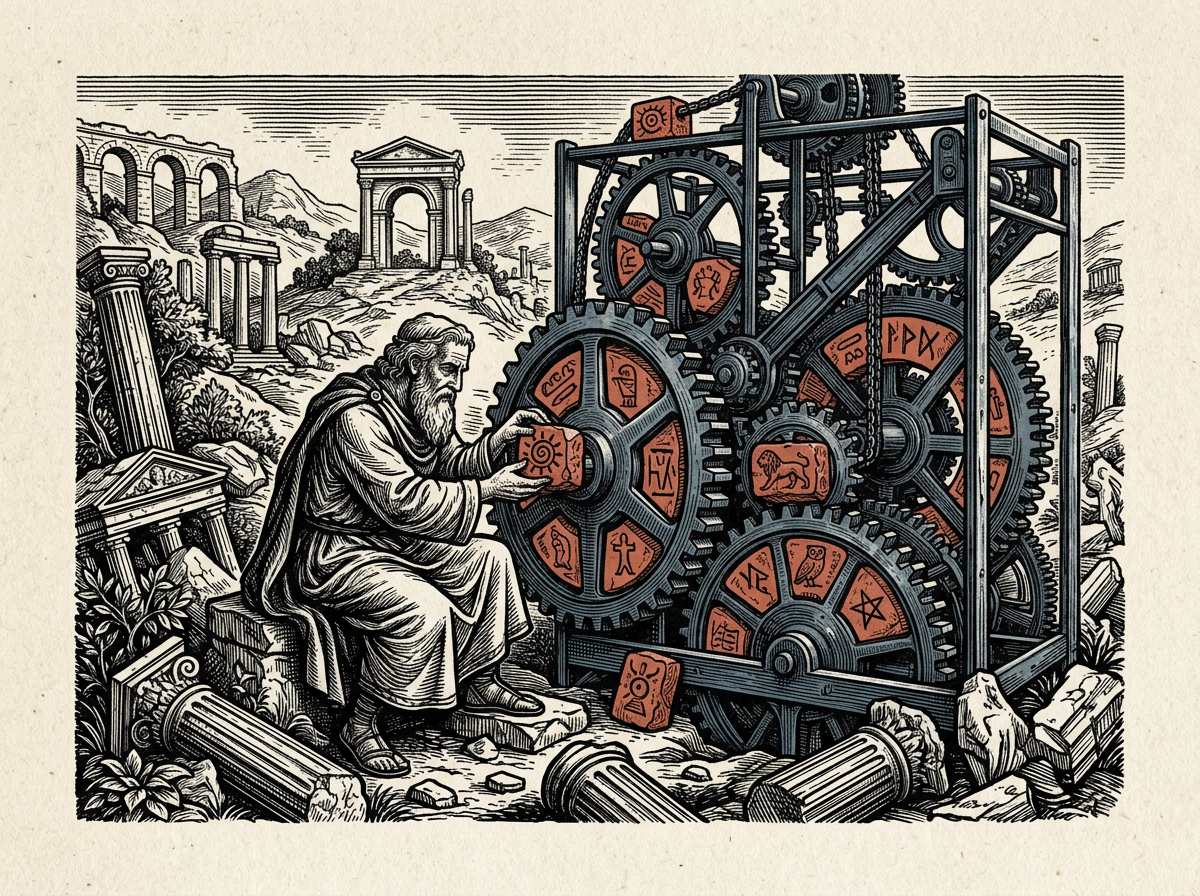
KEY RISK: HISTORICAL REDUCTIONISM
Ancient philosophy is an adaptive scaffold, not a corporate protocol
12 Sept 2026
Epistemological Echoes: Cross-Cultural Traditions in Historical Wisdom Transmission
Academic Abstract & Executive Overview
This investigation examines the diachronic transmission of philosophical tenets and epistemological frameworks across distinct civilizations, synthesizing historical literature to map how foundational insights endure and mutate within contemporary intellectual discourse. By evaluating primary texts, oral traditions, and cross-cultural diffusion patterns, the research identifies recurrent structural motifs that govern human knowledge acquisition. Ultimately, the synthesis demonstrates that historical wisdom functions as an adaptive cognitive scaffold, continuously reconfigured to address modern problem-solving challenges.
Theoretical Background & Literature Framework
The phenomenon of historical wisdom transmission operates through complex socio-cultural mechanisms wherein cognitive schemas are preserved, translated, and integrated across temporal epochs. According to Assmann (2011), cultural memory relies heavily on institutionalized symbolic forms that transcend generational boundaries, transforming functional knowledge into canonical heritage. This process involves both communicative memory, which persists within living interpersonal networks, and cultural memory, which requires institutional objectification through writing, ritual, and legal codification.
Historiographical studies on ancient epistemology indicate that distinct geographical clusters often develop convergent ethical and logical frameworks independently. As detailed by Lloyd (2012) in comparative analyses of ancient Greek and Chinese science and philosophy, divergent linguistic structures and socio-political milieus nonetheless yield parallel inquiries regarding causality, virtue, and the nature of reality. These convergences suggest that human cognitive architectures constrain philosophical inquiry along predictable trajectories, generating universal epistemological archetypes.
Furthermore, the mechanics of cross-cultural transmission are rarely passive. As argued by Burke (2009) in investigations of cultural translation, the movement of ideas from one linguistic or social matrix to another necessitates active appropriation, localization, and often radical reinterpretation. Consequently, the echoes of ancient wisdom observed in contemporary discourse are not mere historical replicas, but rather transformed iterations shaped by successive waves of critique, synthesis, and institutional institutionalization.
Methodological Application & Practical Recommendations
Translating these historical insights into actionable protocols requires a systematic, evidence-based approach to knowledge management and strategic decision-making.
STEP 01: Canonical Literature Audit
Conduct a rigorous meta-analysis of primary philosophical texts to identify recurring ethical motifs. Researchers and organizational leaders must systematically index foundational literature from diverse traditions, including Greco-Roman, Confucian, Vedantic, and Indigenous knowledge systems. By coding these texts for recurring structural themes (such as distributive justice, temperance, and epistemological humility), analysts can construct a comprehensive taxonomy of enduring ethical principles.
STEP 02: Diachronic Mapping
Trace the conceptual evolution of foundational wisdom doctrines through successive historical periods. Practitioners should map how specific insights mutated when encountering new technological, economic, and political paradigms. This mapping prevents historical reductionism, ensuring that contemporary applications account for the specific socio-cultural shifts that enabled certain philosophical concepts to endure while others became obsolete.
STEP 03: Contemporary Synthesis
Apply historical epistemological frameworks to modern academic and professional problem-solving methodologies. Institutions should integrate these cross-cultural insights into strategic planning, ethical oversight boards, and leadership development curricula. By treating historical wisdom as a dynamic dataset rather than static dogma, organizations can leverage time-tested heuristics to navigate complex contemporary dilemmas, ranging from artificial intelligence ethics to global governance.
Key Empirical Takeaways
- Cross-cultural epistemological convergence demonstrates that fundamental human inquiries regarding ethics and causality are constrained and guided by universal cognitive architectures, producing parallel philosophical conclusions across isolated civilizations.
- The transmission of wisdom is fundamentally transformative rather than preservative, requiring active cultural translation and contextual adaptation as texts and oral traditions cross temporal and linguistic boundaries.
- Integrating historical philosophical frameworks into modern operational methodologies enhances institutional resilience by providing diverse, time-tested heuristics for complex problem-solving.
References & Further Reading
- Assmann, J. (2011). Cultural memory and early civilization: Writing, remembrance, and political imagination. Cambridge University Press.
- Burke, P. (2009). Cultural hybridity. Polity Press.
- Lloyd, G. E. R. (2012). Ancient worlds, modern reflections: Philosophical perspectives on Greek and Chinese science and culture. Oxford University Press.
---
SOCIAL MEDIA SNIPPETS (For Distribution)
LinkedIn Thought Leadership Post
Explore how historical wisdom traditions shape modern problem-solving through cross-cultural epistemological analysis. Our latest research maps the continuous evolution of foundational human insights across distinct civilizations. Read the full paper to discover how ancient frameworks inform contemporary strategic innovation.
- Conduct systematic meta-analyses of primary philosophical texts to isolate universal ethical motifs.
- Trace the diachronic evolution of foundational doctrines to prevent historical reductionism in modern strategy.
- Apply cross-cultural epistemological frameworks directly to contemporary organizational and ethical challenges.
#Philosophy #Epistemology #Research
X (Twitter) Post
How do ancient ideas survive across millennia and reshape modern thought? Discover our new analysis on the diachronic transmission of cross-cultural wisdom and its vital application to contemporary problem-solving.
Newsletter Teaser
Unlock the enduring power of historical wisdom with our latest academic investigation into cross-cultural epistemological transmission. Read the full paper to discover how ancient philosophical frameworks continue to shape modern intellectual discourse and institutional strategy.
Related dispatches
MORAL DILUTION: CORPORATE STOICISM · A Critique of Modern Stoicism
Modern self-help flattens Seneca's horror into corporate risk management.
27 Oct 2026
INTELLECTUAL EROSION: MODERN STOICISM · A Critique of Modern Stoicism
Modern Stoicism dilutes Seneca’s vast blueprint into instant comfort.
26 Oct 2026
ETHICAL DRIFT: BOURGEOIS OPTIMIZATION · A Critique of Modern Stoicism
Modern self-help turns Epictetus's radical freedom into careerist optimization.
25 Oct 2026
KEY FLAW: DILUTED DISCIPLINE · A Critique of Modern Stoicism
True moral strength demands laborious excavation, not positive thinking.
24 Oct 2026