CORE DISTORTION: WEALTH HEDGING
How pop-Stoicism turned radical asceticism into a cozy financial hedge
12 Sept 2026
11th September: What Would Less Look Like? | The Commodification of Voluntary Poverty
The Text in Question
The Daily Stoic Rendering:
“Let us get used to dining out without the crowds, to being a slave to fewer slaves, to getting clothes only for their real purpose, and to living in more modest quarters.” - Seneca, On Tranquility of Mind, 9.3b
Standard Academic Translation:
“Let us learn to increase our self-restraint, to curb luxury, to moderate ambition, to soften anger, to regard poverty with good humor, and to cultivate frugality, even if we are ashamed to use the cheaper remedies for our desires to keep our natural needs within narrow bounds, and to entrust the rest to fortune.” - Seneca, Dialogues (On Tranquility of Mind, 9.3)
1.5 Academic Context & Breakdown
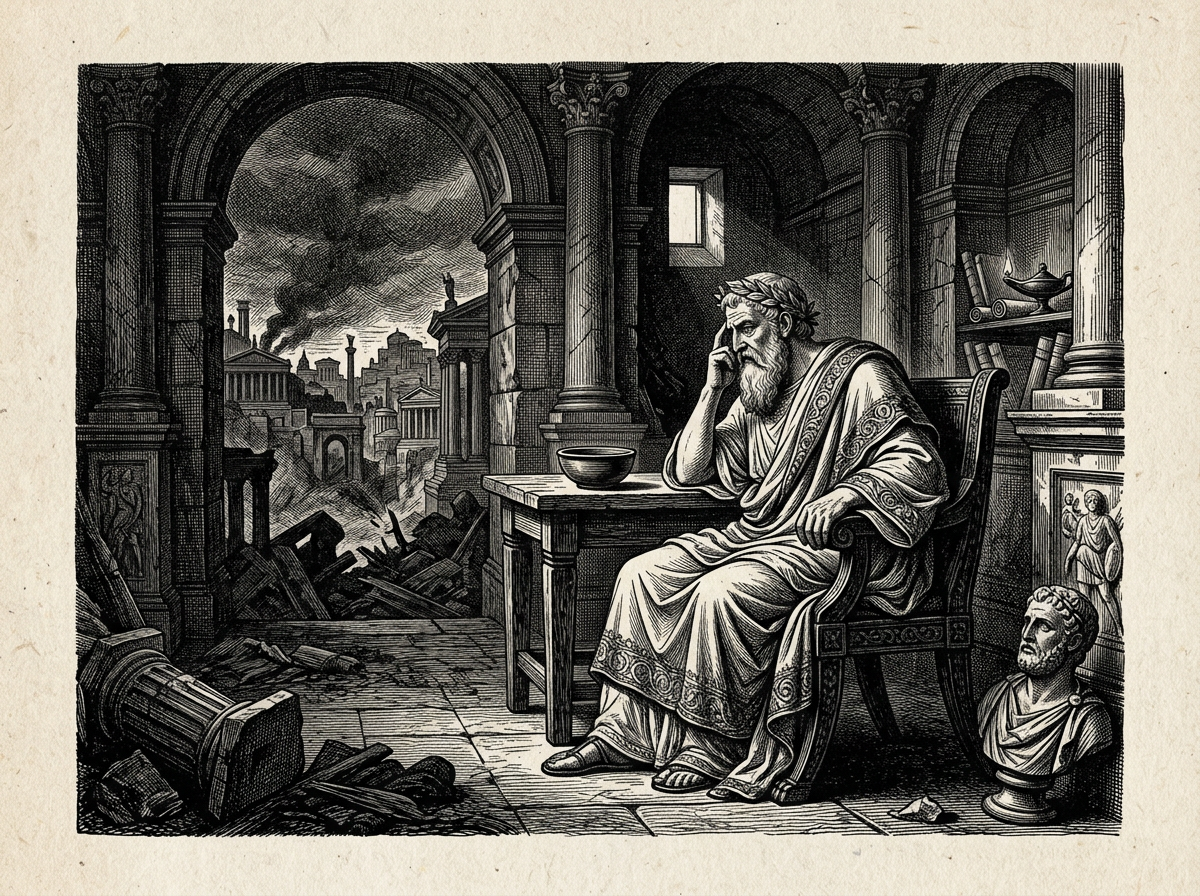
Seneca wrote these words in Rome around 62 AD, addressing his friend Serenus, a man drowning in political anxiety and material restlessness. Imperial Rome was a pressure cooker of lethal politics, unchecked decadence, and sudden executions. Seneca himself sat in a room of marble while Emperor Nero’s paranoia steadily tightened around his neck, aware that his vast fortune could be seized at a tyrant’s whim.
The standard translation reveals Seneca's true target: spiritual discipline, moral restraint, and total detachment from external fortune. He is not offering a life hack to optimize lifestyle comfort. He demands an internal surrender of ambition, anger, and material pride to safeguard the soul against catastrophic ruin.
- The Opening Counter-Punch
The Daily Stoic guts Seneca’s rigorous moral medicine and sells it back to affluent readers as a sanitized exercise in personal financial planning. It weaponizes historical tragedies like Stefan Zweig's exile to hawk a shallow, self-serving strategy for "living within your means." This isn't Stoic ascetism; it is upper-middle-class anxiety management disguised as ancient wisdom.
- The Breakdown
- Distortion of Ascetic Practice into Financial Hedging — The commentary advises that "living within your means now" is the primary way to guard against the swings of fate. Seneca calls for radical moral restraint and embracing poverty with good humor, but the commentary shifts the goalpost to basic wealth management. This rewrites a profound spiritual detachment from physical possessions into a mere budgeting strategy for fearful consumers.
- Co-opting Catastrophe to Soften Inconvenience — The text invokes Stefan Zweig losing his life to fascism alongside "couples [who] have their money stolen by financial crooks" to justify its advice. Equating the horrors of totalitarian exile with temporary financial loss is a gross authentic failure that trivializes genuine suffering. It turns monumental human tragedy into a cheap fear-tactic to convince readers to practice soft, suburban frugality.
- Sanitizing Moral Duty into Ego Protection — The commentary claims we practice having less "so that if we are ever forced to have less, it would not be so bad." Seneca demands that we curb ambition and master our desire to eliminate ego entirely, regardless of whether fortune strikes. The Daily Stoic flips this on its head, treating voluntary poverty as a vaccine against "emotional vertigo" to keep the fragile modern ego safe and comfortable.
- The Lesson & Application
The academic text teaches that true freedom requires limiting our desires to nature's bare essentials rather than catering to artificial social standards. We practice this not by paring down luxury for an aesthetic trial, but by actively cutting off toxic ambition, taming anger, and willingly embracing lower social status without shame.
- How the Philosopher Would Respond
Seneca would utterly reject this domestic insurance policy disguised as philosophy. He did not advocate for cozy budgeting tricks to soften the blow of bad luck, but for an uncompromising, daily death to material attachment.
“If you would not have a man flinch when the crisis comes, train him before it comes... Set aside a certain number of days, during which you shall be content with the scantiest and cheapest fare, with coarse and rough dress, saying to yourself the while: 'Is this the condition that I feared?'” - Seneca, Letters from a Stoic (Letter XVIII)
Related dispatches
MORAL DILUTION: CORPORATE STOICISM · A Critique of Modern Stoicism
Modern self-help flattens Seneca's horror into corporate risk management.
27 Oct 2026
INTELLECTUAL EROSION: MODERN STOICISM · A Critique of Modern Stoicism
Modern Stoicism dilutes Seneca’s vast blueprint into instant comfort.
26 Oct 2026
ETHICAL DRIFT: BOURGEOIS OPTIMIZATION · A Critique of Modern Stoicism
Modern self-help turns Epictetus's radical freedom into careerist optimization.
25 Oct 2026
KEY FLAW: DILUTED DISCIPLINE · A Critique of Modern Stoicism
True moral strength demands laborious excavation, not positive thinking.
24 Oct 2026