PRIVATE PRACTICE: INNER GOVERNANCE
Stoicism works best when treated as private duty, not performance
09 Sept 2026
What is Marcus Aurelius' "Meditations" and How to Apply Its Lessons?
Quick Summary: What You Need to Know
Marcus Aurelius’ Meditations is a deeply personal collection of private journals written by the Roman Emperor during military campaigns in the second century AD. Serving as one of the foundational texts of late Stoic philosophy, it provides timeless wisdom on maintaining inner peace, emotional self-reliance, and radical acceptance in the face of overwhelming chaos. Today, its pages offer a practical roadmap for navigating modern stress by teaching us to focus entirely on duty, virtue, and what is within our direct control.
---
Background & Essential Facts
To truly understand the power of Meditations, you have to look at who wrote it and why. Marcus Aurelius Antoninus ruled the Roman Empire from 161 to 180 AD. He is often remembered as the last of the "Five Good Emperors" and is the closest history has ever come to Plato’s ideal of the philosopher-king.
Yet, despite holding absolute political and military power, Marcus’s life was far from easy. His reign was defined by relentless crises: the devastating Antonine Plague that decimated the population, economic turmoil, betrayals by close friends and generals, and continuous, bloody warfare on the freezing Danubian frontier. Day after day, he bore the immense burden of leading a superpower on the brink of collapse.
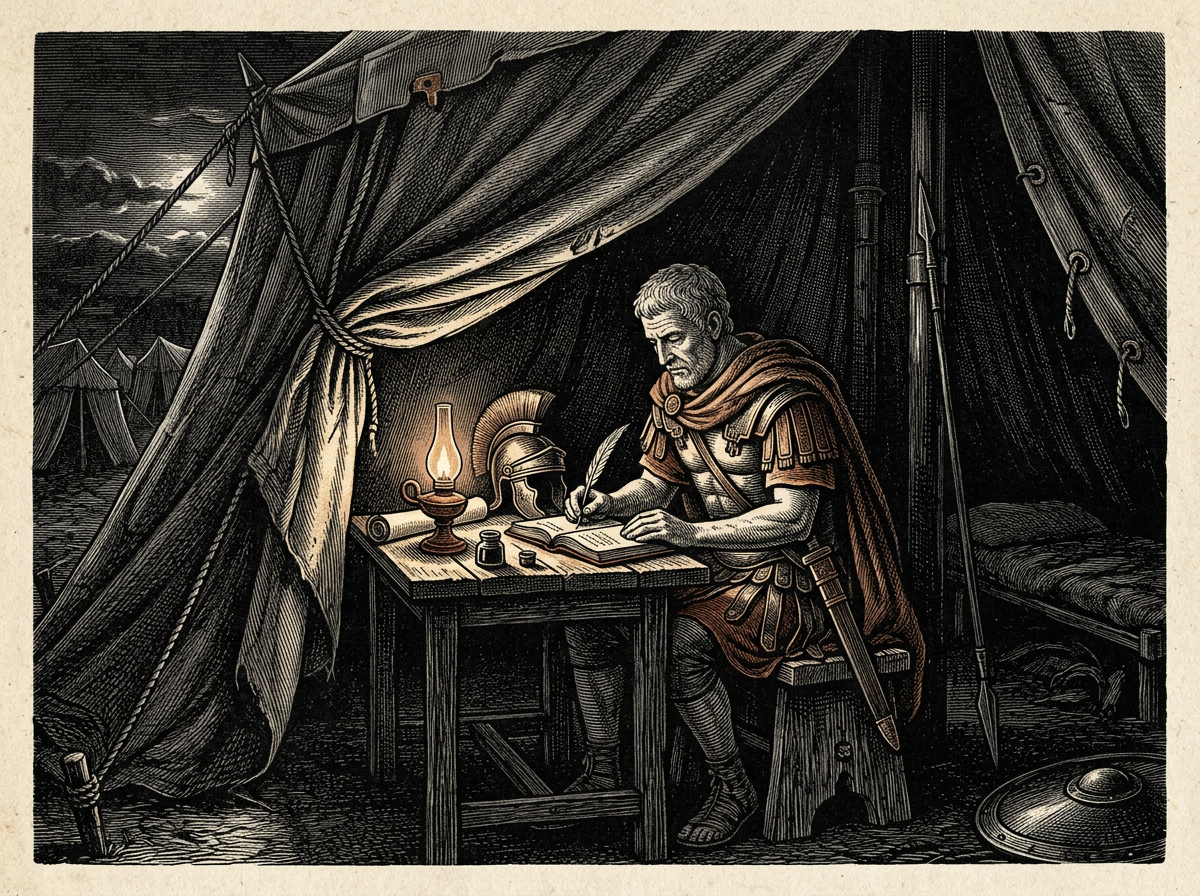
How did he cope? He didn't write his thoughts down to publish a bestseller or lecture the Roman public. Instead, Meditations (originally titled To Himself) was a private spiritual diary. Written by candlelight in military tents late at night, these pages were his personal therapy. They were reminders to himself—mental armor forged to keep him patient, humble, just, and resilient when everything around him was falling apart.
At its core, the text is rooted in Stoicism, a philosophy founded in Athens by Zeno of Citium centuries earlier. But unlike earlier Stoics who wrote grand treatises, Marcus applied the philosophy with raw, human vulnerability. He constantly scolded himself for losing his temper, reminded himself of his mortality, and questioned his own motives. He wrestled with the same anxieties we face today: the desire to stay in bed when work is hard, the frustration with difficult people, and the paralyzing fear of the future.
Because Marcus stripped away the ivory-tower abstraction of philosophy and ground it into daily survival, Meditations remains astonishingly relevant nearly two millennia later.
---
How To Take Action / What To Do
Reading Meditations as a passive piece of history is interesting, but treating it as a practical manual for modern life is transformative. Here is how you can take the ancient wisdom of the Roman Emperor and apply it to your daily routine right now.
STEP 01: Daily Journaling
Marcus Aurelius wrote to himself to clear his head, process his failures, and set his moral compass for the day ahead. You can follow his exact example by establishing a daily reflective journaling practice.
Set aside ten minutes either first thing in the morning or right before bed. Do not use this time for a simple to-do list; instead, interrogate your mind. If you lost your temper at work, write down why you reacted that way and how you can respond with virtue next time. Acknowledge your flaws without self-flagellation, remind yourself of your core values, and set clear intentions for the kind of person you want to be. By externalizing your thoughts on paper, you take the chaotic noise out of your head and subject it to rational inspection.
STEP 02: Practice the View from Above
When we are stressed, our problems feel massive. A rude email, a missed deadline, or a personal slight can consume our entire universe. Marcus combated this cognitive trap by practicing what modern psychologists call cognitive distancing, and what Stoics call "the View from Above."
When you feel overwhelmed by a challenge, consciously zoom out. Imagine your immediate surroundings, then your neighborhood, your city, your country, and finally, the entire planet spinning in the vast emptiness of space. Think of the billions of people who came before you and the billions who will come after. In the grand scale of the cosmos, your current stress is microscopic. This exercise doesn't trivialize your pain; rather, it strips away the panic, allowing you to view your troubles with calm perspective and proportion.
STEP 03: Focus on the Present
Much of our daily suffering comes from regretting the unchangeable past or catastrophizing the unpredictable future. Marcus Aurelius was a master at ruthlessly pulling his focus back to the only thing he could actually control: the present moment.
Whenever you feel anxiety creeping in, pause and ask yourself: What is within my control right now? You cannot control the economy, other people's opinions, or what will happen tomorrow. But you can control your thoughts, your immediate actions, and your moral integrity in this exact second. Drop the baggage of yesterday and the worries of tomorrow. Concentrate entirely on doing the task right in front of you with excellence and kindness. As Marcus famously noted, we are only ever stripped of the present moment, because that is all we possess.
---
Key Takeaways
- Born from Crisis: — Meditations was written as a private, unedited journal by Roman Emperor Marcus Aurelius to help himself survive relentless warfare, plague, and political betrayal.
- Practical Stoicism: — The text strips away academic philosophy, offering raw, actionable reminders on how to maintain emotional self-reliance, patience, and duty.
- Timeless Application: — You can apply the emperor's lessons today through daily self-reflection, zooming out to gain perspective ("the View from Above"), and ruthlessly focusing only on the present moment.
Related dispatches
MORAL DILUTION: CORPORATE STOICISM · A Critique of Modern Stoicism
Modern self-help flattens Seneca's horror into corporate risk management.
27 Oct 2026
INTELLECTUAL EROSION: MODERN STOICISM · A Critique of Modern Stoicism
Modern Stoicism dilutes Seneca’s vast blueprint into instant comfort.
26 Oct 2026
ETHICAL DRIFT: BOURGEOIS OPTIMIZATION · A Critique of Modern Stoicism
Modern self-help turns Epictetus's radical freedom into careerist optimization.
25 Oct 2026
KEY FLAW: DILUTED DISCIPLINE · A Critique of Modern Stoicism
True moral strength demands laborious excavation, not positive thinking.
24 Oct 2026