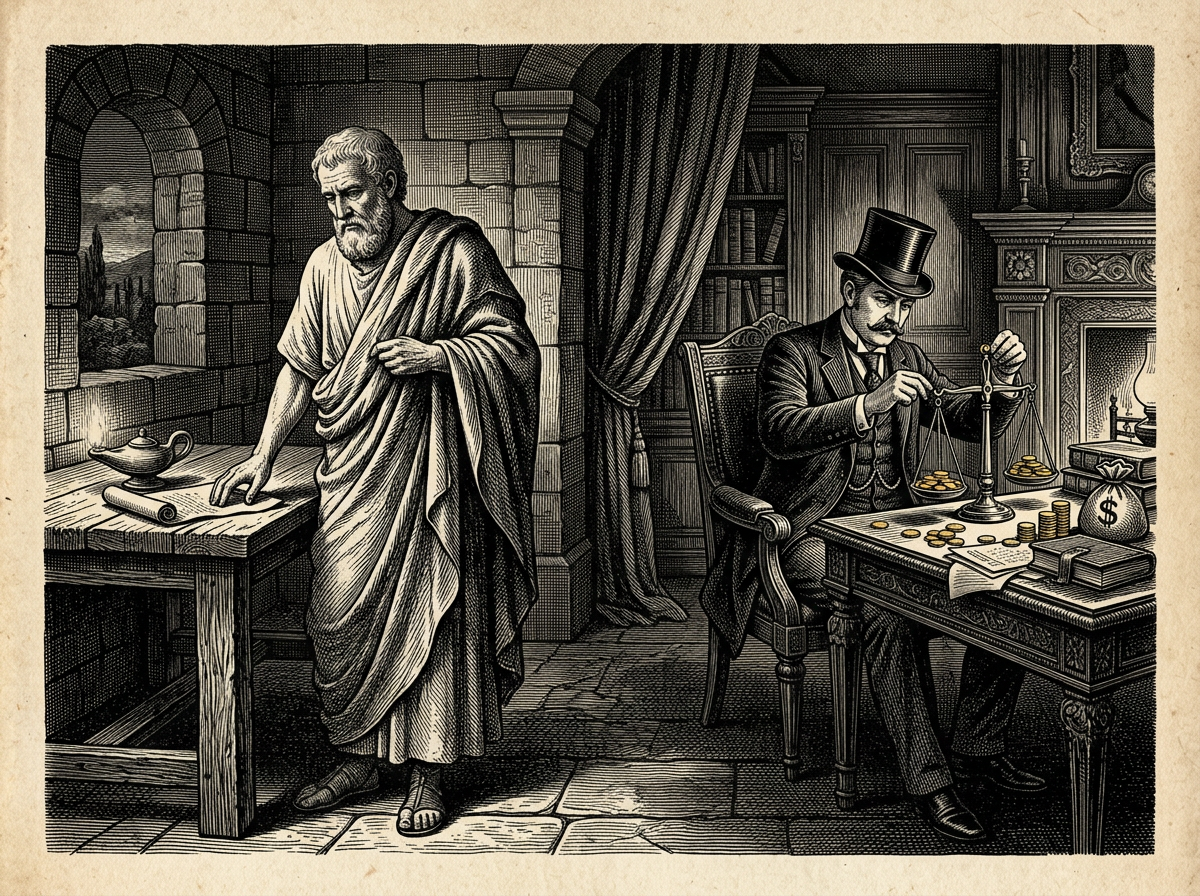
CORE DISTORTION: RETAILED CONTENTMENT
Wanting less is spiritual discipline, not a shortcut to feeling rich.
29 Aug 2026
29th August - Want Nothing = Have Everything
“No person has the power to have everything they want, but it is in their power not to want what they don’t have, and to cheerfully put to good use what they do have.”
SENECA, MORAL LETTERS, 123.3
The commentary:
Is there a person so rich that there is literally nothing they can’t afford? Surely there isn’t. Even the richest people regularly fail in their attempts to buy elections, to purchase respect, class, love, and any number of other things that are not for sale. If obscene wealth will never get you everything you want, is that the end of it? Or is there another way to solve for that equation? To the Stoics, there is: by changing what it is that you want. By changing how you think, you’ll manage to get it. John D. Rockefeller, who was as rich as they come, believed that
“a man’s wealth must be determined by the relation of his desires and expenditures to his income. If he feels rich on $10 and has everything he desires, he really is rich.”
Today, you could try to increase your wealth, or you could take a shortcut and just want less.
Chaff & Wheat Analyse:
The commentator takes Seneca’s radical call for complete detachment from material desires and lowers it to a cheap hack for personal feeling.
The Distortion of Truth
- The Trap — Seneca is making a fundamental claim about virtue and human freedom: freedom comes from eliminating unnatural desires entirely. The commentator turns this spiritual liberation into a simple mind trick to "feel rich."
- The Sordid Comparison — He quotes John D. Rockefeller a robber baron whose life was defined by endless accumulation to explain Stoic virtue. Equating a billionaire's math on "expenditures vs. income" with Seneca’s call for moral mastery is an insult to philosophy.
- The Coward’s Shift — Seneca tells you to cultivate genuine contentment with what you have. The commentator calls this a "shortcut" to getting what you want. He treats wanting less not as a moral goal, but as an easy life hack for people who can't get rich.
Ego Over Truth: Why the Commentator Distorts
This is not a misunderstanding of Seneca; it is a sales pitch. Real Stoicism requires painful self-discipline and stripping away the ego's demand for status and luxury. But telling readers to kill their material ambitions doesn't sell books to ambitious consumers.
The commentator reframes Stoicism as a clever mental shortcut. He assures the reader that they don't actually need to change their soul or challenge their values they just need to manipulate their expectations so they can feel as successful as a billionaire. By commodifying Seneca's wisdom into a tool for easy self-satisfaction, he makes himself the popular guru of painless "wisdom."
How Marcus Aurelius Would Respond
Marcus Aurelius would view this commentary as shallow, commercialized posturing.
“Wipe out the imagination; check the desire; extinguish appetite; keep the ruling faculty in its own power.”
- Meditations, 9.7
To Marcus, taming your desires is not a "shortcut" to make yourself feel wealthy or compare yourself to tycoons. It is a daily, uncompromising war against the body's impulses and the world's distractions. He would ruthlessly point out that using Seneca's words as a mental trick to pretend you are rich proves you are still completely enslaved by the idea of wealth.
Related dispatches
MORAL DILUTION: CORPORATE STOICISM · A Critique of Modern Stoicism
Modern self-help flattens Seneca's horror into corporate risk management.
27 Oct 2026
INTELLECTUAL EROSION: MODERN STOICISM · A Critique of Modern Stoicism
Modern Stoicism dilutes Seneca’s vast blueprint into instant comfort.
26 Oct 2026
ETHICAL DRIFT: BOURGEOIS OPTIMIZATION · A Critique of Modern Stoicism
Modern self-help turns Epictetus's radical freedom into careerist optimization.
25 Oct 2026
KEY FLAW: DILUTED DISCIPLINE · A Critique of Modern Stoicism
True moral strength demands laborious excavation, not positive thinking.
24 Oct 2026