MORAL DILUTION: WEALTH SANCTIFICATION
Comfortable Stoicism dilutes ancient moral discipline into simple self-justification.
28 Aug 2026
28th August - The Opulent Stoic
“The founder of the universe, who assigned to us the laws of life, provided that we should live well, but not in luxury. Everything needed for our well-being is right before us, whereas what luxury requires is gathered by many miseries and anxieties. Let us use this gift of nature and count it among the greatest things.”
SENECA, MORAL LETTERS, 119.15
The commentary:
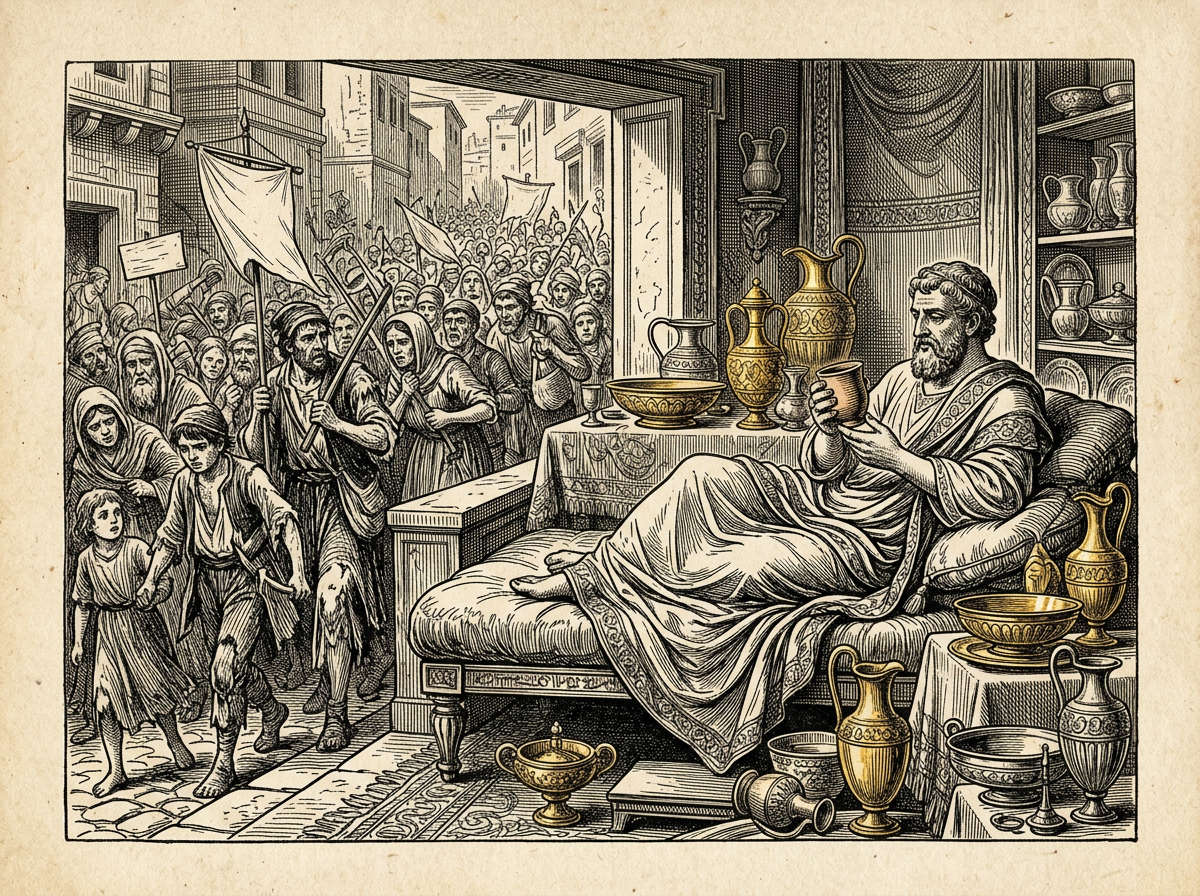
Even in his own time, Seneca was criticized for preaching Stoic virtues while accumulating one of the largest fortunes in Rome. Seneca was so rich that some historians speculate that major loans he made to the inhabitants of what is now Britain caused what became a horrifically brutal uprising there. His critics’ derisive nickname for him was “The Opulent Stoic.” Seneca’s response to this criticism is pretty simple: he might have wealth, but he didn’t need it. He wasn’t dependent on it or addicted to it. Nor, despite his large bank account, was he considered to be anything close to Rome’s most lavish spenders and pleasure hunters. Whether his rationalization was true or not (or whether he was a tad hypocritical), his is a decent prescription for navigating today’s materialistic and wealth-driven society. This is the pragmatic instead of the moralistic approach to wealth. We can still live well without becoming slaves to luxury. And we don’t need to make decisions that force us to continue to work and work and work and drift further from study and contemplation in order to get more money to pay for the things we don’t need. There is no rule that says financial success must mean that you live beyond your means. Remember: humans can be happy with very little.
Chaff & Wheat Analyse:
The commentator takes Seneca’s explicit condemnation of luxury and twists it into a convenient, middle-class justification for keeping your money while feeling morally superior.
The Distortion of Truth
- The Trap — Seneca is warning that luxury is a trap built on "miseries and anxieties," declaring that nature gives us everything we actually need. The commentator bypasses this moral clarity to defend Seneca’s massive, imperial fortune and by extension, the reader's financial comfort.
- The Dishonest Spin — He labels Seneca’s hypocrisy a "decent prescription" and calls it "the pragmatic instead of the moralistic approach to wealth." Stoicism is a moral philosophy. Stripping the morality out of Stoicism to call it "pragmatic" is just an excuse to avoid hard choices.
- The Lie — He reassures the reader: "He might have wealth, but he didn't need it." This is the ultimate self-delusion of the affluent. It allows anyone with a fat bank account to pretend they are a practicing Stoic simply by claiming in their mind, "I could give this up if I wanted to."
Ego Over Truth: Why the Commentator Distorts
This is pure commercial self-justification. True Stoicism demands that wealth be treated as a strict "indifferent" something to be discarded immediately if it corrupts character or demands injustice. But telling modern, comfortable readers that their greed and wealth accumulation might be morally rotten doesn't build a massive audience.
The commentator redefines Stoicism as "not spending beyond your means" and "not working too hard.
“He domesticates Seneca’s warning into a harmless personal finance tip. By absolving Seneca of his massive hypocrisy, the commentator absolves the reader and himself of theirs, creating a comfortable, guilt-free brand of”
Opulent Stoicism" for the modern world.
How Marcus Aurelius Would Respond
Marcus Aurelius would view this commentary with icy, unyielding disgust.
“Receive wealth without arrogance, and be ready to let it go without struggle.”
- Meditations, 8.33
To Marcus, wealth was not a game of psychological mental gymnastics where you get to hoard gold while whispering to yourself that you aren't "attached
“to it. He would ruthlessly point out that using philosophy to excuse your own opulence and comfort is the mark of a hypocrite. If your wealth comes from squeezing others or distracts you from virtue, calling it”
pragmatic" is just cowardice in fine clothing.
Related dispatches
MORAL DILUTION: CORPORATE STOICISM · A Critique of Modern Stoicism
Modern self-help flattens Seneca's horror into corporate risk management.
27 Oct 2026
INTELLECTUAL EROSION: MODERN STOICISM · A Critique of Modern Stoicism
Modern Stoicism dilutes Seneca’s vast blueprint into instant comfort.
26 Oct 2026
ETHICAL DRIFT: BOURGEOIS OPTIMIZATION · A Critique of Modern Stoicism
Modern self-help turns Epictetus's radical freedom into careerist optimization.
25 Oct 2026
KEY FLAW: DILUTED DISCIPLINE · A Critique of Modern Stoicism
True moral strength demands laborious excavation, not positive thinking.
24 Oct 2026