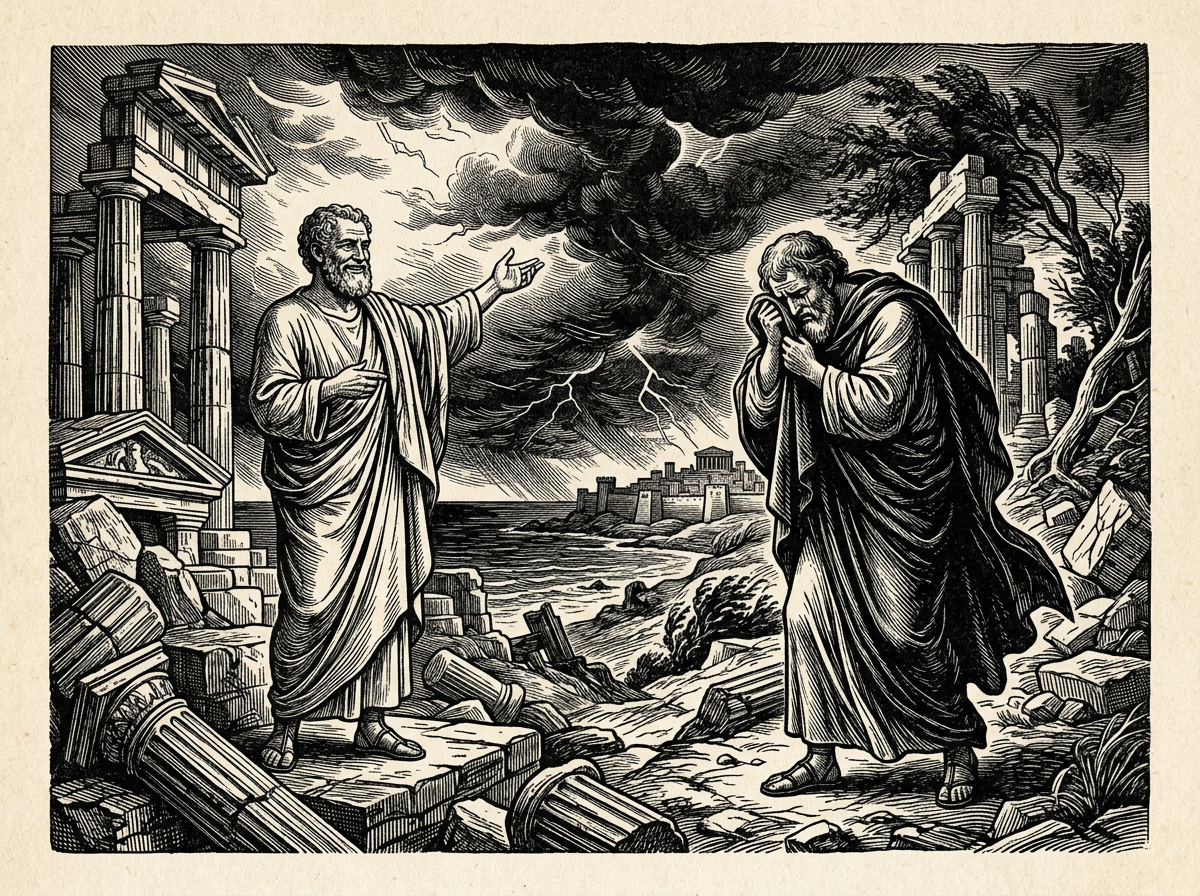
CORE DISTORTION: CHEAP OPTIMISM
When cheerful Stoicism flattens the true weight of human tragedy
27 Aug 2026
27th August - Laugh, Or Cry?
The commentary:
“Heraclitus would shed tears whenever he went out in public - Democritus laughed. One saw the whole as a parade of miseries, the other of follies. And so, we should take a lighter view of things and bear them with an easy spirit, for it is more human to laugh at life than to lament it.”
SENECA, ON TRANQUILITY OF MIND, 15.2
Chaff & Wheat Analyse:
Is this observation the origin of that famous expression about frustrating news: “I don’t know whether to laugh or cry?” The Stoics saw little purpose in getting angry or sad about things that are indifferent to our feelings. Especially when those feelings end up making us feel worse. It’s also another bit of evidence that the Stoics were hardly some depressing, bitter group of old men. Even when things were really bad, when the world made them want to weep in despair or rage, they chose to laugh about it. Like Democritus, we can make that same choice. There is more humor than hate to be found in just about every situation. And at least humor is productive making things less heavy, not more so.
reduces a profound choice between two philosophical attitudes toward human suffering into a superficial, feel-good prescription for toxic positivity and self-satisfaction.
The Distortion of Truth
- The Trap — Seneca is weighing two heavy cosmic perspectives on the human condition: Heraclitus’s deep empathy for human suffering versus Democritus’s sharp detachment from human foolishness. The commentator flattens this debate into a lighthearted coping mechanism.
- The Cheerful Lie — The commentator claims that choosing humor is "productive" because it "makes things less heavy." Seneca never says humor is meant to make you feel good or productive. Democritus did not laugh because he was having a good time or trying to be cheerful he laughed out of cold, merciless detachment from the absurdity of human vanity.
- The Coward’s Shift — Seneca warns against letting the mind be shattered by the tragedies of the world. The commentator twists this into an insecure defense mechanism: proving that Stoics weren't "depressing, bitter group of old men." He abandons moral depth just to defend the "brand" of Stoicism and make it look fun, light, and approachable.
Ego Over Truth: Why the Commentator Distorts
This isn't an innocent misunderstanding; it is brand management. Facing the sheer scale of human tragedy (Heraclitus's grief) or the utter absurdity of human ignorance (Democritus's laughter) requires a terrifying level of psychological honesty.
Because existential honesty makes readers uncomfortable, the commentator sells a cute, sanitized alternative: Just smile, choose humor, and don't take things too seriously! He flatters the reader’s desire to breeze through life without feeling real pain or doing hard moral work, packaging Stoicism as a cheerful life-hack to boost his own popularity.
How Marcus Aurelius Would Respond
Marcus Aurelius would view the commentary as foolish, shallow frivolity.
“When you are offended at any man's shameless conduct, immediately ask yourself: Is it possible then that shameless men should not be in the world? It is not possible.”
- Meditations, 9.42
To Marcus, the tragedy and folly of human beings are not subjects for lighthearted entertainment or superficial jokes. He would ruthlessly remind the commentator that whether you weep or laugh, both can be forms of self-indulgent weakness if they cause you to forget your serious duty to the human community. Laughing just to keep things "less heavy" is the response of a child who wants to avoid reality, not a Stoic who stands steadfast in the storm.
Related dispatches
MORAL DILUTION: CORPORATE STOICISM · A Critique of Modern Stoicism
Modern self-help flattens Seneca's horror into corporate risk management.
27 Oct 2026
INTELLECTUAL EROSION: MODERN STOICISM · A Critique of Modern Stoicism
Modern Stoicism dilutes Seneca’s vast blueprint into instant comfort.
26 Oct 2026
ETHICAL DRIFT: BOURGEOIS OPTIMIZATION · A Critique of Modern Stoicism
Modern self-help turns Epictetus's radical freedom into careerist optimization.
25 Oct 2026
KEY FLAW: DILUTED DISCIPLINE · A Critique of Modern Stoicism
True moral strength demands laborious excavation, not positive thinking.
24 Oct 2026