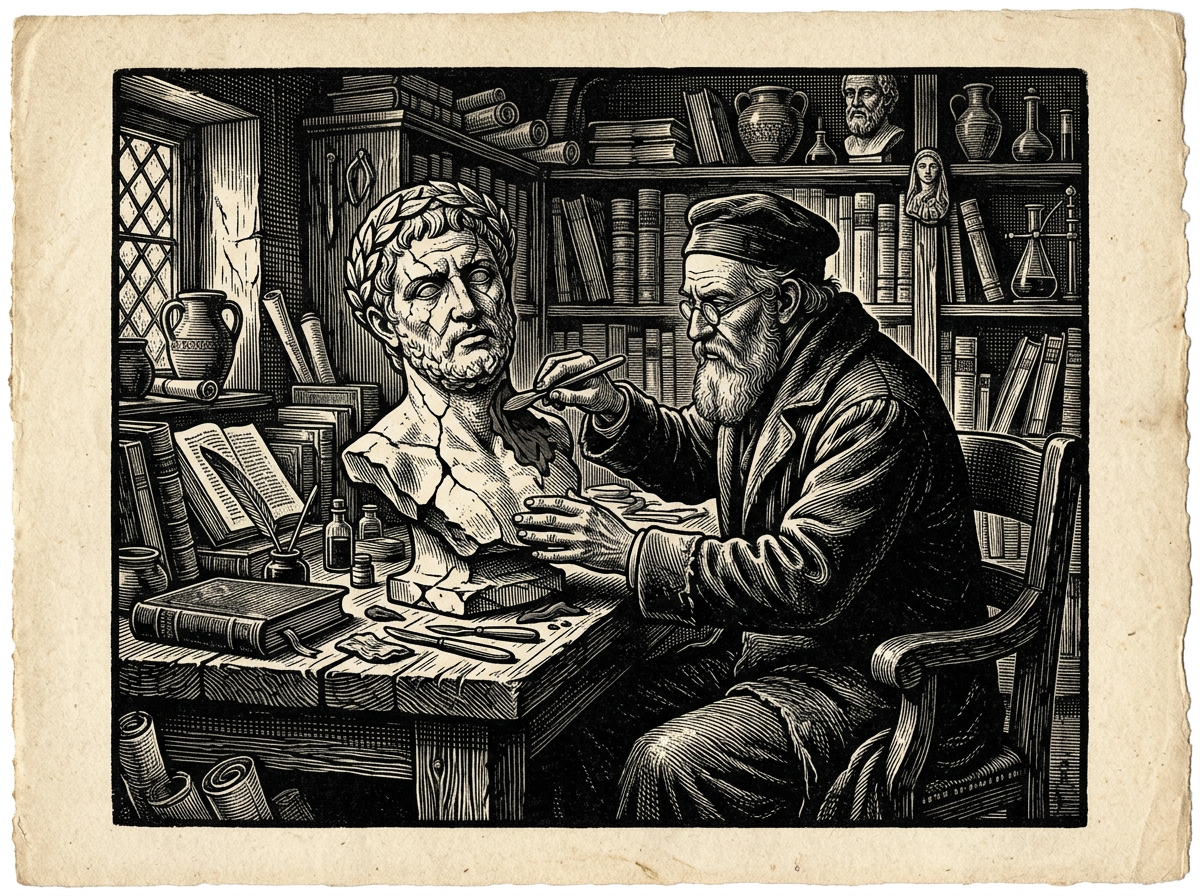
CENTRAL FAULT: CONVENIENT TRUTH
True philosophy demands lived virtue, not tailored self-help slogans
11 Aug 2026
12th August - Make The Words Your Own
“Many words have been spoken by Plato, Zeno, Chrysippus, Posidonius, and by a whole host of equally excellent Stoics. I’ll tell you how people can prove their words to be their own by putting into practice what they’ve been preaching.”
SENECA, MORAL LETTERS, 108.35;38
The commentary:
One of the criticisms of Stoicism by modern translators and teachers is the amount of repetition. Marcus Aurelius, for example, has been dismissed by academics as not being original because his writing resembles that of other, earlier Stoics. This criticism misses the point. Even before Marcus’s time, Seneca was well aware that there was a lot of borrowing and overlap among the philosophers. That’s because real philosophers weren’t concerned with authorship, only what worked. More important, they believed that what was said mattered less than what was done. And this is as true now as it was then. You’re welcome to take all of the words of the great philosophers and use them to your own liking (they’re dead; they don’t mind). Feel free to tweak and edit and improve as you like. Adapt them to the real conditions of the real world. The way to prove that you truly understand what you speak and write, that you truly are original, is to put them into practice. Speak them with your actions more than anything else.
Chaff & Wheat Analyse:
The Distortion: Stealing the Authority, Killing the Truth
commits a self-serving bait-and-switch: it takes Seneca’s call for moral accountability and turns it into a license for philosophical piracy.
- The Stolen Premise — Seneca demands that you prove you understand a principle by living it, not just repeating it.
- The Parasitic Twist — The commentary twists this into: "Feel free to tweak and edit and improve as you like... You’re welcome to take all of the words... and use them to your own liking."
Seneca was not telling readers to rewrite Stoicism to fit their personal comforts. He was telling them to align their lives with objective reality and virtue. The commentator redefines "practice" as
“permission to distort ancient ideas for your own convenience.”
It is the ultimate intellectual scam: take the timeless authority of Seneca, strip away his demanding standards, and hand the reader a custom-built, comfortable illusion.
Motivation: Ego, Pandering, and Pop-Wisdom
This is not just a lack of philosophical rigor; it is shameless self-promotion.
To study genuine philosophy requires discipline, humility, and submitting your ego to harsh truths. That doesn't build a massive social media following. To sell books to a lazy audience, the commentator must reassure them that they don't need to conform to Stoic principles—Stoic principles will conform to them.
By telling readers to "tweak and edit
“truth as they see fit, the commentator validates their intellectual laziness. He plays the benevolent guru, giving the reader cheap applause and permission to feel like a”
philosophical practitioner" without doing any of the actual, agonizing work of self-transformation.
Marcus Aurelius’s Judgment
Marcus Aurelius would view this commentary with total contempt. In Meditations, Marcus constantly reminds himself to abandon vanity, stop seeking approval, and stick to unvarnished truth:
"Waste no more time arguing about what a good man should be. Be one."
Marcus would judge the commentator as a sophist posing as a guide—a man who encourages people to play games with words so he can profit from their applause. To Marcus, taking sacred principles, stripping their bite, and encouraging people to mold truth around their own desires isn't "originality." It is pure, unfiltered corruption.
Related dispatches
MORAL DILUTION: CORPORATE STOICISM · A Critique of Modern Stoicism
Modern self-help flattens Seneca's horror into corporate risk management.
27 Oct 2026
INTELLECTUAL EROSION: MODERN STOICISM · A Critique of Modern Stoicism
Modern Stoicism dilutes Seneca’s vast blueprint into instant comfort.
26 Oct 2026
ETHICAL DRIFT: BOURGEOIS OPTIMIZATION · A Critique of Modern Stoicism
Modern self-help turns Epictetus's radical freedom into careerist optimization.
25 Oct 2026
KEY FLAW: DILUTED DISCIPLINE · A Critique of Modern Stoicism
True moral strength demands laborious excavation, not positive thinking.
24 Oct 2026