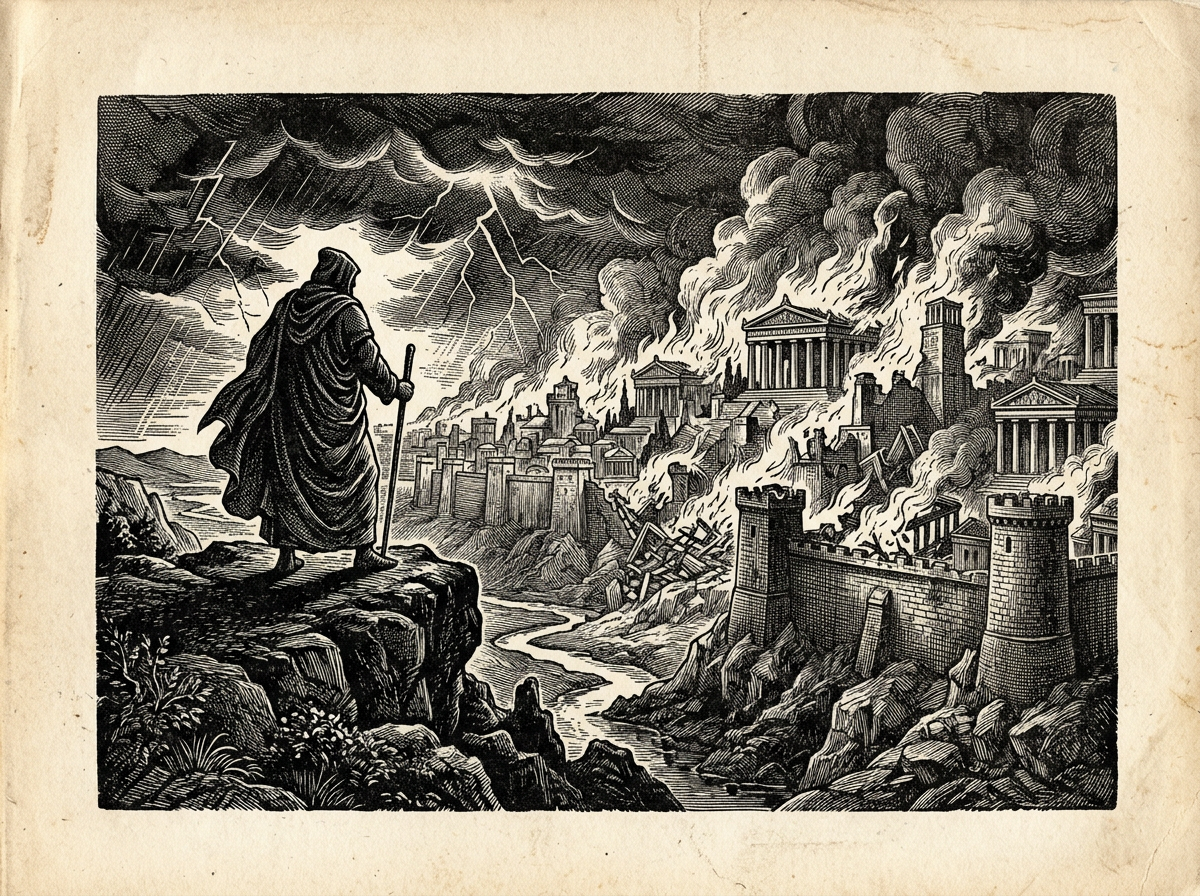
MAIN ERROR: DOMESTICATED FATE
Seneca’s severe confrontation with catastrophe is not a lesson in etiquette.
28 Sept 2026
24th September: It Could Happen To You | The Reduction of Cosmic Fate to a Trivial Karma Wheel
The Text in Question
The Daily Stoic Rendering:
“Being unexpected adds to the weight of a disaster, and being a surprise has never failed to increase a person’s pain. For that reason, nothing should ever be unexpected by us. Our minds should be sent out in advance to all things and we shouldn’t just consider the normal course of things, but what could actually happen. For is there anything in life that Fortune won’t knock off its high horse if it pleases her?” - Seneca, Moral Letters, 91.3a
4
Standard Academic Translation:
"It is the unexpected that presses hardest; novelty adds to the weight of calamities, and no mortal has ever failed to feel the grief heightened by surprise. Therefore, nothing ought to be unexpected by us. Our minds should be sent forward in advance to meet all problems, and we should consider, not merely what usually happens, but what may possibly happen. For what is there that Fortune does not drag down from its highest peak, whenever she pleases?" - Seneca, Moral Letters, 91.3a-4 (trans. Richard M. Gummere)
Academic Context & Breakdown
Seneca composed Letter 91 in 65 AD, writing from an environment suffocating under the paranoia of Nero’s reign. The prosperous colony of Lugdunum (modern Lyon) had been entirely consumed by a single night’s fire, wiping away immense wealth and security in hours. Seneca himself was an aging statesman whose immense fortune and very life hung by a thread under a tyrannical student known for sudden executions.
In Gummere's translation, Seneca presents the core Stoic practice of premeditatio malorum (the premeditation of evils). He does not offer a gentle exercise in empathy, but an aggressive mental deployment ("our minds should be sent forward in advance") into total existential vulnerability. Seneca insists that Fortune (Fortuna) wields absolute, unpredictable dominance over all external goods, capable of razing great cities and pulling down rulers in a moment.
The commentary neuters a terrifying meditation on cosmic instability into a superficial lecture on social etiquette and bad karma. It rewires Seneca’s urgent demand to face total ruin into a cozy reminder to be humble when donating to charity. By swapping out cosmic volatility for a predictable turn of events, the commentary turns Stoic preparation into comfortable self-soothing.
The Opening Counter-Punch
The commentary guts Seneca’s severe meditation on cosmic destruction and replaces it with a shallow reminder to stay humble. It takes a terrifying confrontation with total annihilation and degrades it into a domestic warning that bad luck might eventually hit you, too.
The Breakdown
- The commentary replaces Seneca's radical confrontation with cosmic chaos with a predictable karmic loop, asking "how often does that happen to us? We comfort a friend during a breakup, only to be surprised when our own relationship ends." Seneca was not analyzing domestic relationship drama or minor social ironies; he was confronting the total, sudden destruction of entire cities and lives by fate. By reducing absolute disaster to routine interpersonal setbacks, the commentary flattens a severe spiritual discipline into a mild life observation.
- The commentary distorts an internal preparation for total ruin into a transactional moral exercise, suggesting that "the next time you make a donation to charity, don’t just think about the good turn you’re doing, but take a moment to consider that one day you may need to receive charity yourself." Seneca never urged his reader to contemplate disaster merely to keep their civic pride or charitable ego in check. The commentary transforms an aggressive mental rehearsal for catastrophe into a cozy lesson on social humility.
- The commentary treats historical martyrdom as a theatrical flex of self-congratulation, boasting that Seneca "knew it could happen to him too, and so he was prepared for it." In Gummere’s translation, the focus is not on celebrating one's own foresight or political preparedness, but on submitting the human mind entirely to the absolute power of Fortune. The commentary swaps out Seneca's terrifying submission to cosmic law for a secular narrative of personal foresight and heroic composure.
The Lesson of the Text
The academic translation teaches that peace of mind comes from fearlessly anticipating the total loss of everything we hold dear before fate takes it away. We apply this by actively visualizing the complete destruction of our health, status, and possessions today, ensuring that when catastrophe strikes, surprise does not compound our grief.
How the Philosopher Would Respond
Seneca would flatly reject this attempt to turn the terrifying power of Fortune into a soft lesson on charitable giving. He did not write to help you manage minor social setbacks, but to force your mind to stand firm when the cosmos tears down your world.
"A single day, a single hour, renders equal the greatest and the least of things. The rise and fall of cities is swift; how small a part of time is needed to destroy what was built by long labor!" - Seneca, Moral Letters, 91.6
Related dispatches
MAIN ERROR: EGOIC REDUCTION · A Critique of Modern Stoicism
Modern self-help turns Epictetus’s humbling theology into a cheap life hack.
28 Sept 2026
CRITICAL FLAW: TRIVIALIZED TRAUMA · A Critique of Modern Stoicism
Modern Stoicism turns existential trauma into wealth management anxiety.
28 Sept 2026
LIFESTYLE TRAP: BOURGEOIS LEISURE · A Critique of Modern Stoicism
How modern self-help turned Seneca's warnings into resort etiquette.
28 Sept 2026
CHIEF DISTORTION: LIFESTYLE OPTIMIZATION · A Critique of Modern Stoicism
Cold showers cannot save you from self-imposed moral servitude
28 Sept 2026