CONCEPTUAL FLATTENING: HABIT LOOPS
The inner citadel requires conscious reason, not automated habits
28 Sept 2026
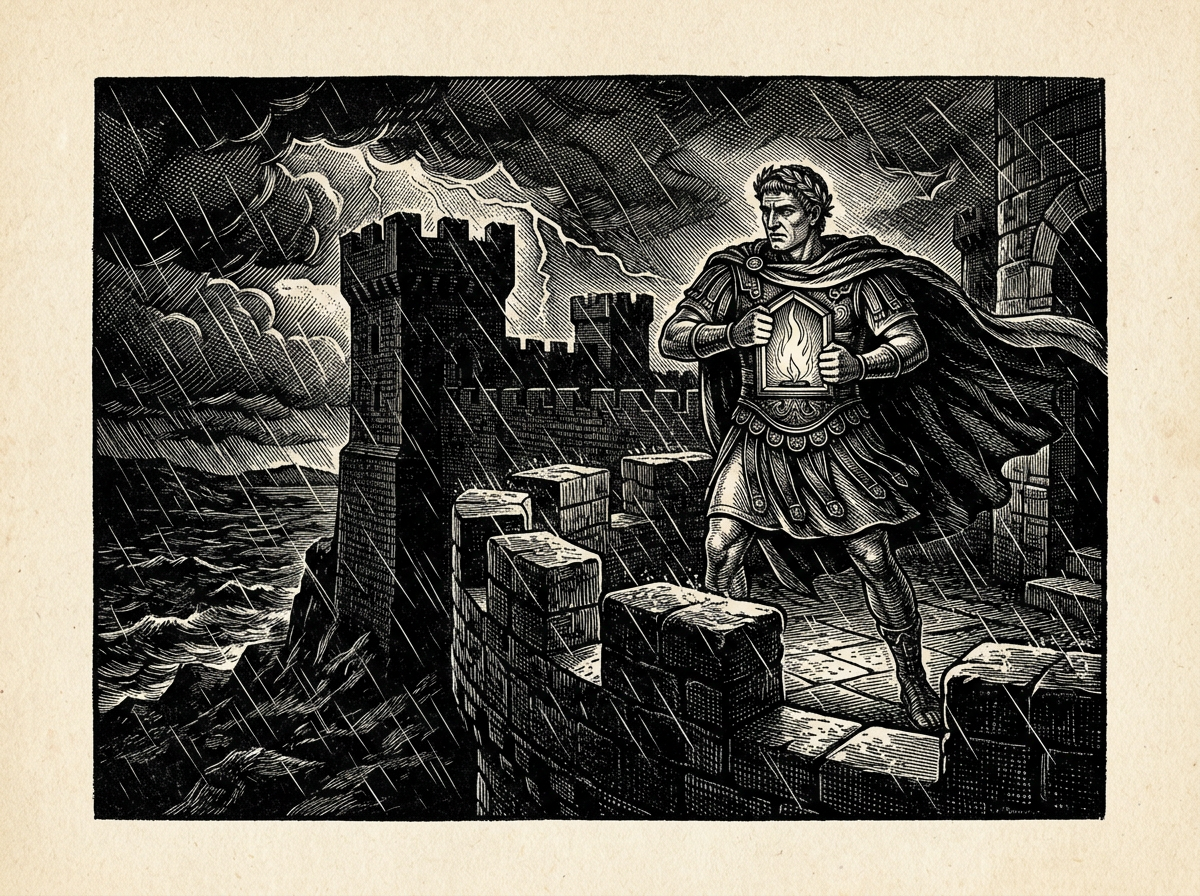
23rd September: The Most Secure Fortress | The Fallacy of Reducing the Sacred Inner Citadel to Unconscious Habit Formation
The Text in Question
The Daily Stoic Rendering:
“Remember that your ruling reason becomes unconquerable when it rallies and relies on itself, so that it won’t do anything contrary to its own will, even if its position is irrational. How much more unconquerable if its judgments are careful and made rationally? Therefore, the mind freed from passions is an impenetrable fortress a person has no more secure place of refuge for all time.” - Marcus Aurelius, Meditations, 8.48
Standard Academic Translation:
"Remember that the ruling center becomes invincible when it withdraws into itself and rests content with itself, doing nothing which it does not will to do, even if its position is unreasonable. How much more when it judges with reason and circumspection? Therefore the mind freed from passions is a citadel; for man has nothing more secure to which he can fly for refuge and for the future be inexpugnable." - Marcus Aurelius, Meditations, 8.48 (trans. A.S.L. Farquharson)
Academic Context & Breakdown
Marcus Aurelius penned Book 8 in a freezing military tent along the Danube front, weighed down by the plague consuming his empire and the constant threat of Germanic invasion. Surrounded by political intrigue and imminent death, he was not looking for a life-hack to build better morning routines. He was conducting emergency maintenance on his own soul, fighting to preserve his inner freedom against the crushing chaos of the Roman world.
In Farquharson's translation, Marcus describes the absolute autonomy of the "ruling center" (hegemonikon). When the rational mind detaches from irrational emotional impulses and anchors itself in clear judgment, it becomes a citadel an unassailable inner fortress that no external catastrophe can breach. This is not a mechanical behavioral reflex, but a state of hyper-conscious, rational self-sovereignty that renders the individual immune to destructive passions.
The commentary guts this profound defense of rational sovereignty and replaces it with a pop-psychology lecture on habit loops. It transforms an Emperor’s sacred inner sanctuary into a mindless muscle-memory exercise. By swapping out conscious moral judgment for unthinking repetition, the commentary turns Stoicism into a self-help manual for automated efficiency.
The Opening Counter-Punch
The commentary guts Marcus Aurelius’s high-minded defense of rational self-mastery and degrades it into a lesson on building unconscious habits. It takes a severe meditation on creating an impenetrable sanctuary of conscious reason and replaces it with a Bruce Lee quote about kicking drills.
The Breakdown
- The commentary replaces hyper-conscious rational judgment with unthinking automatic behavior, claiming that training allows us to "unconsciously go to that habit in trying times." Farquharson’s translation stresses that the citadel is built when the mind "judges with reason and circumspection." Marcus calls for absolute, vigilant consciousness, whereas the commentary distorts Stoic virtue into an automated, unthinking reflex.
- The commentary misinterprets Marcus’s point about the stubborn power of the will, asserting that "what he means is that proper training can change your default habits." Marcus was illustrating the raw, innate power of the mind showing that if the will can remain stubborn even when obstinate or unreasonable, its power is absolute when guided by reason. The commentary rewires an insight on metaphysical freedom into a basic self-help tip for behavioral modification.
- The commentary reduces the sacred sanctuary of the soul to a mundane productivity checklist, asking the reader to "think about which behaviors you’d like to be able to default to if you could." Marcus Aurelius was not offering a habit-tracker to help you stop gossiping or stay calm in traffic. He was describing the ultimate spiritual refuge (citadel) that protects human dignity from despair, tyranny, and death.
The Lesson of the Text
The academic translation teaches that true freedom and security come from a mind that actively releases destructive passions and relies entirely on its own rational judgment. We apply this by constantly retreating into our inner reason during moments of crisis, examining our impressions before reacting so that no external event can compromise our moral integrity.
How the Philosopher Would Respond
Marcus Aurelius would flatly reject the claim that spiritual fortress-building is merely a matter of mechanical habit. He did not fortify his soul so he could act like an unthinking automaton, but to keep his rational consciousness awake, free, and uncorrupted by the world.
"How easy it is to repel and wipe away every disturbing or unsuitable impression, and immediately to be in all tranquility." - Marcus Aurelius, Meditations, 5.2
Related dispatches
MAIN ERROR: EGOIC REDUCTION · A Critique of Modern Stoicism
Modern self-help turns Epictetus’s humbling theology into a cheap life hack.
28 Sept 2026
CRITICAL FLAW: TRIVIALIZED TRAUMA · A Critique of Modern Stoicism
Modern Stoicism turns existential trauma into wealth management anxiety.
28 Sept 2026
LIFESTYLE TRAP: BOURGEOIS LEISURE · A Critique of Modern Stoicism
How modern self-help turned Seneca's warnings into resort etiquette.
28 Sept 2026
CHIEF DISTORTION: LIFESTYLE OPTIMIZATION · A Critique of Modern Stoicism
Cold showers cannot save you from self-imposed moral servitude
28 Sept 2026