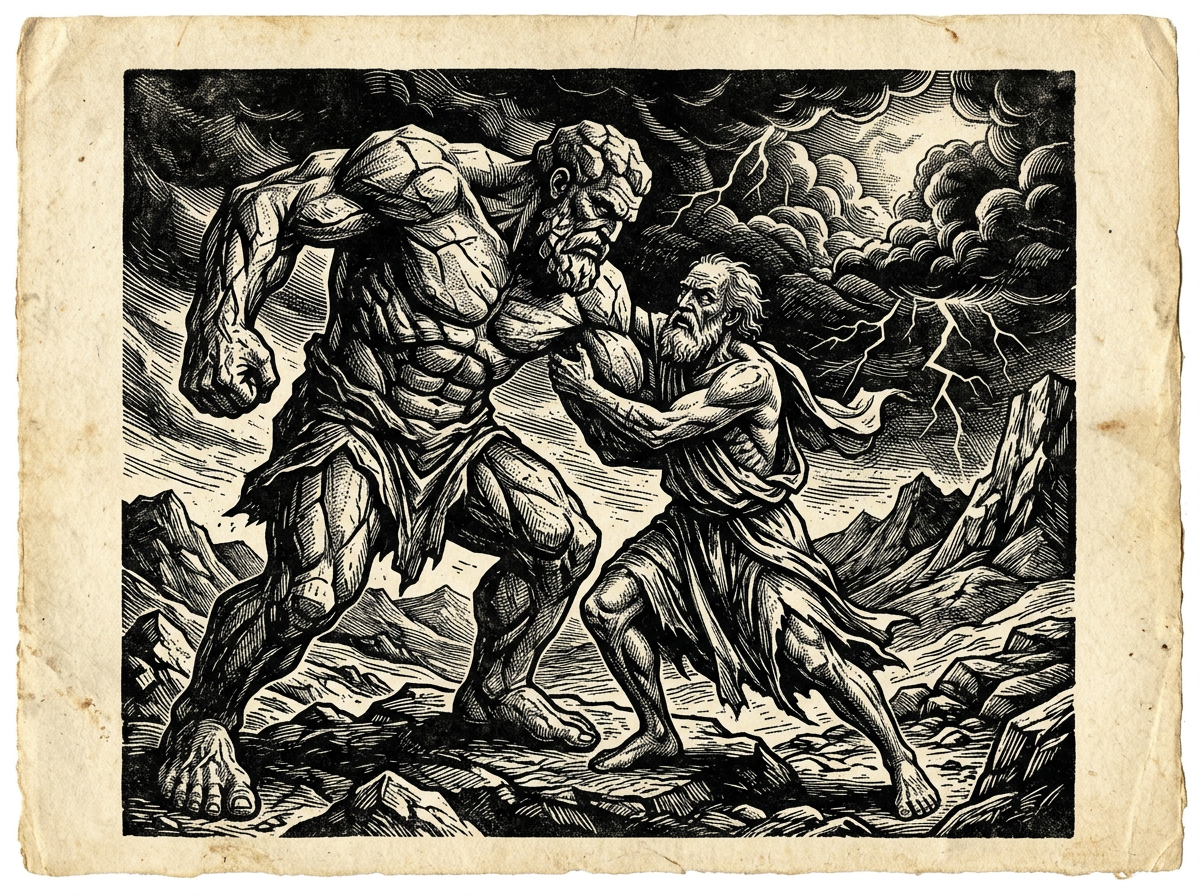
CORE ERROR: COMMODIFIED SUFFERING
Stoicism is a forge for the soul, not a hustle manifesto
28 Sept 2026
22nd September: No Pain, No Gain | The Reduction of Divine Crucible to Varsity Sports Meritocracy
The Text in Question
The Daily Stoic Rendering:
“Difficulties show a person’s character. So when a challenge confronts you, remember that God is matching you with a younger sparring partner, as would a physical trainer. Why? Becoming an Olympian takes sweat! I think no one has a better challenge than yours, if only you would use it like an athlete would that younger sparring partner.” - Epictetus, Discourses, 1.24.1-2
Standard Academic Translation:
"Difficulties are the things that show what men are. For the future, then, remember, when a difficulty befalls, that God, like a trainer of wrestlers, has matched you with a rough young man. 'For what purpose?' you say. Why, that you may become an Olympic victor; but that cannot be without sweat. No man, in my opinion, has a more profitable difficulty than you have, if only you will use it as an athlete uses his rough young sparring partner." - Epictetus, Discourses, 1.24.1-2 (trans. W.A. Oldfather)
Academic Context & Breakdown
Epictetus delivered this discourse in the provincial Greek city of Nicopolis, speaking to students facing exile, tyranny, and execution under Roman imperial rule. As a formerly enslaved man who had been tortured and permanently crippled by his master, Epictetus knew physical suffering intimately. He was not giving a motivational pep talk to young men trying to win local athletic trophies or advance their careers.
In Oldfather's translation, Epictetus frames human suffering through a theological lens of divine testing. God acts as the master trainer (gymnastēs), deliberately pairing the soul with a brutal, unyielding antagonist ("a rough young man") to forge moral strength. The "Olympic victor" is not someone who earns worldly acclaim or athletic prestige, but a human soul that endures tyranny, poverty, and bodily ruin without surrendering its moral integrity (prohairesis).
The commentary hijacks this cosmic test of spiritual survival and rewires it into a shallow locker-room speech. It flattens a terrifying divine ordeal into a lesson about athletic ambition and West Point military victory. By recasting existential suffering as a workout routine for personal success, the commentary degrades Stoic theology into a gym-bro hustle manifesto.
The Opening Counter-Punch
The commentary guts Epictetus’s theological defense of suffering and replaces it with a generic varsity athletic speech. It takes a severe lesson on maintaining moral integrity under imperial tyranny and degrades it into a motivational lecture on out-training your athletic rivals.
The Breakdown
- The commentary trivializes cosmic trials by treating them as optional athletic practice, claiming that "like us, they saw sports as both a fun pastime as well as a training ground." Epictetus was not discussing recreational hobbies or "fun pastimes"; he was preparing his students to face imprisonment, torture, and death without flinching. By recasting divine testing as a fun exercise, the commentary strips suffering of its weight and reduces Stoic discipline to an opt-in self-improvement program.
- The commentary smuggles military expansionism and worldly dominance into a spiritual exercise, quoting MacArthur's claim that sports yield "the fruits of victory." Epictetus explicitly taught that external outcomes victory, fame, status are completely indifferent (adiaphora) and utterly worthless for measuring moral character. The commentary distorts an internal fight for moral purity into a secular conquest for external dominance and glory.
- The commentary turns spiritual survival into a meritocratic flex for ambitious strivers, claiming that "the greats don’t avoid these tests... they are the pathway to it." Epictetus never framed hardship as a branding tool to prove you are one of "the greats" who outmatches rivals. In Oldfather’s translation, the goal is not to show off superior talent or attain status, but to endure the trial God assigned you without betraying your rational soul.
The Lesson of the Text
The academic translation teaches that hardships are intentionally designed by the cosmos to test and refine our moral character. We apply this by ceasing to view adversity as an unfair interruption to our lives, recognizing it instead as the exact weight required to strengthen our moral agency.
How the Philosopher Would Respond
Epictetus would sneer at the attempt to turn divine testing into a secular motivational speech for status-seekers. He did not teach to help you win athletic trophies or achieve worldly success, but to keep your soul unbent when fate throws you into the dust.
"God says to you: 'If I had been able, I would have made your little body and your little property free and unhampered; but as it is, do not forget that this body is not your own, but only clay cleverly kneaded.' ... Keep these thoughts at hand by day and by night; write them, read them, talk of them to yourself and to your neighbor." - Epictetus, Discourses, 1.1.10-12
Related dispatches
MAIN ERROR: EGOIC REDUCTION · A Critique of Modern Stoicism
Modern self-help turns Epictetus’s humbling theology into a cheap life hack.
28 Sept 2026
CRITICAL FLAW: TRIVIALIZED TRAUMA · A Critique of Modern Stoicism
Modern Stoicism turns existential trauma into wealth management anxiety.
28 Sept 2026
LIFESTYLE TRAP: BOURGEOIS LEISURE · A Critique of Modern Stoicism
How modern self-help turned Seneca's warnings into resort etiquette.
28 Sept 2026
CHIEF DISTORTION: LIFESTYLE OPTIMIZATION · A Critique of Modern Stoicism
Cold showers cannot save you from self-imposed moral servitude
28 Sept 2026