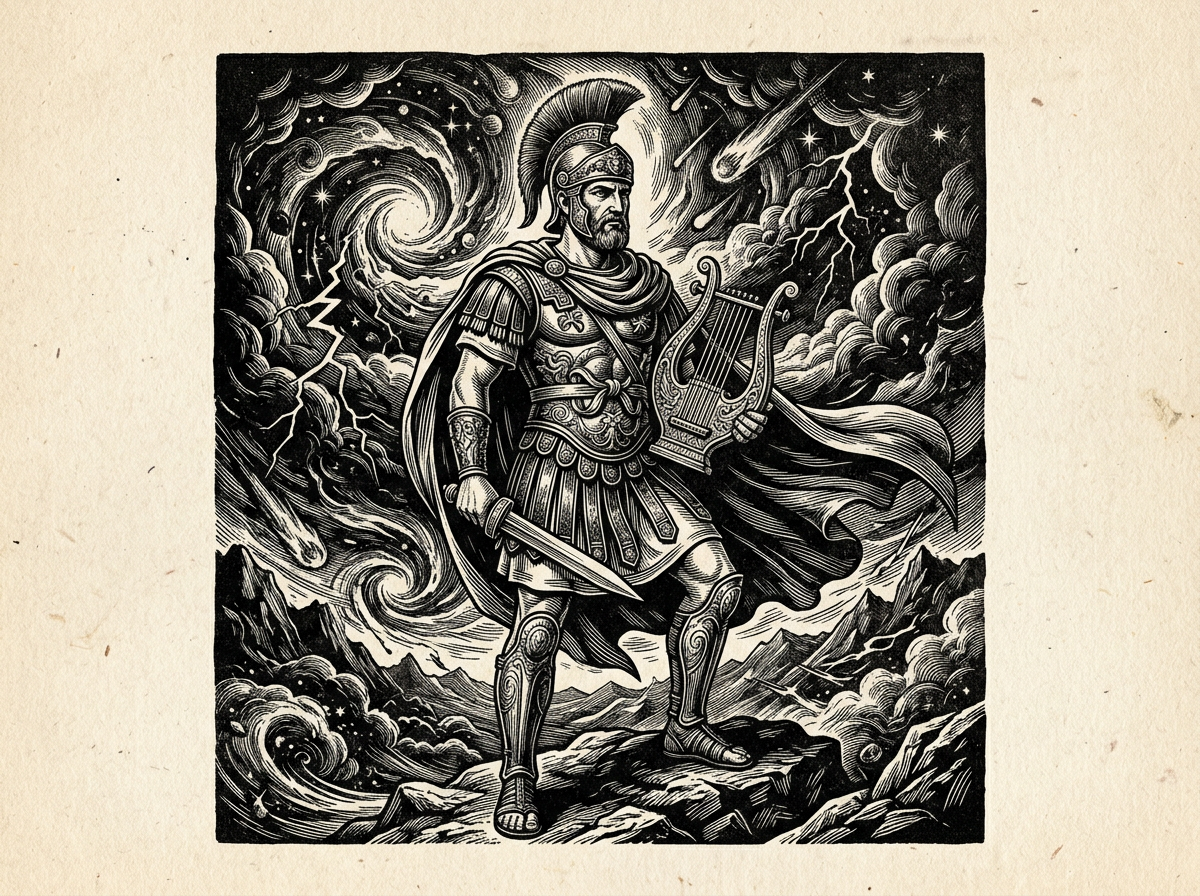
MORAL DILUTION: COSMIC HARMONY
Modern self-help shrinks imperial spiritual battles into basic inconvenience management.
21 Sept 2026
21st September: Maintain Composure, Maintain Control | The Domestication of Imperial Trauma into Minor Inconvenience Management
The Text in Question
The Daily Stoic Rendering:
“When forced, as it seems, by circumstances into utter confusion, get a hold of yourself quickly. Don’t be locked out of the rhythm any longer than necessary. You’ll be able to keep the beat if you are constantly returning to it.” - Marcus Aurelius, Meditations, 6.11
Standard Academic Translation:
"When thou art forced, as it seems, by circumstances to be disturbed, return to thyself quickly, and be not out of tune longer than thou must; for thou wilt have more mastery over the harmony by continual return to it." - Marcus Aurelius, Meditations, 6.11 (trans. A.S.L. Farquharson)
Academic Context & Breakdown
Marcus Aurelius recorded Book 6 during the grueling northern campaigns, struggling to maintain imperial order against devastating foreign invasions, widespread plague, and constant political betrayal. As the supreme ruler of Rome, he carried the crushing weight of an entire empire on his shoulders, forced to make life-and-death decisions under immense psychological strain. He was not writing a stress-management guide for modern commuters dealing with minor daily hiccups. He was desperately attempting to preserve his own rational center (hegemonikon) from being shattered by imperial trauma.
In Farquharson's translation, Marcus uses a musical metaphor "be not out of tune" and "mastery over the harmony" to describe spiritual alignment with the cosmic Logos. When external chaos violently knocks the ruler off balance, his supreme duty is not merely to relax, but to immediately realign his soul with nature's harmony. Disturbance is an inevitable condition of mortal life, but lingering in discord is a failure of self-mastery.
The commentary neuters this existential fight for spiritual sanity into a comfortable lecture on handling daily annoyances. It transforms Marcus’s urgent demand for cosmic harmony into a self-help routine for keeping your composure when your schedule gets disrupted. By replacing deep soul-realignment with trivial stress control, the commentary degrades Stoicism into a mild coping mechanism for modern convenience.
The Opening Counter-Punch
The commentary guts Marcus Aurelius’s profound meditation on cosmic harmony and replaces it with a trivial checklist for minor suburban annoyances. It takes an Emperor's battle to keep his soul aligned with the universe and degrades it into a cozy reassurance that it's okay if your car battery dies.
The Breakdown
- The commentary trivializes catastrophic spiritual disturbance by equating it to minor daily annoyances, claiming that confusion comes when "your car battery dies, your friend cancels at the last minute, you suddenly don’t feel well." In Farquharson's translation, Marcus is addressing the deep, internal disruption of the soul's harmony ("forced... to be disturbed"). By reframing cosmic discord as trivial schedule disruptions, the commentary lowers the bar of Stoic practice from spiritual alignment to basic emotional composure.
- The commentary replaces Marcus's rigorous call for spiritual re-attunement with a patronizing pat on the back, assuring the reader that "that’s perfectly OK! It happens." Marcus Aurelius never offered soft self-compassion or excused his own mental lapses; he issued a strict command to "return to thyself quickly." The commentary sanitizes the Stoic imperative for urgent self-correction, turning a severe discipline into comfortable self-soothing.
- The commentary distorts Marcus’s metaphor of cosmic harmony into a superficial directive to regain secular control, telling you to "get a hold of yourself and find your way back." In Farquharson's translation, the goal is not merely regaining composure to finish your daily tasks, but achieving "more mastery over the harmony" of the soul. The commentary shifts the ultimate end of Stoicism from alignment with divine order to mere personal convenience and task execution.
The Lesson of the Text
The academic translation teaches that external chaos will inevitably strike, but allowing your internal reason to remain in discord is a choice. We apply this by treating every mental disturbance not as a reason for panic or self-pity, but as an immediate cue to restore our moral harmony before proceeding.
How the Philosopher Would Respond
Marcus Aurelius would flatly reject this attempt to turn spiritual alignment into a manual for managing minor inconveniences. He did not record his private thoughts to help you navigate dead car batteries or cancelled plans, but to ensure your soul remained steadfast when the world crumbled around you.
"Constantly regard the universe as one living being, having one substance and one soul; and observe how all things have reference to one perception, the perception of this one living being; and how all things act with one movement; and how all things are the cooperating causes of all things which exist." - Marcus Aurelius, Meditations, 4.40
Related dispatches
MAIN ERROR: EGOIC REDUCTION · A Critique of Modern Stoicism
Modern self-help turns Epictetus’s humbling theology into a cheap life hack.
28 Sept 2026
CRITICAL FLAW: TRIVIALIZED TRAUMA · A Critique of Modern Stoicism
Modern Stoicism turns existential trauma into wealth management anxiety.
28 Sept 2026
LIFESTYLE TRAP: BOURGEOIS LEISURE · A Critique of Modern Stoicism
How modern self-help turned Seneca's warnings into resort etiquette.
28 Sept 2026
CHIEF DISTORTION: LIFESTYLE OPTIMIZATION · A Critique of Modern Stoicism
Cold showers cannot save you from self-imposed moral servitude
28 Sept 2026