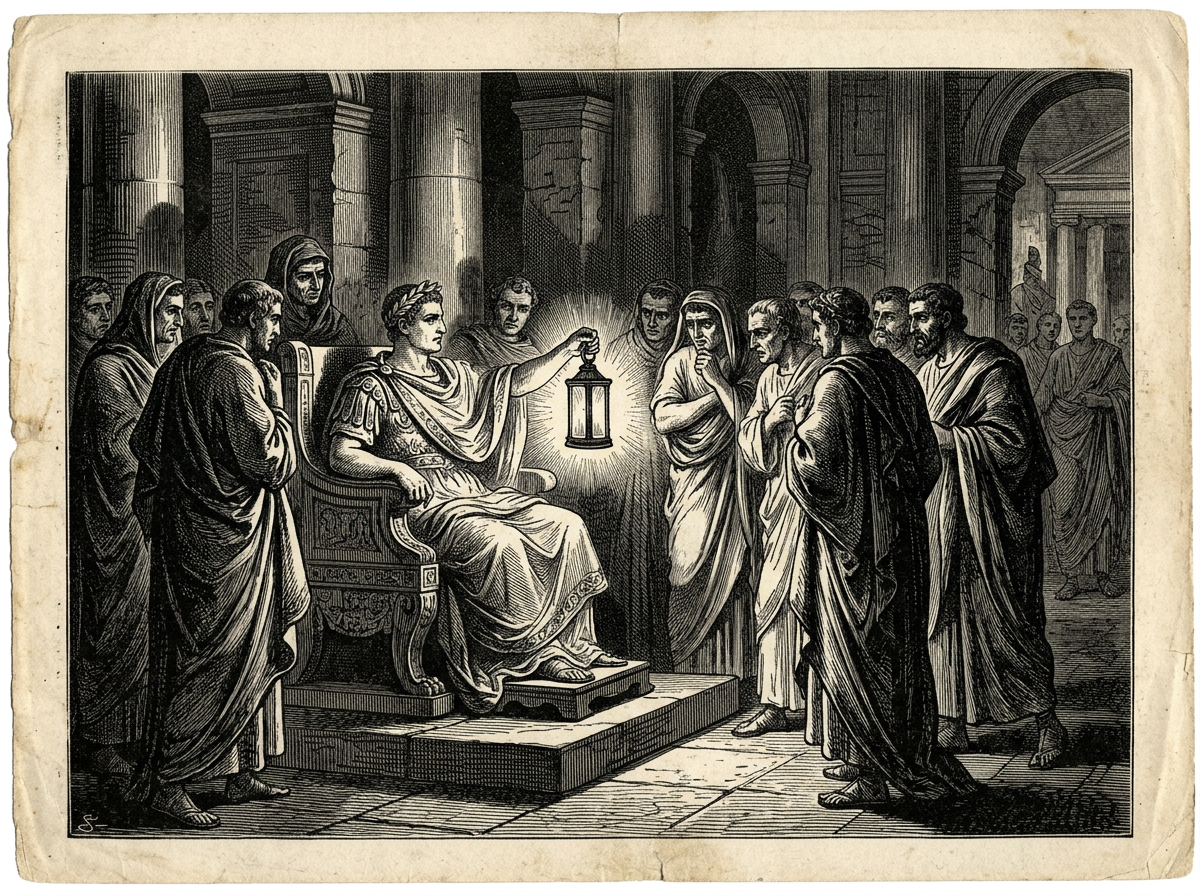
CORE DISTORTION: EGO DEFENSE
Marcus Aurelius was an emperor, not your personal brand manager.
17 Sept 2026
17th September: Dealing With Haters | The Reduction of Sacred Moral Rectitude to Social Media PR Management
The Text in Question
The Daily Stoic Rendering:
“What if someone despises me? Let them see to it. But I will see to it that I won’t be found doing or saying anything contemptible. What if someone hates me? Let them see to that. But I will see to it that I’m kind and good-natured to all, and prepared to show even the hater where they went wrong. Not in a critical way, or to show off my patience, but genuinely and usefully.” - Marcus Aurelius, Meditations, 11.13
Standard Academic (Translation A.S.L. Farquharson):
"Will any man despise me? Let him see to it. But I will see to it that I may not be found doing or saying anything worthy of contempt. Will any man hate me? Let him see to it. But I will be kindly and well-disposed to everyone, and ready to show him his error, not reproachfully, nor as showing off my endurance, but noble and good." - Marcus Aurelius, Meditations, 11.13
Academic Context & Breakdown
Marcus Aurelius penned Book 11 while wrestling with betrayal within his own court and managing the vast, crumbling machinery of the Roman Empire. He faced relentless political intrigue, bad faith actors, and open rebellion from trusted generals like Avidius Cassius. He was not drafting advice on how to handle internet trolls or manage petty social awkwardness. He was reminding himself how an Emperor must preserve his own soul when surrounded by backstabbers and genuine enemies.
In Farquharson’s translation, Marcus sets up a radical spiritual firewall. He makes a stark division between external hostility, which belongs entirely to the offender and internal moral purity, which remains his sole duty. His commitment to remain "kindly and well-disposed" while showing the offender their error is not a strategy to win an argument or change their mind. It is an unyielding obligation to cosmic duty, requiring him to act with noble benevolence even toward those who plot his destruction.
The commentary neuters this terrifying imperial burden into a cheap, modern handbook for managing personal brand optics. It rewires Marcus’s demand for unshakeable moral rectitude into a lazy formula for dismissive self-defense. By swapping out cosmic duty for social indifference, the commentary turns Stoicism into an excuse to ignore criticism and protect the fragile ego.
The Opening Counter-Punch
The commentary guts Marcus Aurelius’s profound moral imperative and replaces it with a shallow pop-psychology coping mechanism. It takes an Emperor's grueling commitment to show unconditional benevolence to his enemies and degrades it into a self-satisfied trick for brushing off "haters."
The Breakdown
- The commentary replaces Marcus's rigorous call for moral self-examination with pseudo-psychoanalysis, claiming that "when someone has a strong opinion about something, it usually says more about them than whatever or whomever the opinion happens to be about." Marcus Aurelius never urged his readers to dismiss external hostility as the hater's projection. By pathologizing the offender, the commentary allows the reader to feel morally superior rather than doing the hard work of ensuring they are not "found doing or saying anything worthy of contempt."
- The commentary smuggles modern managerial pragmatism into a sacred duty, reducing moral action to whether "there is a chance for influence or change." In Farquharson's translation, Marcus does not make his kindness or corrective instruction contingent on a cost-benefit calculation of "influence." He commands himself to remain "noble and good" regardless of the outcome, whereas the commentary treats human interaction as a transactional PR strategy.
- The commentary recasts Stoic benevolence as lazy self-absorption, concluding that "we don’t have time to think about what other people are thinking, even if it’s about us." Marcus Aurelius explicitly stated he was "ready to show him his error," requiring active, patient engagement with the offender. The commentary twists an active commitment to guide others into a self-centered excuse to ignore the world and protect one's personal peace.
The Lesson of the Text
The academic translation teaches that the malice of others has zero power to degrade your moral character unless you respond with malice in kind. We apply this by refusing to retaliate against hostility, holding ourselves strictly accountable for our own integrity while offering patient, dignified correction to those who oppose us.
How the Philosopher Would Respond
Marcus Aurelius would flatly reject this attempt to turn moral duty into an exercise in self-absorbed indifference. He did not write to help you protect your peace of mind from critics, but to command that you serve the human brotherhood even when it bites you.
"When you wake up in the morning, tell yourself: The people I deal with today will be meddling, ungrateful, arrogant, dishonest, jealous, and surly. They are like this because they cannot distinguish good from evil. But I have seen the beauty of good, and the ugliness of evil, and I have recognized that the wrongdoer has a nature related to my own." - Marcus Aurelius, Meditations, 2.1
Related dispatches
MAIN ERROR: EGOIC REDUCTION · A Critique of Modern Stoicism
Modern self-help turns Epictetus’s humbling theology into a cheap life hack.
28 Sept 2026
CRITICAL FLAW: TRIVIALIZED TRAUMA · A Critique of Modern Stoicism
Modern Stoicism turns existential trauma into wealth management anxiety.
28 Sept 2026
LIFESTYLE TRAP: BOURGEOIS LEISURE · A Critique of Modern Stoicism
How modern self-help turned Seneca's warnings into resort etiquette.
28 Sept 2026
CHIEF DISTORTION: LIFESTYLE OPTIMIZATION · A Critique of Modern Stoicism
Cold showers cannot save you from self-imposed moral servitude
28 Sept 2026