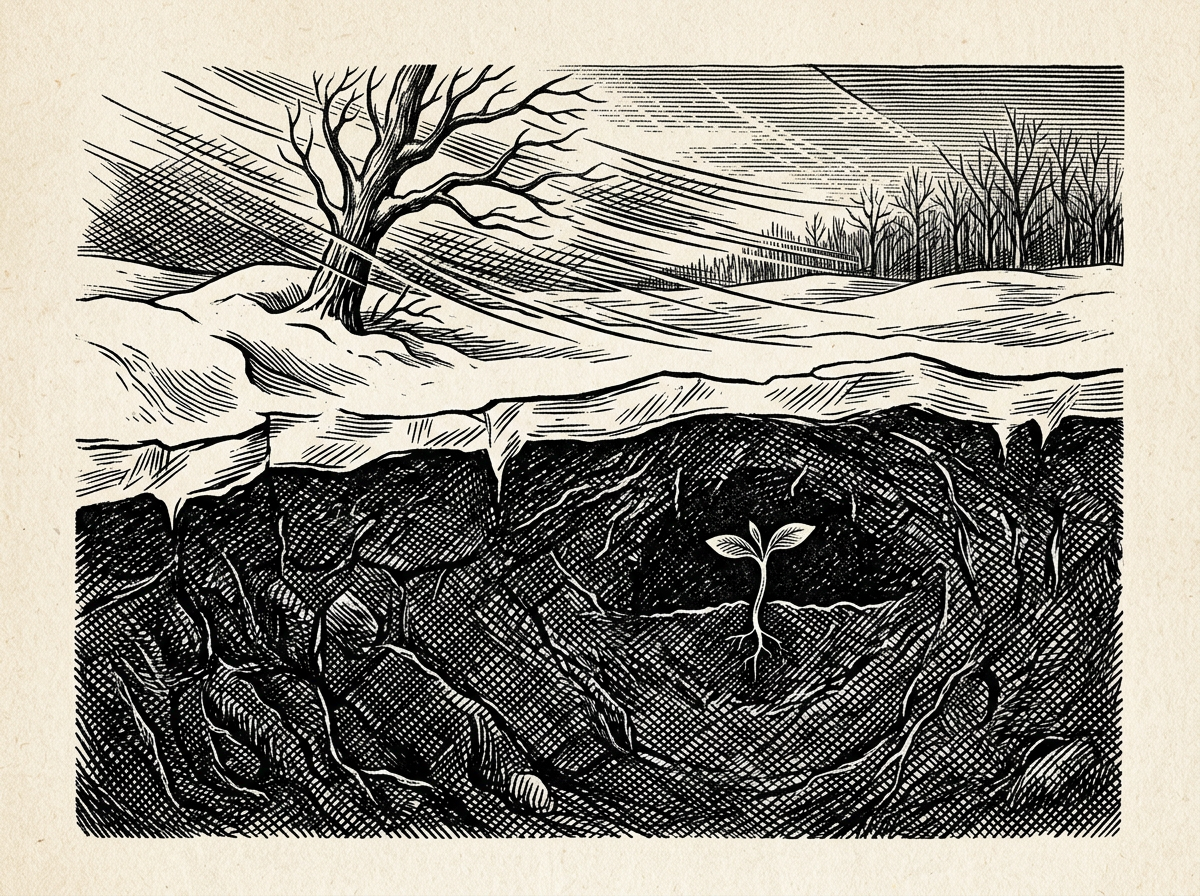
SPIRITUAL RISK: PREMATURE EXPOSURE
Stop treating private moral growth as a branding strategy
15 Sept 2026
15th September: A Garden Is Not For Show | The Fallacy of Turning Spiritual Incubation into Capitalist Productivity
The Text in Question
The Daily Stoic Rendering:
“First practice not letting people know who you are, keep your philosophy to yourself for a bit. In just the manner that fruit is produced the seed buried for a season, hidden, growing gradually so it may come to full maturity. But if the grain sprouts before the stalk is fully developed, it will never ripen. . . . That is the kind of plant you are, displaying fruit too soon, and the winter will kill you.” - Epictetus, Discourses, 4.8.35b
37
Academic Translation (W.A. Oldfather):
"First, practice this, not to let men know who you are; keep your philosophy to yourself for a little while. That is how fruit comes: the seed must be buried for a season, hidden, growing gradually so that it may reach full maturity. But if the ear of corn sprouts before the stalk is fully developed, it is defective. . . . You are that kind of plant; you blossom too soon, the frost will nip you." - Epictetus, Discourses, 4.8.35b-37
Academic Context & Breakdown
Epictetus delivered this instruction as a formerly enslaved man teaching young, aristocratic Roman students who were eager to wear the philosopher's cloak and parade their new intellect around the forum. He spoke from a crowded, unheated lecture hall in Nicopolis, looking at pampered men who treated moral philosophy like a fashionable status symbol.
In Oldfather's translation, Epictetus warns of a fatal spiritual vulnerability: premature exposure destroys internal transformation. The imagery of the seed buried in darkness is an existential demand for radical secrecy, requiring the student to undergo painful, silent self-examination away from public applause. If you display your virtue before it is structurally sound, the brutal frosts of fate and temptation will kill your character entirely.
The commentary hijacks a warning against intellectual vanity and rewires it into a pragmatic self-improvement routine. It flattens Epictetus’s urgent warning of moral death into a comfortable lecture about personal productivity and long-term habits. By replacing spiritual survival with utility, the commentary turns a sacred retreat inward into a strategy for personal success.
The Opening Counter-Punch
The commentary guts Epictetus's lethal warning about moral ruin and replaces it with a cozy metaphor about domestic utility. It takes a terrifying decree that vanity will destroy your soul and degrades it into a gentle reminder to build a sturdy personal brand.
The Breakdown
- The commentary changes Epictetus’s existential warning of spiritual death into a harmless critique of superficial hobbies. By equating vanity to how "fooling with books so you can sound smart or have an intimidating library is like tending a garden to impress your neighbors," the commentary trivializes the threat. Epictetus was not mocking aesthetic pretension; he was warning that unearned intellectual pride leaves a man helpless when real suffering arrives.
- The commentary injects transactional capitalism into an explicit demand for internal purity. It claims that growing a garden to "feed a family? That’s a pure and profitable use of your time." Epictetus never measured the hidden incubation of the soul by its practical return on investment or secular utility. Framing virtue as "profitable" distorts a self-sacrificing spiritual discipline into a net-positive life strategy.
- The commentary softens the violent reality of the winter freeze into a manageable obstacle you can optimize around. It promises that if you tend your seeds, "they and you are prepared and sturdy for the hard winters of life." Oldfather’s translation offers no such comforting guarantee; it states plainly that premature exhibition means "the frost will nip you" - total failure and moral death. The commentary replaces Epictetus's terrifying imperative with standard self-help optimism.
The Lesson of the Text
The academic translation teaches that moral growth demands absolute privacy and time in the dark before it can survive real-world strain. We apply this by deliberately hiding our discipline, refusing to talk about our virtues or perform our principles for an audience until they are deeply rooted.
How the Philosopher Would Respond
Epictetus would sneer at the suggestion that philosophy exists to yield a smooth, "profitable" life for your household. He did not teach to help you manage your reputation or optimize your time, but to rip away your vanity before life crushes you.
"Will you not leave off boasting, and showing off your power, like fools in a theater? Show me one who is really sick and yet happy, in danger and yet happy, dying and yet happy, in exile and yet happy. Show him to me! By the gods, I would fain see a Stoic!" - Epictetus, Discourses, 2.19.24-25
Related dispatches
MAIN ERROR: EGOIC REDUCTION · A Critique of Modern Stoicism
Modern self-help turns Epictetus’s humbling theology into a cheap life hack.
28 Sept 2026
CRITICAL FLAW: TRIVIALIZED TRAUMA · A Critique of Modern Stoicism
Modern Stoicism turns existential trauma into wealth management anxiety.
28 Sept 2026
LIFESTYLE TRAP: BOURGEOIS LEISURE · A Critique of Modern Stoicism
How modern self-help turned Seneca's warnings into resort etiquette.
28 Sept 2026
CHIEF DISTORTION: LIFESTYLE OPTIMIZATION · A Critique of Modern Stoicism
Cold showers cannot save you from self-imposed moral servitude
28 Sept 2026