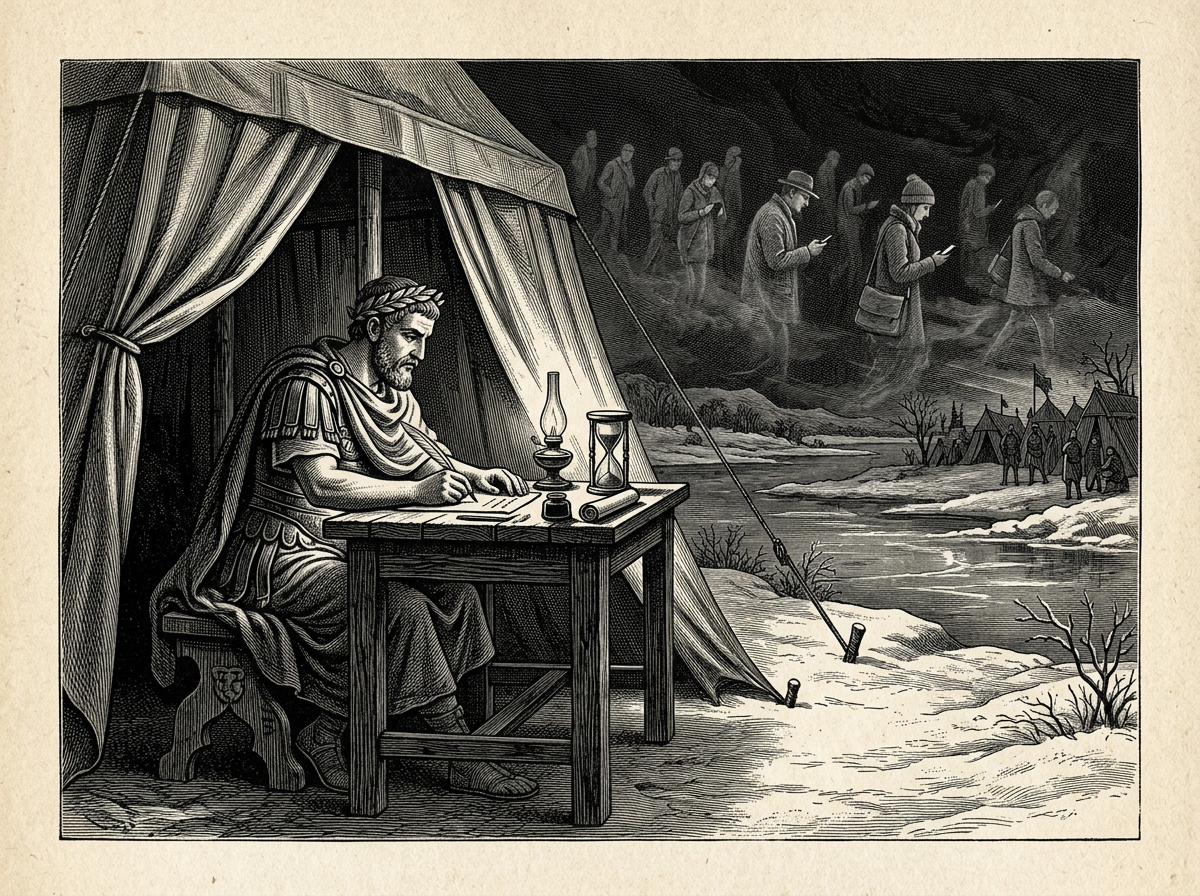
CORE PROBLEM: SANITIZED STOICISM
Marcus Aurelius demanded spiritual surrender, not consumerist self-soothing
14 Sept 2026
14th September: A Different Way To Pray | The Commodification of Spiritual Transformation into Self-Help Life Hacks
The Text in Question
The Daily Stoic Rendering:
“Try praying differently, and see what happens: Instead of asking for ‘a way to sleep with her,’ try asking for ‘a way to stop desiring to sleep with her.’ Instead of ‘a way to get rid of him,’ try asking for ‘a way to not crave his demise.’ Instead of ‘a way to not lose my child,’ try asking for ‘a way to lose my fear of it.’” - Marcus Aurelius, Meditations, 9.40.(6)
Standard Academic Translation:
"Begin then to pray in this way, and you will see. One man prays: 'How may I sleep with that woman?' Do you pray: 'How may I lose the desire to sleep with her?' Another: 'How may I be rid of that man?' Do you pray: 'How may I not wish to be rid of him?' A third: 'How may I not lose my little child?' Do you pray: 'How may I not fear to lose him?' Turn your prayers altogether this way, and see what comes." - Marcus Aurelius, Meditations, 9.40 (trans. A.S.L. Farquharson)
Academic Context & Breakdown
Marcus Aurelius wrote Book 9 of his private notebooks while stationed on the frozen northern frontier along the Danube, enduring winter military campaigns, betrayal, and widespread plague. Surrounded by death and the weight of ruling an empire, he was not writing a life-hack manual for eager modern strivers. He was conducting an intense internal examination, attempting to align his own mortal mind with the cosmic order (Logos) before his own imminent death.
In the original Greek text, Marcus addresses the pagan practice of praying to the gods for external favors or protection against bad luck. He asks a fundamental question: if the gods have given humanity free will and moral agency, why pray for external circumstances rather than internal virtue? The passage is a radical call to dismantle the ego's entitlement, urging the practitioner to surrender control over mortal outcomes and cultivate moral immunity.
The commentary neuters a radical, terrifying confrontation with mortality and transforms it into a sanitized productivity hack. It rewires Marcus Aurelius’s call for complete spiritual surrender into a psychological trick to help you manage daily stress. By stripping out the sacred cosmos, the commentary turns Stoicism into an instrument of self-centered optimization.
The Breakdown
- The commentary flattens prayer into secular wishing, claiming that "in life we all find ourselves hoping and asking for things." Marcus Aurelius is not discussing hoping for your favorite sports team to win; he is addressing the raw human instinct to beg the divine for safety, lust, and survival. By reducing sacred petition to a casual "C’mon, c’mon, c’mon," the text degrades a serious theological overhaul into an everyday bad habit.
- The commentary recast the discipline of desire as a transactional productivity tool so "that your lives will magically be easier." The original academic text does not promise comfort or convenience if you change your mindset; it demands that you face the terrifying prospect of losing a child without breaking your moral integrity. The commentary shifts the focus from radical acceptance of tragedy to consumerist self-soothing.
- The commentary framing reduces cosmic alignment to personal agency, asking "what about asking for fortitude and strength so you can do what you need to do?" Marcus Aurelius was not offering self-empowerment tips to help you execute your daily task list. He was commanding the soul to destroy its attachment to external preferences entirely, aligning the individual will with the relentless reality of nature.
The Lesson of the Text
The standard translation teaches us that true prayer is not an attempt to bend reality to our desires, but an exercise in training our desires to accept reality. We apply this by actively identifying where we beg life to be different whether fearing loss, seeking pleasure, or resenting others and systematically converting those anxieties into requests for internal mastery.
How the Philosopher Would Respond
Marcus Aurelius would flatly reject this attempt to turn spiritual discipline into a self-help life hack. He did not write his private thoughts to optimize your career or make your daily routine run smoothly, but to prepare your soul for inevitable loss, decay, and death.
"Everything harmonizes with me, which is harmonious to thee, O Universe. Nothing for me is too early nor too late, which is in due time for thee." - Marcus Aurelius, Meditations, 4.23
Related dispatches
MAIN ERROR: EGOIC REDUCTION · A Critique of Modern Stoicism
Modern self-help turns Epictetus’s humbling theology into a cheap life hack.
28 Sept 2026
CRITICAL FLAW: TRIVIALIZED TRAUMA · A Critique of Modern Stoicism
Modern Stoicism turns existential trauma into wealth management anxiety.
28 Sept 2026
LIFESTYLE TRAP: BOURGEOIS LEISURE · A Critique of Modern Stoicism
How modern self-help turned Seneca's warnings into resort etiquette.
28 Sept 2026
CHIEF DISTORTION: LIFESTYLE OPTIMIZATION · A Critique of Modern Stoicism
Cold showers cannot save you from self-imposed moral servitude
28 Sept 2026