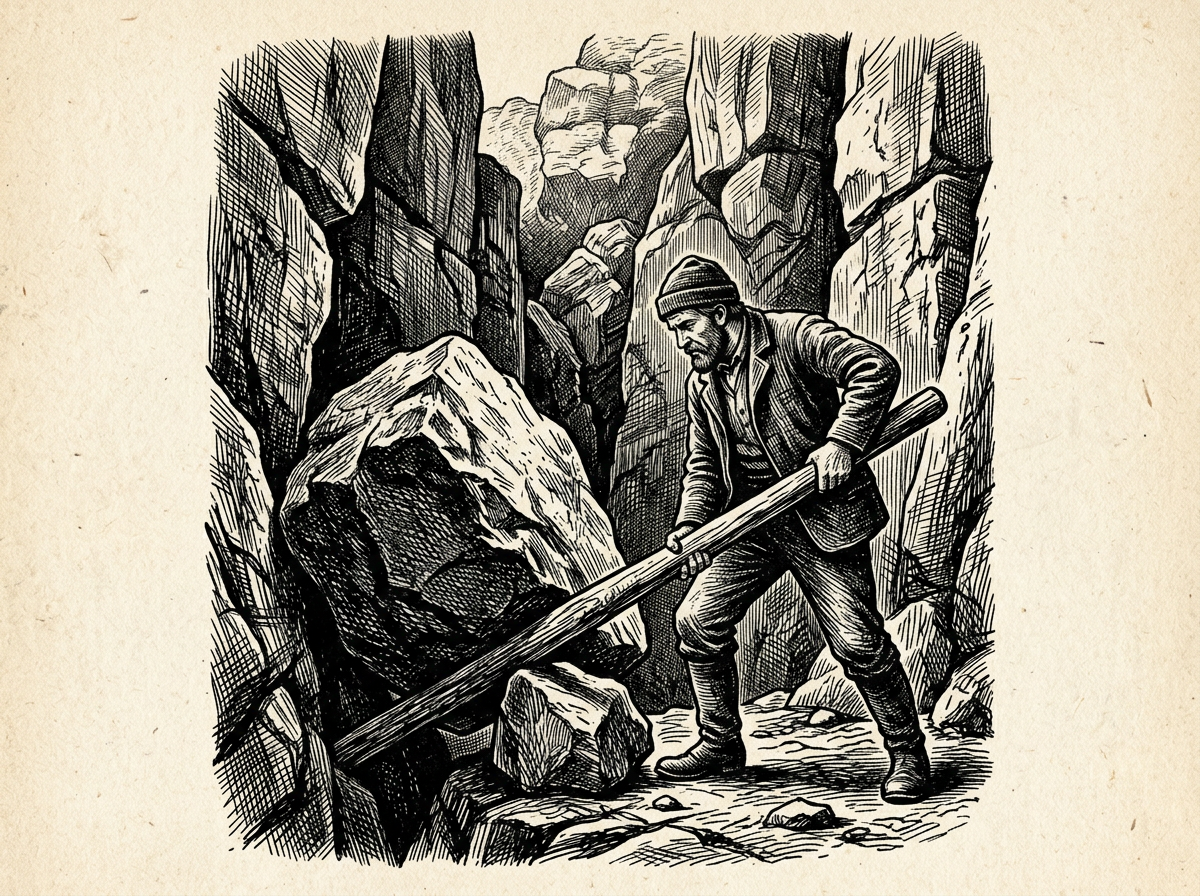
TACTICAL AGENCY: STRATEGIC LEVERAGE
Hardship yields to strategic leverage, not blind force.
06 Aug 2026
6th August - There Is Always More Room To Maneuve…
6th August - There Is Always More Room To Maneuver Than You Think
The commentary:
“Apply yourself to thinking through difficulties, hard times can be softened, tight squeezes widened, and heavy loads made lighter for those who can apply the right pressure.”
Chaff & Wheat Analyse:
SENECA, ON TRANQUILITY OF MIND, 10.4b
Are you ever been hopelessly losing a game that suddenly broke wide open and you won? Remember that time when you thought you were certain to fail the test, but with an all-nighter and some luck you managed to eke out a decent score? That hunch you pursued that others would have given up on, that turned out brilliantly?
It’s that kind of energy and creativity and above all faith in yourself that you need right now. Defeatism won’t get you anywhere (except defeat). But focusing your entire effort on the little bit of room, the tiny scrap of an opportunity, is your best shot. An aide to Lyndon Johnson once remarked that around the man
“there was a feeling, if you did everything, you would win.”
Everything. Or as Marcus Aurelius put it, if it’s humanly possible, you can do it.
The Meaning of the Passage
In On Tranquility of
Mind 10.4b, Seneca offers a prescription for mental flexibility when facing tough circumstances.
He uses physical metaphors, softening hard times, widening tight squeezes, and lightening heavy loads, to explain that our perception and strategy dictate the weight of our burdens. A problem rarely has fixed, unyielding walls; instead, applying "the right pressure" (using reason, creativity, and focused effort) allows you to find leverage where there initially seemed to be none.
The modern commentary bridges Seneca’s ancient advice with real-world examples:
- It recalls personal "come-from-behind" victories, passing an impossible test, turning around a losing game, or pursuing an unlikely hunch.
- It highlights President Lyndon B. Johnson’s relentless work ethic, the belief that if you leave no stone unturned and exhaust every possibility, you can engineer a way forward.
The Core Meaning
is: Despair and defeatism are choices. Even in the narrowest, most restricted situations, a creative mind will always find a tiny margin of opportunity to maneuver.
What is the Agreement (The Core Argument)?
Seneca and the modern commentary agree on three main pillars:
- Circumstances are flexible, not static — Hardships feel rigid and absolute only when viewed with panic or defeatism. When approached with calm analysis, almost every problem contains hidden options.
- Defeatism is a self-fulfilling prophecy — If you convince yourself there is no way out, you stop looking, ensuring your own defeat.
- Effort expands options — "Applying the right pressure" means deploying focused effort, tactical creativity, and persistence to open up doors that seemed locked.
Is It True?
Yes, this principle is overwhelmingly supported by cognitive science, psychology, and real-world history.
- Psychological Truth — Learned Helplessness vs. Agency
Psychologist Martin
Seligman famously identified the concept of learned helplessness, a state where an individual, after experiencing adversity, comes to believe they have zero control over their environment and stops trying altogether.
Seneca's insight directly combats learned helplessness. Modern Cognitive Behavioral Therapy (CBT) uses Seneca's exact approach: breaking a seemingly insurmountable crisis down into actionable micro-steps to restore a sense of agency.
- Strategic Leverage ("The Right Pressure")
In physics and engineering, a small amount of force applied via a lever can move immense weight. The same is true in human affairs:
- Tactical execution — In business, military history, and sports, winning rarely comes from overwhelming force; it comes from finding an unexpected angle, a blind spot, or a tiny weakness in a situation and applying concentrated effort right there.
- The "Lyndon Johnson Effect" — Lyndon B. Johnson was famous for squeezing results out of impossible legislative situations through sheer relentless effort, knowing every detail, making every phone call, and exploring every avenue when others gave up.
- Where Nuance is Needed — Optimism vs. Delusion
While Seneca encourages us to find room to maneuver, it is vital to distinguish between pragmatic resourcefulness and delusional denial:
- Stoic Realism — Seneca does not say you can magically make impossible things happen. He says you can soften and lighten hardship. Realism requires acknowledging cold facts while ruthlessly searching for the remaining options within those facts.
The Takeaway: When you feel cornered by life, step back from panic. Stop looking at how tight the squeeze is, and start looking for where to apply "the right pressure." There is almost always a lever you haven't pulled yet.
This quote is not from the Bible. It is by the Roman Stoic philosopher Seneca, from his work On Tranquillity of Mind (De Tranquillitate Animi, 10.4b).
- Meaning of the Quote
At its core, this quote is a classic statement of Stoic resilience and practical problem-solving. Seneca is making several key points about dealing with adversity:
- Active Engagement over Panic ("Apply yourself to thinking through difficulties"): Hardship requires intellectual composure. Instead of being overwhelmed by emotion or feeling helpless, you use reason and deliberate reflection to analyze the problem.
- Flexibility and Perspective ("Hard times can be softened, tight squeezes widened"): Circumstances rarely stay as rigid or unyielding as they first appear. With patience, shift in perspective, or clever maneuvering, even severe constraints usually offer some breathing room.
- Leverage and Strategy ("Heavy loads made lighter for those who can apply the right pressure"): This uses the physical metaphor of a lever or fulcrum. Pushing hard against a problem in the wrong way causes exhaustion; applying force or strategic effort in the right spot makes daunting burdens manageable.
- Is It a Biblical Teaching?
While the quote itself is secular philosophy, its ideas share both overlaps and stark differences with Christian/biblical theology.
Where it aligns with biblical concepts
- The value of wisdom and diligence — The Bible frequently encourages using foresight, reason, and disciplined thought rather than reacting impulsively.
- “By wisdom a house is built, and through understanding it is established; through knowledge its rooms are filled with rare and beautiful treasures.” — Proverbs 24:3–4
- Easing heavy burdens — The idea of lightening heavy loads is a prominent theme in the Scriptures (e.g., Galatians 6:2 on bearing one another's burdens).
Key differences in worldview
The fundamental difference lies in where the power comes from:
Theme
Seneca’s Stoicism
Biblical Teaching
Source of Strength
Self-Reliance & Reason: Lightening the burden depends on your ability to think through it and apply the right pressure.
Divine Reliance & Grace: Strength comes from God when human capacity falls short (2 Corinthians 12:9).
Handling Burdens
Strategic Force: You apply pressure to maneuver out of tight spots.
Surrender & Trust: You cast your cares upon God rather than relying solely on human intellect.
A key contrast is found in Proverbs 3:5–6:
"Trust in the Lord with all your heart and lean not on your own understanding; in all your ways submit to him, and he will make your paths straight."
While Seneca encourages leaning heavily on your own understanding to apply the right pressure, Scripture teaches that human intellect has limits, and ultimate relief comes from faith, prayer, and God's providence (e.g., Matthew 11:28–30, where Jesus offers to make heavy burdens light through rest in Him).
Related dispatches
MAIN ERROR: EGOIC REDUCTION · A Critique of Modern Stoicism
Modern self-help turns Epictetus’s humbling theology into a cheap life hack.
28 Sept 2026
CRITICAL FLAW: TRIVIALIZED TRAUMA · A Critique of Modern Stoicism
Modern Stoicism turns existential trauma into wealth management anxiety.
28 Sept 2026
LIFESTYLE TRAP: BOURGEOIS LEISURE · A Critique of Modern Stoicism
How modern self-help turned Seneca's warnings into resort etiquette.
28 Sept 2026
CHIEF DISTORTION: LIFESTYLE OPTIMIZATION · A Critique of Modern Stoicism
Cold showers cannot save you from self-imposed moral servitude
28 Sept 2026