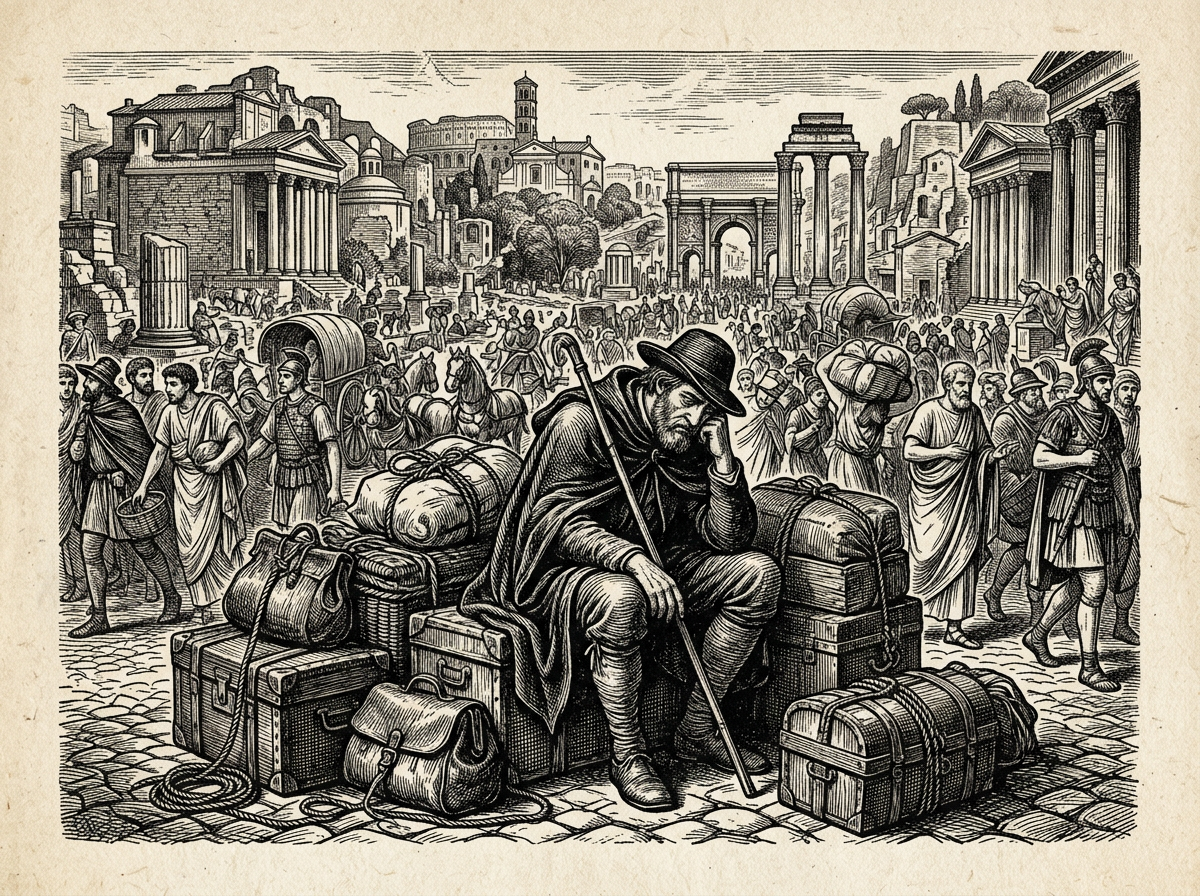
CORE ILLUSION: GEOGRAPHIC ESCAPE
Stop expecting a change of scenery to cure internal friction.
03 Aug 2026
3rd August - The Good Life Is Anywhere
“At this moment you aren’t on a journey, but wandering about, being driven from place to place, even though what you seek to live well is found in all places. Is there any place more full of confusion than the Forum? Yet even there you can live at peace, if needed.”
The commentary:
A SENECA, MORAL LETTERS, A well-known writer once complained that after becoming successful, wealthy friends were always inviting him to their beautiful, exotic houses.
“Come to our home in the south of France,”
they would say. Or,
“Our Swiss ski chalet is a wonderful place to write.”
The writer traveled the world, living in luxury, hoping to find inspiration and creativity in these inspiring manors and mansions. Yet it rarely happened. There was always the allure of another, better house. There were always distractions, always so many things to do, and the writer’s block and insecurity that plagues creative types traveled with him wherever he went.
Chaff & Wheat Analyse:
We tell ourselves that we need the right setup before we finally buckle down and get serious. Or we tell ourselves that some vacation or time alone will be good for a relationship or an ailment. This is self-deceit at its finest. It’s far better that we become pragmatic and adaptable, able to do what we need to do anywhere, anytime. The place to do your work, to live the good life, is here.
The Meaning of the Passage
In Moral
Letters 28, Seneca addresses a common human flaw: the belief that changing our geography will fix our internal problems.
Seneca argues that if you are restless, anxious, or unfulfilled, traveling to a beautiful place will not cure you, because you bring yourself with you wherever you go. Conversely, if you have cultivated inner peace, self-discipline, and virtue, you can thrive anywhere. He uses the Roman Forum (the chaotic, noisy heart of political and commercial life in ancient Rome) as an extreme example: if your mind is calm, you can find peace even in the middle of a bustling, chaotic crowd.
The modern commentary illustrates this using a writer suffering from writer's block. The writer moves from luxurious chalet to seaside manor, hoping a change of scenery will unlock creativity. But the insecurity and writer's block travel right alongside them in their luggage.
The Core Meaning
is: Happiness and focus are portable internal states, not geographic destinations.
What is the Agreement (The Core Argument)?
Seneca and the modern commentary share a central argument regarding geographical escape and environmental dependence:
- The Illusion of "The Right Setup" — Waiting for the perfect environment, a quiet cabin, a pristine desk, or a long vacation, before doing good work or living well is a form of procrastination.
- You Can't Outrun Yourself — External changes cannot fix internal deficiencies. As Seneca famously writes elsewhere in the same letter (Moral Letters 28.2), "Why do you wonder that globe-trotting does not help you, seeing that you wander about with yourself?"
- Adaptability over Idealism — True mastery is being able to produce, reflect, and maintain peace regardless of your surroundings, whether in a quiet library or a noisy airport terminal.
Is It True?
Yes, it is overwhelmingly supported by both psychological science and historical practice.
- The Psychological Trap — "Destination Addiction"
Psychology identifies a phenomenon called destination addiction, the obsessive belief that happiness is located in the next job, the next city, or the next vacation.
Research on the hedonic treadmill reveals that when people move to a new location or change their environment, they experience a temporary spike in mood. However, within weeks or months, their baseline happiness returns to where it was before. If you were anxious or distracted in New York, you will eventually be anxious or distracted in the South of France.
- The Science of Focus & Adaptability
Modern productivity literature echoes Seneca's warning against relying on "the right setup":
- Environmental dependence creates fragility — If you can only write or work when the room temperature is 70°F, your coffee is exact, and absolute silence prevails, your ability to produce is fragile and easily disrupted.
- Pragmatic adaptability creates resilience — High performers build the ability to enter a state of deep focus regardless of noise or environment, what Seneca called finding peace in the Forum.
- Where Nuance is Needed
While Seneca is correct that internal peace is primary, modern psychology acknowledges that extreme environments do matter:
- Toxic workplaces, abusive relationships, or unsafe living conditions genuinely harm mental health. Seneca isn't suggesting you stay in an unsafe or abusive situation; rather, he is warning against expecting a scenic location to magically cure internal dissatisfaction.
The Takeaway: Stop waiting for a vacation, a better office, or a quiet week to start living well or doing your best work. The place to cultivate peace and focus is right here, right now, exactly where you are sitting.
Related dispatches
MAIN ERROR: EGOIC REDUCTION · A Critique of Modern Stoicism
Modern self-help turns Epictetus’s humbling theology into a cheap life hack.
28 Sept 2026
CRITICAL FLAW: TRIVIALIZED TRAUMA · A Critique of Modern Stoicism
Modern Stoicism turns existential trauma into wealth management anxiety.
28 Sept 2026
LIFESTYLE TRAP: BOURGEOIS LEISURE · A Critique of Modern Stoicism
How modern self-help turned Seneca's warnings into resort etiquette.
28 Sept 2026
CHIEF DISTORTION: LIFESTYLE OPTIMIZATION · A Critique of Modern Stoicism
Cold showers cannot save you from self-imposed moral servitude
28 Sept 2026