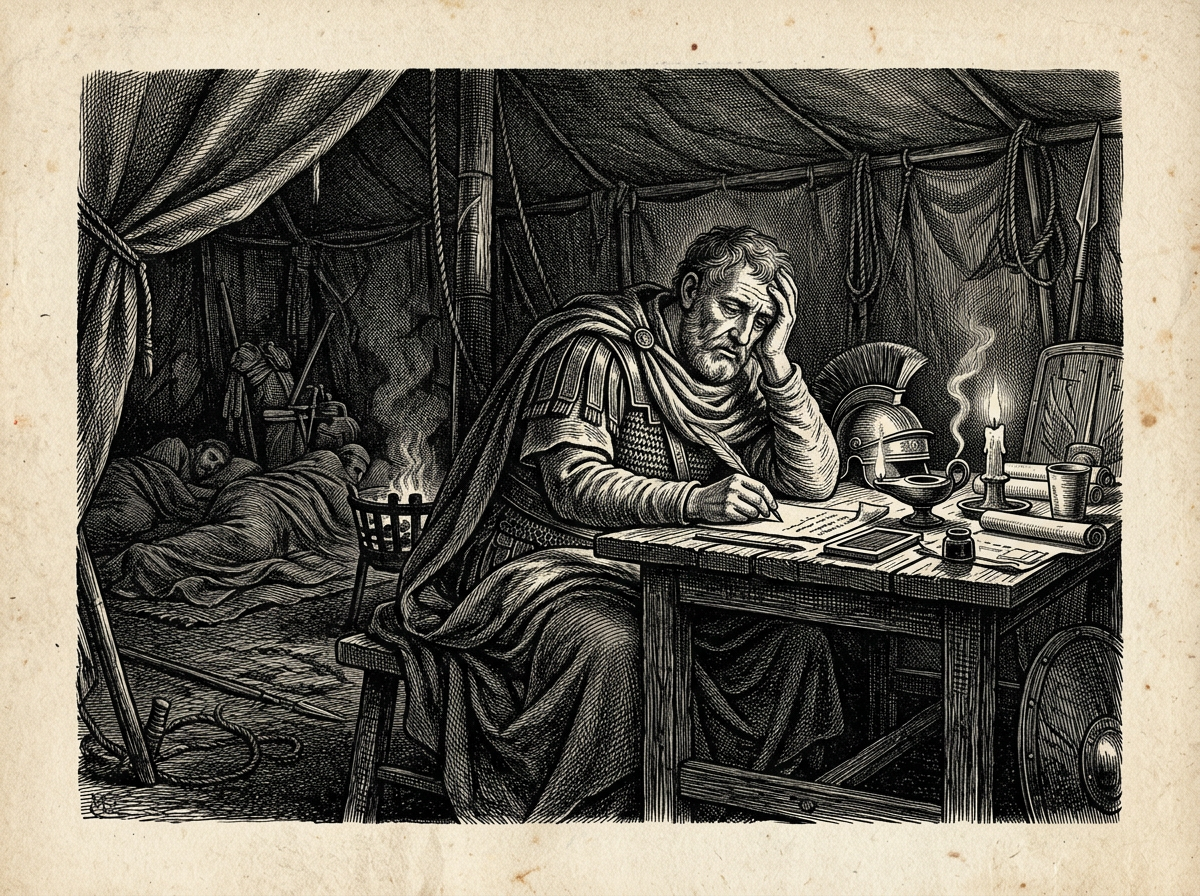
ETHICAL DILUTION: INNER TRANQUILITY
Marcus Aurelius demanded existential duty, not modern self-help tranquility.
10 Oct 2026
10th October: Reverence And Justice | The Misdirection of Cosmic Duty into Shallow Tranquility
The Text in Question
The Daily Stoic Rendering
“Leave the past behind, let the grand design take care of the future, and instead only rightly guide the present to reverence and justice. Reverence so that you’ll love what you’ve been allotted, for nature brought you both to each other. Justice so that you’ll speak the truth freely and without evasion, and so that you’ll act only as the law and value of things require.” - MARCUS AURELIUS, MEDITATIONS, 12.1
Standard Academic Translation
“Cast behind thee all that is past, entrust the future to Providence, and direct the present solely to piety and justice: piety, that thou mayest love the lot assigned to thee, for Nature brought it to thee and thee to it; justice, that thou mayest speak truth without disguise, and do all things according to law and according to their worth.” - MARCUS AURELIUS, MEDITATIONS, 12.1 (C.R. Haines)
Academic Context & Breakdown
Marcus Aurelius wrote Book 12 while facing his final days in a bleak, freezing military camp along the Danube, his body failing and his life's work burdened by empire-wide plague and constant war. He was an aging emperor stripped of illusions, preparing himself for death by stripping life down to its absolute bare essentials.
Surrounded by mud, death, and political deceit, Marcus was reminding himself how to die well: surrender the dead past, abandon anxious control over the future, and channel every remaining breath into immediate moral duty. He was not pursuing personal peace or comfort, but total alignment with cosmic Providence through piety (eusebeia) and justice (dikaiosyne).
The Opening Counter-Punch
The commentary hijacks Marcus Aurelius's severe deathbed command and reduces it to an trivial appetizer for personal peace of mind. It takes an uncompromising imperative for absolute moral obedience and dilutes it into a soft, self-serving strategy for stress-free living. Where the dying emperor demanded total submission to cosmic law, the commentator merely promises a smooth, comfortable life for the reader's ego.
The Breakdown
- The commentary pivots away from Marcus's text to cite Epictetus’s advice to live an “immensely tranquil life,” shifting the core goal of Stoic practice from absolute moral duty to personal psychological comfort. The Academic translation commands strict adherence to piety and justice as intrinsic duties regardless of how you feel, whereas the commentary distorts the text by making inner peace the ultimate reward and motivation.
- By asking “what principles should determine what we persist in and what we ought to resist?”, the commentary flattens Marcus’s radical cosmic framework into a functional decision-making checklist for daily productivity. The original passage commands a complete, existential surrender of past and future to Providence, which the commentary completely changes into a utilitarian tool for personal discipline.
- The commentary equates Marcus's specific commands of piety and justice with a vague, blanket endorsement of “virtue,” sanitizing the stark, religious weight of Marcus’s actual words. The Academic translation demands explicit “piety”, loving your assigned fate because Nature ordained it, while the commentary erases this demanding cosmic submission to make the philosophy more palatable to modern sensibilities.
What is the lesson we can learn from "Standard Academic Translation"? And how can we apply or practice it?
The standard academic rendering demands that you immediately stop wasting mental energy on unchangeable past events or unpredictable future outcomes, directing your entire focus to fulfilling your present moral duty to truth and justice.
To practice this today, identify a situation where you are anxiously obsessing over a future result, consciously surrender that outcome to fate, and execute the single most honest and just action required of you right now without evasion or complaint.
How the Philosopher Would Respond
Marcus Aurelius would despise seeing his urgent, deathbed preparation turned into a cozy, self-satisfied formula for personal tranquility.
“Simple and modest is the work of philosophy. Draw me not aside to insolence and pride.” - MARCUS AURELIUS, MEDITATIONS, 9.29
Related dispatches
CORE ERROR: IDENTITY CURATION · A Critique of Modern Stoicism
Stoicism is an objective scale, not a personal branding exercise
09 Oct 2026
VIRTUE DEGRADATION: POP NEUROSCIENCE · A Critique of Modern Stoicism
Stop reducing ancient moral duty to a dopamine hack.
08 Oct 2026
CORE ERROR: SELFISH VIRTUE · A Critique of Modern Stoicism
Modern self-help turns moral integrity into a hack for anxiety management
07 Oct 2026
MAIN ERROR: THERAPEUTIC REDUCTION · A Critique of Modern Stoicism
Stop treating Stoic virtue as therapy for professional jealousy
06 Oct 2026