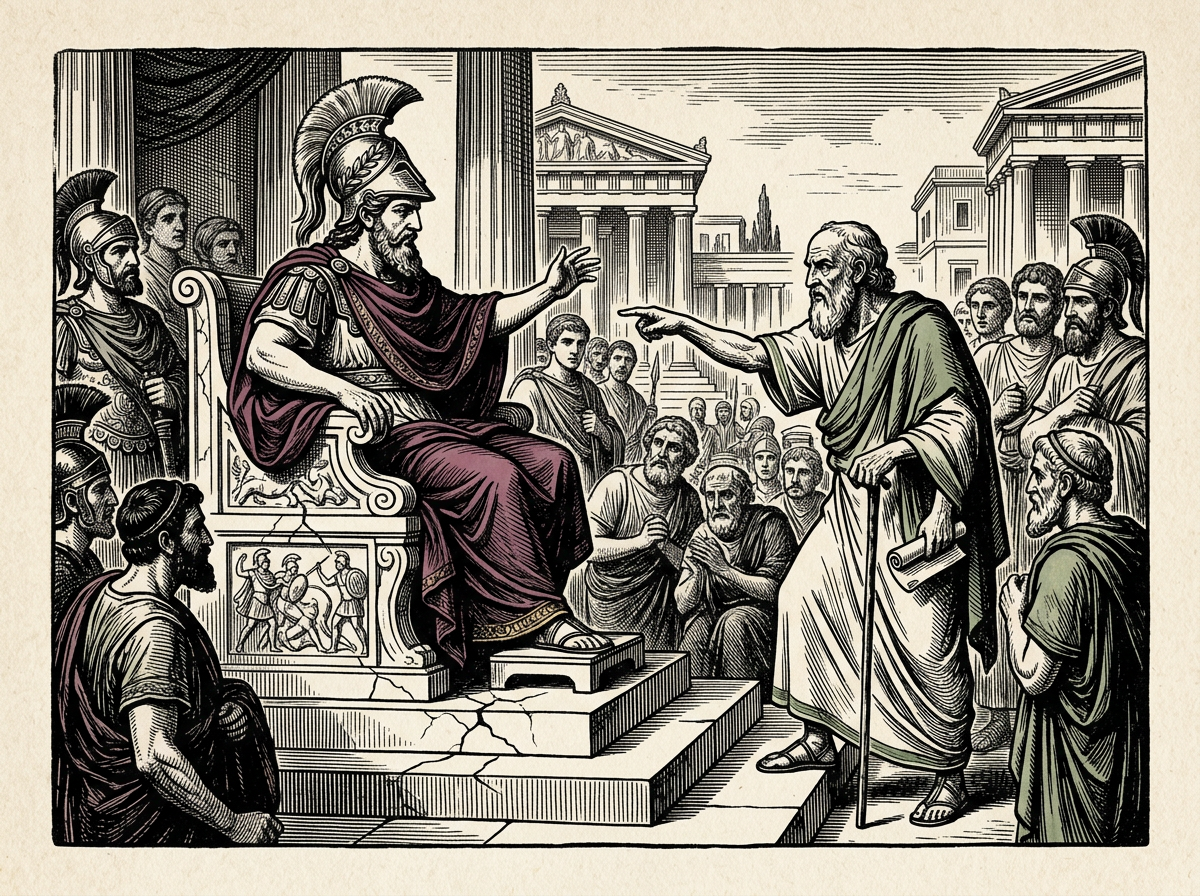
EXECUTIVE HUBRIS: ETHICAL BLINDNESS
Strategic brilliance cannot replace character in modern leadership.
17 Sept 2026
Socratic Intellectualism and Moral Leadership: Virtue, Corruption, and the Dialectic of Character in Classical Athens
Academic Abstract & Executive Overview
The intersection of moral philosophy and institutional governance remains a central problem in contemporary organizational studies. This paper examines the enduring lessons of leadership character through the historical and philosophical relationship between Socrates and Alcibiades as recorded in classical Platonic dialogues. By analyzing the mechanics of Socratic intellectualism, this study explores how moral knowledge relates to administrative competence and how the absence of virtue precipitates organizational corruption. Utilizing foundational texts such as the Alcibiades I and the Symposium alongside modern scholarship by Gregory Vlastos and Martha Nussbaum, we investigate the vulnerabilities of charismatic leadership in high-stakes environments. The historical failure of Alcibiades, despite his exceptional brilliance and Socratic mentorship, offers profound insights into executive hubris, moral education, and the psychological limitations of intellectual brilliance when divorced from genuine character. Furthermore, this paper translates classical dialectical frameworks into actionable methodologies for modern executive governance. We propose systematic approaches for institutional self-correction, rigorous virtue-based character diagnostics, and structural accountability frameworks designed to mitigate the perils of executive exceptionalism. Through this interdisciplinary synthesis of classical philosophy and organizational psychology, institutional leaders and researchers can better navigate the treacherous terrain of power, influence, and ethical responsibility.
Theoretical Background & Literature Framework
The philosophical foundation of Socratic leadership rests on the core premise of Socratic intellectualism, the doctrine that virtue is a form of knowledge and that vice is merely a consequence of ignorance. According to this view, explored extensively by Vlastos (1991), no individual willingly errs or chooses the worse course of action while understanding the better. Within the context of classical Athens, this framework positioned moral education not as a passive adoption of cultural norms, but as an active, relentless examination of the self. As documented in Plato's Alcibiades I (Cooper, 1997), Socrates approaches the young, ambitious, and intensely vain Alcibiades not to flatter his political ambitions, but to force a confrontation with his own profound ignorance regarding justice, statecraft, and the good.
This dynamic mirrors modern psychological and behavioral frameworks regarding cognitive dissonance, self-deception, and narcissistic leadership. Organizational theorists have long observed that high intellectual capacity and charismatic appeal frequently mask severe ethical vulnerabilities. As noted in contemporary leadership literature (Kets de Vries, 2014), leaders who possess exceptional strategic acumen often develop a sense of invulnerability, rationalizing unethical behavior through sophisticated intellectual constructs. In the case of Alcibiades, his brilliance and physical beauty created an echo chamber of adulation that insulated him from constructive criticism. Socrates attempted to puncture this insulating armor through the elenchus, a method of cross-examination designed to expose logical contradictions in a person's moral beliefs.
The tragic trajectory of Alcibiades, who transitioned from a promising democratic reformer to a treasonous exile manipulating both Athens and Sparta, underscores the limits of mere intellectual instruction when unmoored from deep character transformation. Psychological research on executive character development suggests that emotional maturity and moral identity must be intentionally cultivated alongside cognitive intelligence (Coles, 1997). When organizations elevate individuals based solely on technical competence or charismatic metrics, they inadvertently import systemic risk. The Platonic dialogue reveals that without a foundational self-knowledge of one's limitations, ambition transforms into hubris, and leadership talent metastasizes into destructive self-aggrandizement. Thus, the relationship between Socrates and Alcibiades serves as the quintessential historical case study on the corrupting nature of unchecked power and the vital necessity of institutionalized moral scrutiny.
Methodological Application & Practical Recommendations
STEP 01: Socratic Elenchus in Organizational Governance
To counteract the echo chambers that frequently develop at the executive level, modern organizations must systematically integrate collaborative dialectic questioning into their governance structures. The Socratic elenchus operates not as an adversarial courtroom interrogation, but as a cooperative search for truth that exposes hidden assumptions and conceptual contradictions. Executive boards and management teams should institute regular, formalized adversarial review sessions where strategic initiatives and foundational corporate assumptions are subjected to rigorous cross-examination. This process requires appointing designated devil's advocates or institutional gadflies whose primary mandate is to question prevailing orthodoxies without fear of professional reprisal. By institutionalizing this form of intellectual friction, organizations prevent groupthink and bring unarticulated ethical blind spots to light before they manifest as operational failures or catastrophic compliance breaches.
STEP 02: Character Diagnostics
Traditional executive recruitment models rely overwhelmingly on historical performance metrics, technical competencies, and cognitive ability tests, frequently ignoring the moral dimension of leadership. Drawing from virtue ethics and psychological assessment models, institutions must implement comprehensive character diagnostics during the executive selection process. These diagnostic frameworks should evaluate constructs such as epistemic humility, empathy, long-term perspective, and the capacity for self-correction. Utilizing structured behavioral interviews, 360-degree ethical audits, and scenario-based moral dilemmas, human resource committees can assess whether a candidate views power as a mechanism for personal aggrandizement or as a solemn fiduciary responsibility to stakeholders. This diagnostic rigor ensures that candidates possessing the intellectual brilliance of an Alcibiades are simultaneously evaluated for the moral grounding necessary to wield power safely.
STEP 03: Mitigation of Hubris
Executive exceptionalism and unchecked authority invariably erode institutional checks and balances, creating fertile ground for ethical lapses and organizational collapse. To mitigate the corrupting influence of power, institutions must construct robust, structural accountability frameworks that operate independently of executive discretion. These frameworks include decentralized decision-making authorities, mandatory rotating oversight committees, and transparent whistleblowing channels protected by independent governance boards. Furthermore, executives must be subjected to regular, mandatory sabbaticals or peer-review evaluations where their leadership style and decision-making processes are examined for signs of moral drift or entitlement. By embedding structural friction into the architecture of power, organizations protect themselves from the dangerous hubris of individual leaders and preserve the long-term health of the institution.
Key Empirical Takeaways
- Intellectual brilliance and strategic competence do not correlate with moral character; highly capable leaders require deliberate ethical structures to prevent destructive self-interest.
- Unchecked charisma and pervasive adulation foster executive echo chambers, necessitating institutional mechanisms like the Socratic elenchus to expose unexamined assumptions and ethical blind spots.
- The historical trajectory of Alcibiades demonstrates that ambition unmoored from self-knowledge and virtue inevitably degrades into treasonous self-aggrandizement and institutional destabilization.
- Modern executive recruitment must move beyond technical metrics to incorporate rigorous virtue-based character diagnostics that evaluate epistemic humility and moral identity.
- Structural accountability frameworks, including decentralized oversight and mandatory peer reviews, are essential counterweights against the natural corrupting influences of executive exceptionalism and concentrated authority.
References & Further Reading
- Cooper, J. M. (Ed.). (1997). Plato: Complete works. Hackett Publishing.
- Kets de Vries, M. F. R. (2014). The leadership mystique: Leading behavior in the enterprise (2nd ed.). Financial Times Prentice Hall.
- Nussbaum, M. C. (2001). The fragility of goodness: Luck and ethics in Greek tragedy and philosophy (2nd ed.). Cambridge University Press.
- Vlastos, G. (1991). Socrates, ironist and moral philosopher. Cornell University Press.
- Brickhouse, T. C., & Smith, N. D. (1994). Plato's Socrates. Oxford University Press.
- Kahn, C. H. (1996). Plato and the Socratic dialogue: The philosophical use of a literary form. Cambridge University Press.
---
SOCIAL MEDIA SNIPPETS (For Distribution)
LinkedIn Thought Leadership Post
Brilliant leadership without moral character is a ticking time bomb for any organization. Drawing from the classical relationship between Socrates and Alcibiades, modern governance must move beyond traditional competency models to evaluate true ethical alignment. Discover how ancient philosophy solves modern executive challenges.
- Implement collaborative dialectic questioning to dismantle institutional echo chambers.
- Utilize rigorous virtue-based character diagnostics during executive recruitment.
- Construct structural accountability frameworks to counteract the corrupting pull of executive exceptionalism.
#Leadership #Philosophy #Governance
X (Twitter) Post
Brilliance without character destroys institutions. What does the tragic story of Socrates and Alcibiades teach modern executives about hubris, virtue, and the true cost of unchecked power? Read our latest research analysis.
Newsletter Teaser
What happens when exceptional intelligence is paired with zero moral restraint? Explore our deep dive into the classical lessons of Socrates and Alcibiades to discover how modern leaders can prevent executive hubris and institutional corruption.
Related dispatches
FALSE TRAP: RIGID AUTHENTICITY · The Bend Index
Do not mistake the discomfort of growth for professional fraudulence.
28 Sept 2026
MENTAL RESTRUCTURING: PROSPERITY LITERATURE · The Bend Index
How classic prosperity literature functions as early cognitive science
28 Sept 2026
CORE DILEMMA: ABSTRACT PERFECTION · The Bend Index
The unreachable Stoic sage works best as an internal compass
28 Sept 2026
PHYSIOLOGICAL PRIORITY: TRAUMA RECOVERY · The Bend Index
Soothe the body before you rewrite the mind's trauma narrative.
28 Sept 2026