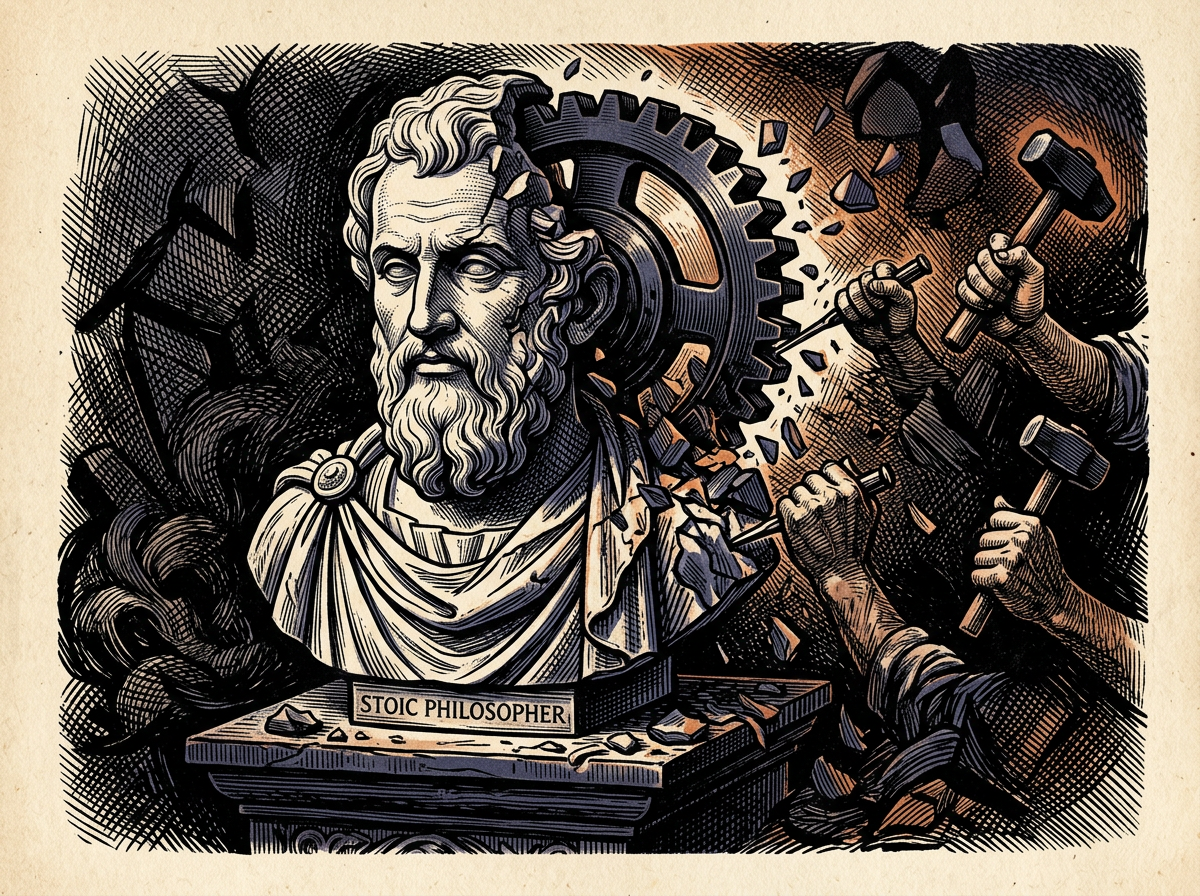
KEY ERROR: ATOMIZED OPTIMIZATION
Stripping Stoicism down to productivity hacks destroys its true moral power
16 Sept 2026
Democratizing Hellenistic Ethics: Pedagogical Strategies and Popularizations of Stoic Philosophy in Contemporary Discourse
Academic Abstract & Executive Overview
This investigation critically evaluates the contemporary cultural phenomenon wherein ancient Greco-Roman philosophy undergoes systemic translation into consumer-oriented, accessible self-help literature. Driven by socioeconomic stressors, post-modern anxieties, and the digital dissemination of short-form psychological heuristics, Stoicism has experienced an unprecedented resurgence in public consciousness. Popular publishing models, most notably encapsulated by the cultural trope of "Stoicism for Dummies" frameworks, attempt to package complex metaphysical, logical, and ethical constructs into digestible modules for the modern lay audience. However, this pedagogical democratization necessitates an epistemological trade-off. While broadening the reach of ancient therapeutic exercises, popularizations frequently truncate the foundational physics and formal logic that sustained classical thinkers such as Epictetus, Seneca, and Marcus Aurelius. Consequently, contemporary adaptations risk reducing a holistic cosmological system into a utilitarian emotional regulation toolkit. This paper analyzes the mechanisms of this translation, establishing evaluative criteria to distinguish between rigorous scholarship and commodified pop-philosophy. Through a systematic assessment of core doctrinal extraction, simplified heuristic design, and critical literature appraisal, we map the delicate boundary between philosophical fidelity and commercial accessibility in the digital age.
Theoretical Background & Literature Framework
The resurgence of Stoic ethics within contemporary psychological discourse is neither accidental nor historically isolated. As documented by Sellars (2006), classical Stoicism was never merely an academic exercise; rather, it functioned as a comprehensive way of life encompassing a tripartite division of philosophy into physics, logic, and ethics. The physics provided a pantheistic, deterministic, and providential understanding of the cosmos, which served as the ontological grounding for human action. Logic ensured rational precision and immunity to cognitive distortion, while ethics defined the highest human good (eudaimonia) through virtue (arete) and living in accordance with nature. When modern therapeutic interventions, particularly Aaron Beck's Cognitive Behavioral Therapy (CBT) and Albert Ellis's Rational Emotive Behavior Therapy (REBT), emerged in the mid-twentieth century, their creators explicitly acknowledged their intellectual debt to Hellenistic philosophy, particularly the Epictetean dichotomy of control. As noted by Long (1986), the fundamental premise that human beings are disturbed not by external events, but by the views they take of events, forms the empirical bedrock connecting ancient Stoic dialectic to contemporary clinical psychology.
Neurological and psychological investigations into emotional regulation further validate these historical linkages. Modern neurobiological models of executive function demonstrate that prefrontal cortical downregulation of limbic reactivity mirrors the Stoic objective of achieving apatheia, defined not as emotional coldness, but as the eradication of irrational passions (pathe). Attachment theory and stress-coping frameworks similarly align with the Stoic concept of prosochê (mindful attention) and the deliberate suspension of assent (synkatathesis) to unexamined impressions (phantasiai). Yet, when these intricate psychological mechanisms are abstracted for mass consumption, the rich tapestry of Hellenistic philosophy undergoes a process of reductionism. Contemporary self-help literature frequently isolates the pragmatic ethical injunctions from their metaphysical and logical prerequisites. This separation transforms a deterministic, cosmologically grounded ethos into an atomized productivity hack. While this democratization broadens access to psychological resilience tools, it also exposes the consumer to the risk of philosophical decontextualization, wherein the radical cosmopolitanism and communitarian obligations inherent in classical Stoicism are eclipsed by hyper-individualistic self-optimization imperatives.
Methodological Application & Practical Recommendations
STEP 01: Core Doctrine Extraction
To maintain philosophical fidelity when translating ancient texts for contemporary audiences, researchers and educators must execute a rigorous core doctrine extraction. This methodological step isolates the primary triad of Stoic praxis, physics, logic, and ethics, ensuring that popular adaptations do not divorce practical advice from its structural foundations. Modern readers often gravitate exclusively toward the ethical writings of Seneca or Marcus Aurelius, treating them as disparate life hacks. A faithful pedagogical framework must explicitly re-link these behavioral maxims to the underlying physics and epistemology. Educators should instruct learners to trace every ethical claim back to its cosmological origin; for instance, the injunction to accept external events without resentment must be understood through the Stoic lens of providential determinism and cosmic interconnectedness, rather than mere psychological resignation. Furthermore, logical rigor must be maintained by teaching learners how to rigorously examine their internal impressions before granting assent. By systematically deconstructing the cognitive chain from impression to value judgment, practitioners preserve the intellectual integrity of the classical tradition, shielding it from superficial distortions found in commercial self-help media.
STEP 02: Simplified Heuristic Design
Translating abstract Hellenistic concepts, such as oikeiosis (natural affinity or appropriation) and eudaimonia (human flourishing), into actionable daily behavioral heuristics requires a delicate balance between linguistic accessibility and conceptual accuracy. Abstract philosophical terms often resist direct translation, leading to semantic dilution in popular literature. To prevent this, instructional designers must construct operational definitions that preserve the teleological orientation of the original terms. For example, oikeiosis can be operationalized not merely as self-preservation, but as an expanding circle of rational concern that bridges individual psychology with cosmopolitan social duty. Heuristics must be designed as cognitive scaffolds that guide daily behavior without reducing philosophy to a rigid set of algorithmic rules. Practitioners should employ structured journaling techniques, morning premeditation exercises (praemeditatio malorum), and evening reviews of moral progress to anchor these translated concepts in lived experience. This methodology transforms passive reading into active self-interrogation, operationalizing complex moral theory into sustainable daily habits that foster long-term psychological resilience.
STEP 03: Critical Literature Appraisal
The proliferation of commercially driven pop-philosophy necessitates the development of robust evaluative rubrics to distinguish between rigorous scholarly analyses and superficial summaries. Scholars and educators must appraise contemporary literature by evaluating its engagement with primary sources, its historical contextualization, and its resistance to modern ideological co-optation. An authentic appraisal rubric must assess whether a text acknowledges the inherent tensions within Stoic doctrine, such as the compatibility of determinism and moral responsibility, or whether it glosses over these complexities for marketing convenience. Furthermore, critical appraisal requires examining the teleological goal of the literature; works that frame Stoicism strictly as a tool for corporate productivity or competitive advantage fail the standard of classical ethics, which prioritizes virtue above external utility. By instituting these rigorous evaluative criteria, academic researchers can guide students and the general public toward intellectually honest engagements with Hellenistic philosophy, ensuring that the democratization of Stoicism does not result in its intellectual evisceration.
Key Empirical Takeaways
- The contemporary resurgence of Stoic philosophy functions largely as a secular therapeutic framework, drawing heavily on ancient cognitive restructuring techniques that prefigure modern Cognitive Behavioral Therapy.
- Popularizations of Stoicism frequently isolate ethical maxims from their foundational physics and logic, creating a risk of philosophical reductionism and hyper-individualistic distortion.
- Effective pedagogical frameworks must translate complex Hellenistic terms like eudaimonia and oikeiosis into actionable daily heuristics while preserving their classical teleological orientation.
- Rigorous critical appraisal rubrics are essential for distinguishing between intellectually sound primary source interpretations and commercially driven, productivity-oriented pop-philosophy.
- Empirical alignment between Stoic mindfulness practices (prosochê) and neurobiological models of prefrontal emotional regulation demonstrates the enduring clinical validity of Hellenistic psychological exercises.
References & Further Reading
- Hadot, P. (1995). The Inner Citadel: The Meditations of Marcus Aurelius. Harvard University Press.
- Inwood, B. (1985). Ethics and Human Action in Early Stoicism. Oxford University Press.
- Long, A. A. (1986). Hellenistic Philosophy: Stoics, Epicureans, Sceptics. University of California Press.
- Nussbaum, M. C. (1994). The Therapy of Desire: Theory and Practice in Hellenistic Ethics. Princeton University Press.
- Sellars, J. (2006). Stoicism. University of California Press.
- Sorabji, R. (2000). Emotion and Peace of Mind: From Stoic Agitation to Christian Temptation. Oxford University Press.
---
SOCIAL MEDIA SNIPPETS (For Distribution)
LinkedIn Thought Leadership Post
Democratizing ancient philosophy for modern audiences requires balancing accessibility with intellectual rigor. While contemporary self-help adaptations make Hellenistic ethics widely available, they frequently strip away the foundational physics and logic that gave classical Stoicism its true structural integrity. To maintain philosophical fidelity in professional and personal development spaces, we must move beyond productivity hacks and embrace a holistic framework.
- Re-link daily behavioral maxims to their original cosmological and epistemological foundations to avoid shallow reductionism.
- Operationalize complex Hellenistic concepts like oikeiosis into sustainable daily heuristics that foster genuine flourishing.
- Utilize rigorous evaluative rubrics to distinguish between commercially driven pop-philosophy and authentic scholarly analysis.
#Psychology #Philosophy #Leadership #Research
X (Twitter) Post
Is modern pop-Stoicism losing its soul for the sake of self-help convenience? True Hellenistic philosophy requires more than productivity hacks. Discover how to balance accessibility with rigorous primary source scholarship in our latest academic analysis. #Stoicism #Research
Newsletter Teaser
Can complex Greco-Roman metaphysics be successfully translated into modern self-help frameworks without losing its core philosophical integrity? Read our comprehensive analysis on democratizing Hellenistic ethics and discover how to navigate the trade-offs between commercial accessibility and scholarly depth.
Related dispatches
FALSE TRAP: RIGID AUTHENTICITY · The Bend Index
Do not mistake the discomfort of growth for professional fraudulence.
28 Sept 2026
MENTAL RESTRUCTURING: PROSPERITY LITERATURE · The Bend Index
How classic prosperity literature functions as early cognitive science
28 Sept 2026
CORE DILEMMA: ABSTRACT PERFECTION · The Bend Index
The unreachable Stoic sage works best as an internal compass
28 Sept 2026
PHYSIOLOGICAL PRIORITY: TRAUMA RECOVERY · The Bend Index
Soothe the body before you rewrite the mind's trauma narrative.
28 Sept 2026