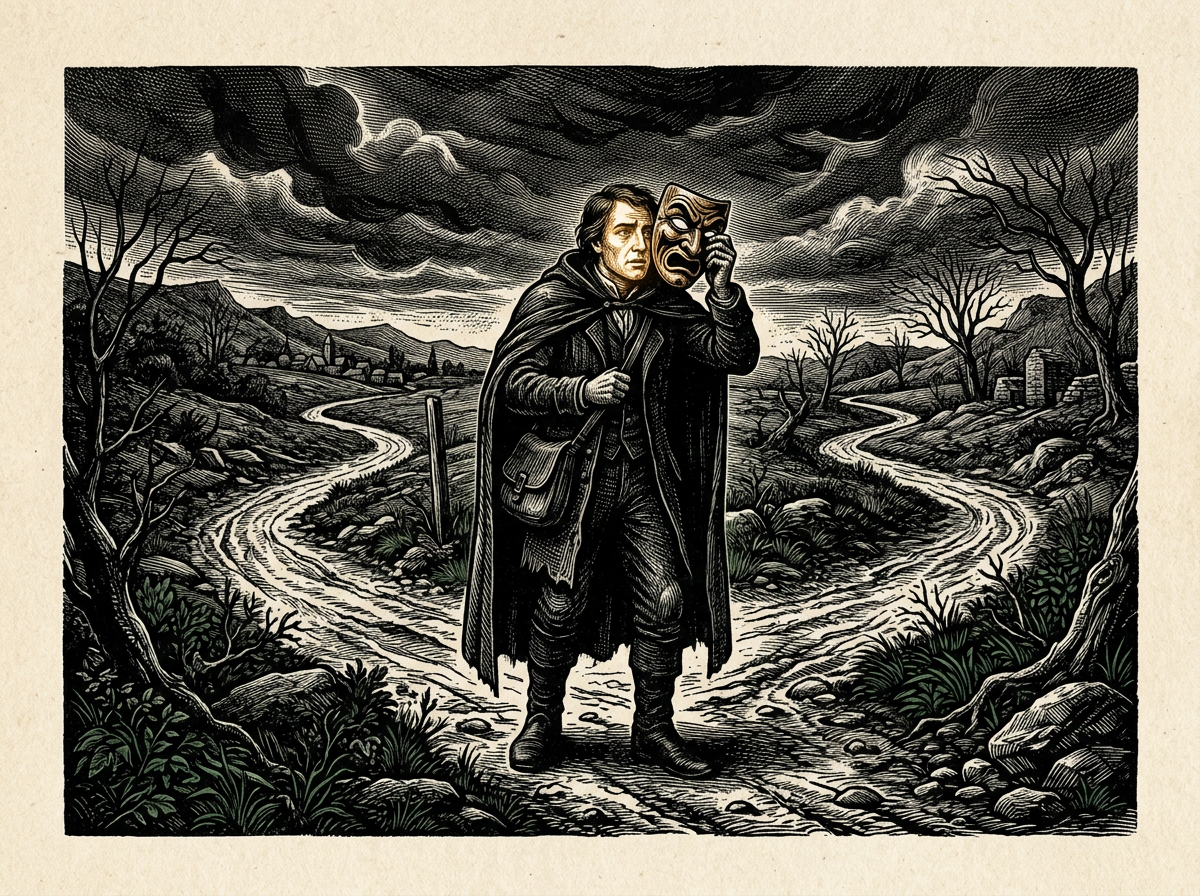
MAIN DEFENSE: FEIGNED HELPLESSNESS
Why claiming you have no choice is your ultimate self-deception
15 Sept 2026
Radical Freedom, Bad Faith, and Ontological Responsibility in Jean-Paul Sartre's Existential Philosophy
Academic Abstract & Executive Overview
Jean-Paul Sartre's existential phenomenology, established most notably in his 1943 magnum opus Being and Nothingness: An Essay on Phenomenological Ontology, represents a radical departure from classical metaphysical traditions by inverting the traditional relationship between essence and existence. According to Sartre, as explicated by Warnock (1967), human reality is defined by the foundational principle that existence precedes essence. This ontological framework strips humanity of any pre-established teleological design, forcing the conscious subject into a state of absolute, unmediated freedom. Within this paradigm, the individual is condemned to be free, bearing total responsibility for their self-definition, choices, and projects. However, the sheer vertigo of this radical autonomy frequently induces profound existential dread, prompting individuals to flee from their freedom into psychological mechanisms of self-deception, which Sartre terms bad faith (mauvaise foi). This paper provides a comprehensive, academically rigorous analysis of Sartrean ontology, exploring the mechanics of bad faith, the inescapable burden of ontological responsibility, and the pragmatic transition toward authentic action. By examining the intersection of phenomenological philosophy and psychological self-determination, this study evaluates how modern frameworks of agency can utilize existential principles to mitigate psychological alienation and foster genuine self-authorship.
Theoretical Background & Literature Framework
To comprehend the architecture of Sartrean existentialism, one must first analyze the ontological distinction between being-in-itself (être-en-soi) and being-for-itself (être-pour-soi). As detailed by Sartre (1943), the being-in-itself characterizes non-conscious objects, which are completely opaque, identical to themselves, and radically contingent yet inert. A table or a rock simply is, possessing a fixed nature and a predetermined essence. Conversely, the being-for-itself characterizes human consciousness, which is defined by a radical nothingness (néant). Consciousness is not a static substance; rather, it is a perpetual act of detachment from its own past and its environment. Because consciousness is characterized by this constitutive nothingness, it possesses no innate human nature or divine blueprint. As Sartre famously declared in his 1946 lecture L'existentialisme est un humanisme, man first exists, encounters himself in the world, and only afterwards defines himself through his actions.
This absence of a foundational blueprint gives rise to radical freedom. Unlike deterministic frameworks in classical psychology and behaviorism, which view human action as the predictable output of genetic predispositions and environmental conditioning (Skinner, 1971), Sartrean ontology posits that freedom is coextensive with consciousness itself. Even in situations of extreme constraint, such as imprisonment or oppression, the individual retains the ontological freedom to assign meaning to their condition. As Warnock (1967) notes, one cannot choose not to choose, because refusing to choose is itself a choice with definitive existential consequences. Freedom is not merely a faculty possessed by the ego; it is the very fabric of human reality.
However, this absolute freedom carries an unbearable psychological cost. The realization that one is entirely the author of one's life, devoid of external moral authorities or immutable human essences to justify one's actions, generates profound anxiety, or existential angst (angoisse). In psychological literature, this mirrors the observations found in modern cognitive and existential frameworks regarding the paralysis of choice (Schwartz, 2004). To escape this paralyzing anxiety, individuals frequently resort to bad faith (mauvaise foi). Bad faith is a complex psychological phenomenon wherein an individual deceives themselves into believing they are bound by deterministic constraints, thereby abdicating their freedom. For example, a waiter who plays the role of a diligent waiter with excessive zeal is treating themselves as an object, acting as if their biological and social role constitutes an immutable essence (Sartre, 1943). By conflating their social function with ontological necessity, they temporarily alleviate the anxiety of freedom at the expense of their authentic selfhood. Overcoming bad faith requires a courageous confrontation with ontological responsibility, aligning one's daily actions with deeply examined personal values rather than societal sedimentation.
Methodological Application & Practical Recommendations
STEP 01: Deconstruct Bad Faith
The initial phase of enacting Sartrean authenticity requires a rigorous phenomenological audit of personal behaviors, speech patterns, and life choices to identify instances where external pressures, societal expectations, or biological determinism are falsely invoked as absolute constraints. In psychological practice, this mirrors cognitive restructuring techniques where irrational beliefs about helplessness are challenged, yet Sartre demands an ontological rather than merely psychological critique. Individuals must systematically analyze situations where they utter phrases such as "I have no choice" or "That is simply how my personality is constructed."
Empirical observations in clinical psychology indicate that individuals frequently adopt fixed role identities to reduce cognitive dissonance associated with difficult life transitions (Festinger, 1957). To counteract this tendency, the researcher or practitioner must engage in a deliberate suspension of automatic justifications. By examining moments of professional compliance, relational dependency, or habitual conformity, the individual isolates instances where they have transformed themselves into objects (choses) for the gaze of the Other. Deconstructing bad faith demands that the individual strip away institutional alibis and recognize that every passive acceptance of a social role is an active, ongoing choice to surrender self-sovereignty. This diagnostic practice creates the necessary cognitive and ontological clearance to acknowledge one's true locus of agency.
STEP 02: Acknowledge Ontological Freedom
Once bad faith has been systematically identified and dismantled, the individual must actively confront the terrifying reality of ontological freedom. This step transitions the subject from passive self-deception to active self-definition. Drawing upon existential counseling paradigms (May, 1983), the individual must map out autonomous life choices independent of familial validation, cultural imperatives, or peer expectations. This requires recognizing that the future is radically open and unwritten, and that no past trauma or historical circumstance can dictate future action unless the individual currently chooses to let it do so.
Practically, this involves designing a comprehensive inventory of core projects. In Sartrean philosophy, the "fundamental project" is the overarching choice through which an individual makes sense of their existence in the world. The individual must draft autonomous life trajectories across vocational, relational, and ethical domains, ensuring these paths emerge from internal deliberation rather than societal momentum. By explicitly acknowledging that they are the sole arbiters of their values, the individual metabolizes the initial vertigo of angst into a constructive engine for personal agency. This phase establishes a firm boundary between external conditioning and internal sovereignty, ensuring that future life trajectories are self-authored.
STEP 03: Practice Authentic Action
The final stage of the Sartrean framework translates ontological theory into concrete, daily behavioral execution. Authentic action requires aligning daily decisions with the deeply examined values established in Step 02, while fully accepting the anxiety, uncertainty, and ultimate consequences associated with self-determination. Authenticity is not a static psychological state that one achieves permanently; rather, it is a continuous, rigorous mode of being that must be renewed with every passing choice.
In practical terms, the individual must implement real-time behavioral checks during moments of decision-making. When confronted with moral, professional, or interpersonal dilemmas, the agent must ask: "If everyone were to act as I am acting now, what kind of world would be created?" This echoes the Kantian categorical imperative, but within Sartre's framework, it is stripped of universal rationalism and anchored entirely in individual responsibility for the human condition. Furthermore, the individual must cease seeking post-hoc absolution from external authorities, accepting that their choices are fundamentally underdetermined and therefore entirely their own burden to bear. Through sustained, authentic action, the subject transcends psychological alienation, actualizing the radical freedom that defines human consciousness.
Key Empirical Takeaways
- Existence precedes essence, establishing that human beings possess no innate, predetermined nature and must construct their identity exclusively through ongoing actions and choices (Sartre, 1943).
- Radical freedom is an inescapable ontological reality of human consciousness, meaning that even passivity and compliance are active choices for which the individual bears total responsibility (Warnock, 1967).
- Bad faith (mauvaise foi) functions as a pervasive psychological defense mechanism where individuals deceive themselves into accepting deterministic limitations to escape the acute anxiety of freedom (Festinger, 1957).
- Authentic self-determination requires a rigorous phenomenological deconstruction of societal roles, followed by the courageous assumption of total responsibility for one's life projects (May, 1983).
References & Further Reading
- Festinger, L. (1957). A Theory of Cognitive Dissonance. Stanford University Press.
- May, R. (1983). The Discovery of Being: Writings in Existential Psychology. W. W. Norton & Company.
- Sartre, J.-P. (1943). Being and Nothingness: An Essay on Phenomenological Ontology. Gallimard.
- Sartre, J.-P. (1946). Existentialism Is a Humanism. Yale University Press.
- Schwartz, B. (2004). The Paradox of Choice: Why More Is Less. New York: HarperCollins.
- Skinner, B. F. (1971). Beyond Freedom and Dignity. Alfred A. Knopf.
- Warnock, M. (1967). Existentialism. Oxford University Press.
---
SOCIAL MEDIA SNIPPETS (For Distribution)
LinkedIn Thought Leadership Post
Human agency is often obscured by societal expectations and self-deception, but Sartrean philosophy reminds us of our inescapable freedom. Discover how to dismantle bad faith, embrace radical responsibility, and lead with authenticity.
- Deconstruct bad faith by identifying where external pressures are falsely used as deterministic excuses.
- Acknowledge ontological freedom by mapping out life choices independent of external validation.
- Practice authentic action by aligning daily decisions with deeply examined personal values.
#Existentialism #Leadership #PersonalGrowth
X (Twitter) Post
You are not a victim of your circumstances; you are condemned to be free. Explore how Jean-Paul Sartre's philosophy of radical freedom and bad faith can transform your approach to personal responsibility and authentic decision-making today.
Newsletter Teaser
Are you hiding behind societal expectations to escape the terrifying burden of choice? Dive into our comprehensive academic analysis of Jean-Paul Sartre's existential philosophy to learn how to conquer bad faith and master radical self-determination.
Related dispatches
FALSE TRAP: RIGID AUTHENTICITY · The Bend Index
Do not mistake the discomfort of growth for professional fraudulence.
28 Sept 2026
MENTAL RESTRUCTURING: PROSPERITY LITERATURE · The Bend Index
How classic prosperity literature functions as early cognitive science
28 Sept 2026
CORE DILEMMA: ABSTRACT PERFECTION · The Bend Index
The unreachable Stoic sage works best as an internal compass
28 Sept 2026
PHYSIOLOGICAL PRIORITY: TRAUMA RECOVERY · The Bend Index
Soothe the body before you rewrite the mind's trauma narrative.
28 Sept 2026