IDEOLOGICAL DISTORTION: IMPERIAL STOICISM
How Victorian institutions turned ancient Stoicism into an imperial code
14 Sept 2026
The Victorian Synthesis: Nineteenth-Century Appropriations of Classical Stoic Ethics
Academic Abstract & Executive Overview
This investigation examines the nineteenth century British appropriation of classical Stoic philosophy to establish institutional frameworks of duty, emotional restraint, and imperial administration. By synthesizing Hellenistic ethical theory with industrial and administrative pressures, Victorian moralists engineered a distinct cultural paradigm that prioritized character formation over metaphysical inquiry. Through an evaluation of educational curricula, periodical literature, and civil service apparatuses, this study demonstrates how ancient Greek and Roman texts were systematically repurposed to serve modern nationalist objectives.
Theoretical Background & Literature Framework
The intellectual landscape of nineteenth century Britain was characterized by an acute anxiety regarding social order, industrial transformation, and the rapid expansion of global governance. As Thomas Dixon illustrates in From Passions to Emotions: The Creation of a Psychological Category (2003), the transition from theological models of the soul to secularized psychological frameworks necessitated new vocabularies for self regulation. Within this context, Victorian intellectuals turned toward antiquity, finding in Hellenistic philosophy a rigorous blueprint for emotional economy.
As John Sellars notes in Stoicism (2006), classical Stoicism was originally formulated as a cosmopolitan philosophy emphasizing cosmopolitan citizenship, internal autonomy, and alignment with universal reason. However, the Victorian reception of Seneca, Epictetus, and Marcus Aurelius operated through a process of selective domestication. Rather than embracing the radical cosmopolitanism of early Hellenistic thought, nineteenth century commentators utilized Stoic ethics to reinforce British nationalism, class stratification, and patriarchal authority.
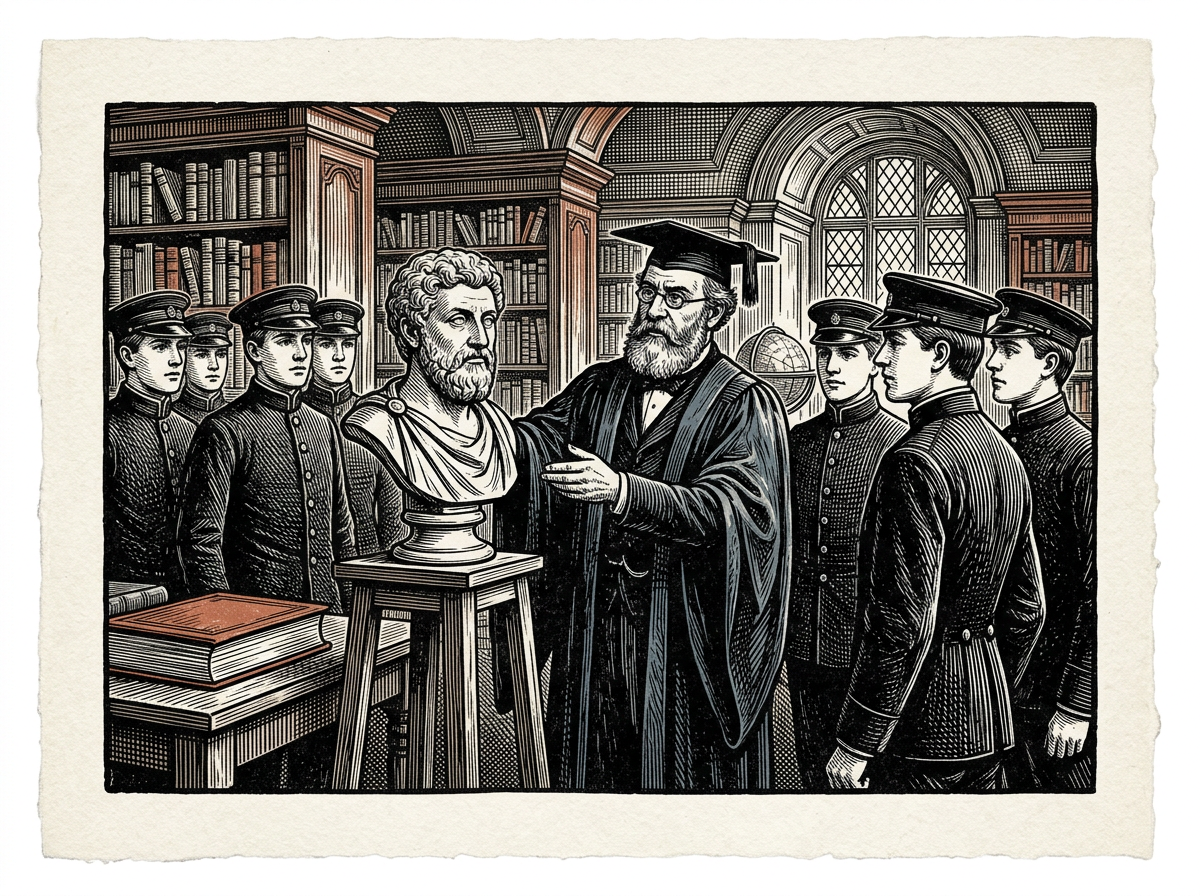
This ideological translation relied heavily on the institutionalization of classical education. The elite public school system, pioneered by figures like Thomas Arnold at Rugby School, transformed the reading of Greek and Roman authors into an ethical crucible. Texts were scanned not merely for linguistic mastery, but for moral exemplars of endurance, self denial, and unflinching resolve. Consequently, the Stoic sage was reimagined as the British gentleman administrator, uniquely equipped to govern both his own passions and the expanding imperial territories.
Methodological Application & Practical Recommendations
To systematically analyze the mechanisms of this historical appropriation, researchers must execute three distinct methodological protocols.
STEP 01: Historiographical Mapping
Analysts must examine primary texts from nineteenth century educational curricula, sermons, and periodical literature to identify recurring Stoic tropes. Researchers should catalog references to Seneca and Marcus Aurelius within journals such as the Edinburgh Review and the Quarterly Review. This mapping involves tracking shifts in vocabulary from Christian resignation to secularized Stoic fortitude, quantifying the frequency of terms related to duty, apatheia, and emotional control across decades of public discourse.
STEP 02: Institutional Contextualization
Investigators must examine how public schools and civil service frameworks utilized Stoic ideals to shape character formation and imperial administration. This step requires archival research into school statutes, examination papers, and administrative handbooks issued by the East India Company and the Colonial Office. Researchers should evaluate the pedagogical mechanisms through which classical texts were translated into practical codes of conduct for colonial officials stationed abroad.
STEP 03: Critical Synthesis
Scholars must draft a comparative analysis contrasting Seneca's cosmopolitan ethics with the nationalist and moralistic adaptations of the Victorian era. This involves juxtaposing primary source excerpts from classical authors against Victorian commentary to isolate ideological divergences. The resulting synthesis must evaluate how universalist philosophical propositions were successfully localized to serve specific socio-political imperatives of the British Empire.
Key Empirical Takeaways
- Victorian moralists selectively reinterpreted classical Stoic texts, prioritizing utilitarian character formation, nationalist duty, and emotional suppression over the original cosmopolitan and metaphysical frameworks of Hellenistic philosophy.
- Elite public school curricula served as the primary ideological apparatus for translating ancient philosophical ideals into codes of conduct for the British civil service and imperial administration.
- The historical shift from theological governance to secular psychological management in the nineteenth century relied heavily on a domesticated variant of Stoicism to maintain social order and domestic stability.
References & Further Reading
- Dixon, Thomas. From Passions to Emotions: The Creation of a Psychological Category. Cambridge University Press, 2003.
- Jenkyns, Richard. The Victorians and Ancient Greece. Harvard University Press, 1980.
- Sellars, John. Stoicism. Routledge, 2006.
- Turner, Frank Miller. The Greek Heritage in Victorian Britain. Yale University Press, 1981.
---
SOCIAL MEDIA SNIPPETS (For Distribution)
LinkedIn Thought Leadership Post
New research from Chaff & Wheat investigates how nineteenth century British intellectuals transformed classical Stoicism into a blueprint for imperial administration. Discover how ancient texts were repurposed to shape modern institutional identity and emotional discipline.
- Explore how public schools utilized selective readings of Seneca and Marcus Aurelius to engineer codes of duty.
- Examine the shift from classical cosmopolitanism to Victorian nationalism.
- Understand the historical roots of modern psychological self regulation.
#Philosophy #History #Leadership
X (Twitter) Post
How did the Victorians turn ancient Stoicism into an imperial tool? Our new study maps out nineteenth century curricula and civil service frameworks. Read the full analysis at Chaff & Wheat.
Newsletter Teaser
Discover how nineteenth century educators and imperial administrators repurposed classical Stoic philosophy to engineer a new code of British duty and emotional control. Read our complete analytical paper today.
Related dispatches
FALSE TRAP: RIGID AUTHENTICITY · The Bend Index
Do not mistake the discomfort of growth for professional fraudulence.
28 Sept 2026
MENTAL RESTRUCTURING: PROSPERITY LITERATURE · The Bend Index
How classic prosperity literature functions as early cognitive science
28 Sept 2026
CORE DILEMMA: ABSTRACT PERFECTION · The Bend Index
The unreachable Stoic sage works best as an internal compass
28 Sept 2026
PHYSIOLOGICAL PRIORITY: TRAUMA RECOVERY · The Bend Index
Soothe the body before you rewrite the mind's trauma narrative.
28 Sept 2026